Festival Sponsorship Opportunities in India: The Complete Guide
Which festivals to sponsor, what you can buy at each, what it costs, when to book, and how to get proof it happened. The complete brand-side guide to on-ground festival advertising in India.
India runs the largest recurring on-ground advertising opportunity in the world, and almost none of it is sold properly.
Between August and November, tens of thousands of committees across the country build temporary venues that draw crowds a shopping mall would envy, and fund them by selling advertising space. There is no rate card, no directory, and no agency covering the market end to end. There is a WhatsApp number and a man named Dada who handles sponsorship.
This guide is the map. What is available, what it costs, when to book, and how to avoid the ways this goes wrong.
Why on-ground festival sponsorship deserves a line in your plan
- India's festive advertising market is heading toward ₹55,000 crore, with consumer brands raising festive spends by up to 20% year on year
- Bengal's Durga Puja economy alone is estimated at around ₹65,000 crore, with Kolkata contributing 65–70% — the full analysis is here
- 51% of festive marketing activity now happens outside Diwali
- Kolkata alone had 248 officially registered Durga Puja pandals in 2025
The structural point: each of those pandals is a separate high footfall venue with a community that trusts it. Unlike a billboard, the space comes with an implied endorsement — the committee is a local institution, and a brand it associates with borrows that standing.
The festivals worth planning around
Different festivals, genuinely different audiences and mechanics.
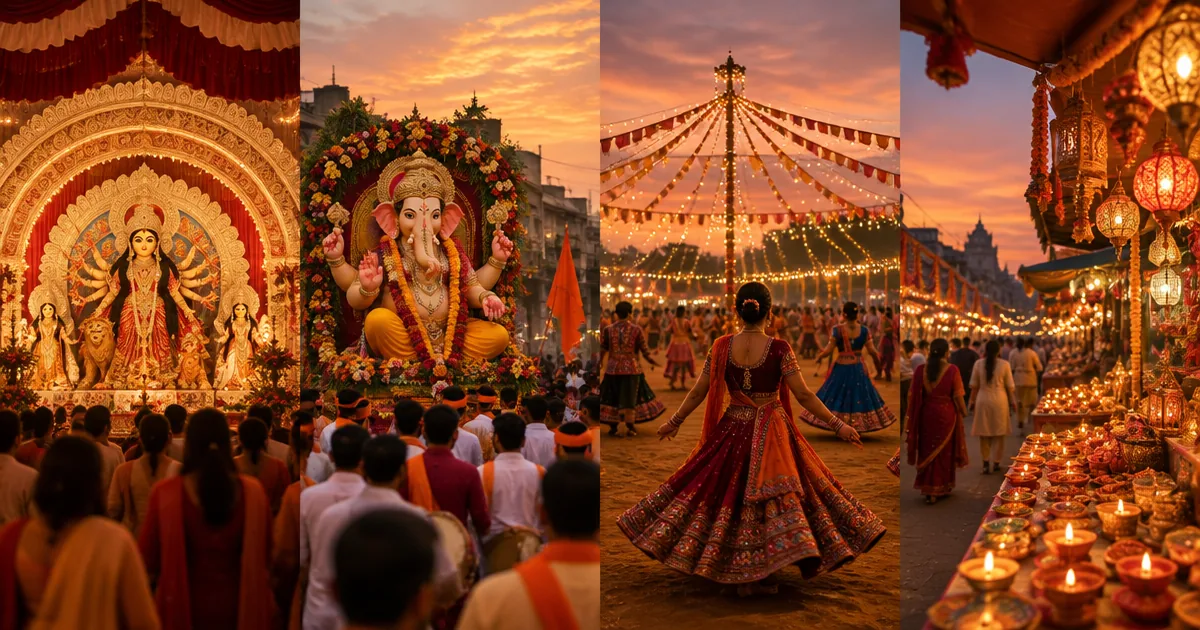
Durga Puja — West Bengal, Assam, Odisha, Jharkhand, Tripura, plus large Bengali populations in Delhi, Mumbai and Bengaluru. Five days, enormous night time footfall, the most developed sponsorship market in India. This is where the inventory is most professional and the competition for it is highest.
Ganesh Chaturthi — Maharashtra, Karnataka, Telangana, Andhra Pradesh, Goa. Ten to eleven days, which is the longest sponsorship window of any Indian festival, plus a massive public procession on the final day. Mandal structures in Mumbai and Pune are highly organised.
Navratri and Garba — Gujarat, Rajasthan, Maharashtra. Nine nights of ticketed or semi ticketed events with a young, affluent, urban audience that dances for four hours a night. The most attractive demographic in Indian festival advertising and the most competitive to buy.
Diwali — nationwide, and the one every brand already plans for. Note that in eastern India the same nights are observed as Kali Puja, with its own pandal and committee structure that works much like Durga Puja. If you are buying in Bengal, you are buying Kali Puja inventory, not Diwali inventory. Our Kali Puja guide covers the difference.
Onam — Kerala. Ten days, strong community and workplace celebration culture, distinct from the North Indian festive calendar entirely.
Chhath Puja — Bihar, Jharkhand, eastern Uttar Pradesh, and heavily in Delhi NCR and Mumbai among migrant communities. Riverbank and ghat based, enormous crowds, and almost entirely unsold as advertising inventory. The clearest arbitrage available today.
Saraswati Puja, Vishwakarma Puja, Janmashtami, Rath Yatra, Pongal, Makar Sankranti — smaller individually, and useful for brands wanting a year round presence rather than a single autumn burst.
For timing across the year, see the India festival marketing calendar. For national brands deciding where to place regional weight, see the regional festival guide.
What you can actually buy
Six units, each doing a different job. We have written a full guide to each.
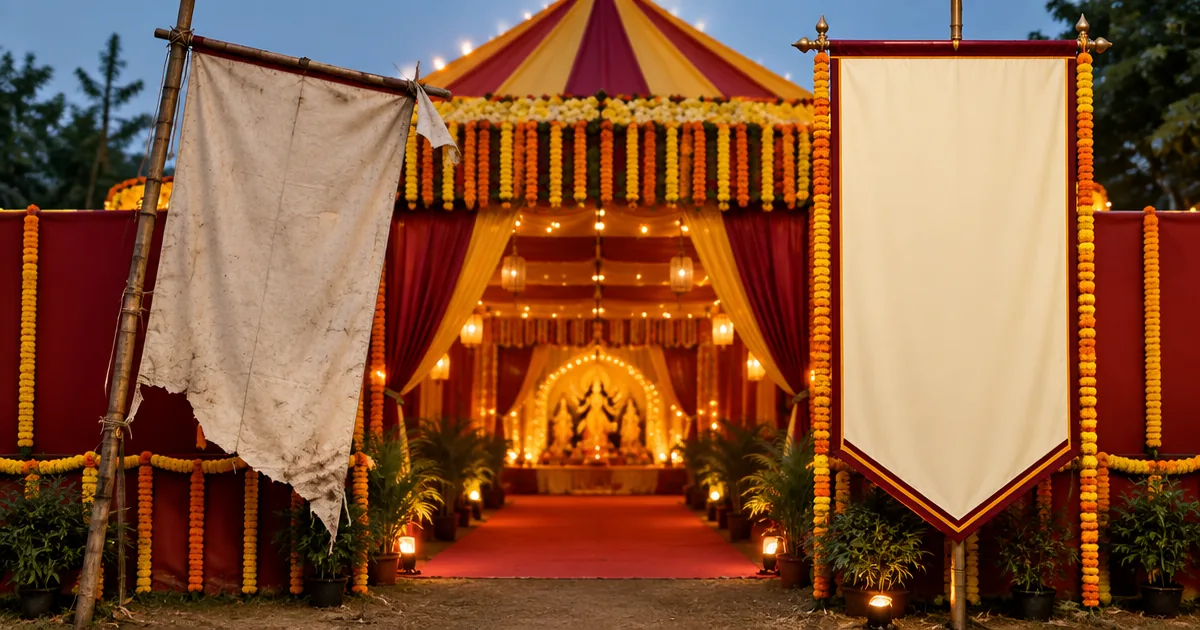
| Unit | What it delivers | Typical entry price | |---|---|---| | Gate and arch | Everyone who enters, twice, plus photographs | ₹5,000 – ₹40,000 | | LED and digital screens | Motion, sequence, a scannable offer | ₹8,000 – ₹60,000 | | Stalls and sampling | Product in hand, and data you keep | ₹3,000 – ₹40,000 space | | Stage and cultural programme | Seated audience, your name said aloud | ₹3,000 – ₹60,000 | | Hoardings and flex | Cheapest real reach, extends beyond the venue | ₹1,000 – ₹30,000 | | Banners and pillars | Repeated local presence on a small budget | ₹2,000 – ₹15,000 |
The one line summary if you are choosing quickly: buy a gate for reach and status, flex for efficiency, a stall if trial is the objective, and the stage if you want the community to know your name rather than merely see it.
What a campaign costs
Four workable shapes, drawn from what brands actually buy.
₹10,000 – ₹25,000. One neighbourhood, one pandal. A banner package plus a gate at a single local puja. Right for a shop, clinic, showroom or coaching centre serving a two kilometre radius. See sponsoring a local puja under ₹25,000.
₹1,00,000 – ₹3,00,000. One city, several pandals. Gates at three or four established pujas in the districts you serve, plus flex across the approach roads. Right for a regional chain, a dealership network, a hospital.
₹5,00,000 – ₹15,00,000. One state, with an activation. A dozen pandals, a stall programme at the largest four, stage sponsorship at two, staffed and photographed properly. Right for an FMCG launch or a state level category push.
₹25,00,000+. Multi state. Durga Puja in the east, Ganesh Chaturthi in the west, Navratri in Gujarat, with consistent creative and centralised measurement. Requires planning from roughly February.
Deeper cost analysis, including a CPM comparison against Meta and programmatic, is in the advertising cost guide.
When to book
This is where most brands lose, and it is entirely avoidable.
| Period | What is happening | |---|---| | Feb – Apr | Committees plan themes and budgets. Best time for multi state deals and title sponsorships. | | May – Jul | The real booking window. Gates and premium positions sell here. Prices are stable and you have choice. | | Aug | Good inventory still available at established pujas. Prices firming. | | Sep | Premium positions largely gone at the well known pujas. Good value still available at smaller ones. | | Final 3 weeks | Committees with unsold space become flexible. Genuine bargains exist, but you take what is left and artwork timelines get tight. |
Book gates in June and July. Everything else has more slack. If you are reading this in September, you have not missed the season — you have missed the famous pandals, which is a different and smaller problem than most brands assume.
How this goes wrong, and how to prevent it
Five failure modes, in order of how often we see them.
1. The branding never goes up. Money paid, nothing installed, and the brand finds out from a friend who visited. Prevention: make payment conditional on dated installation photographs. This single clause eliminates most of the risk. Our proof of display standard sets out what to require.
2. Exclusivity turns out to be shared. You paid for a gate and find five other logos on it. Prevention: get sole or shared stated in writing before paying.
3. Footfall was invented. Committees estimate optimistically. Prevention: ask how the number was arrived at, and discount unverified claims by half.
4. Artwork arrives too late to print. Prevention: files with the committee seven days out, minimum.
5. There is nobody to complain to. An informal arrangement with a volunteer has no recourse. Prevention: transact through something with a dispute process, or accept that you have none.
Buying direct versus buying through a platform
Both are legitimate. Buying direct from a committee you already know is cheaper, and if you have that relationship you should use it.
The difficulty is scale and recourse. Finding twenty committees across four cities, verifying each one is real, agreeing terms, transferring money to twenty bank accounts and chasing twenty sets of photographs is a full time job for six weeks.
PujaSathi exists for that problem: listings with stated prices and exclusivity, committee and KYC verification, payment held and released against evidence, and a defined dispute route. The comparison, including where direct buying still wins, is set out honestly in agency, direct or marketplace.
Getting started
- Decide the outcome — local familiarity, product trial, community standing, or reach
- Pick the festival by where your customers actually are, not by fame
- Pick the unit by outcome, using the table above
- Browse listed pandals, filter by city and festival, and check footfall and photographs
- Confirm exclusivity, duration and the proof requirement before paying
- Send artwork seven days out and approve the design proof
- Collect the installation photographs, and measure what you can
Frequently asked questions
What is festival sponsorship in India?
Buying advertising space or association rights at a community festival venue — a Durga Puja pandal, a Ganesh mandal, a Navratri ground. Committees sell gates, banners, stalls, LED slots and stage rights to fund the celebration, and the brand receives both exposure and the community's implied endorsement.
Which Indian festivals are best for brand sponsorship?
Durga Puja for eastern India, Ganesh Chaturthi for Maharashtra and Karnataka, Navratri for Gujarat, Onam for Kerala, and Chhath for Bihar and Delhi NCR. Choose by where your customers are rather than by which festival is largest.
How much does festival sponsorship cost in India?
From about ₹2,000 for a single banner at a neighbourhood puja to several lakh for title sponsorship of a well known pandal. A workable single locality campaign runs ₹10,000 to ₹25,000; a city level campaign ₹1,00,000 to ₹3,00,000.
When should brands book festival sponsorship?
May to July for an October festival. Gates and premium positions sell first. Multi state campaigns should begin planning in February.
How do I know the sponsorship was actually delivered?
Require dated installation photographs as a condition of payment, video for LED and stage commitments, and written confirmation of exclusivity. On PujaSathi the committee balance is released against submitted evidence.
Is festival sponsorship better than digital advertising?
It does something digital cannot — physical presence at a trusted community occasion, with dwell time measured in minutes. It is weaker on targeting and attribution. Most effective as a complement to digital during the festive burst rather than a replacement.
Can small businesses sponsor a festival?
Yes, and it is where the value is best. A banner package at a local puja starts around ₹5,000 and reaches precisely the catchment a neighbourhood business serves.
The short version
Festival sponsorship is the largest under sold advertising inventory in India. It works best for brands with a local or regional footprint, it is bought between May and July, and the whole risk collapses to one question: can you prove it went up? Make payment conditional on photographs and most of what goes wrong stops going wrong.
**Browse festivals open for sponsorship**
Related: [Durga Puja sponsorship for brands](/blog/durga-puja-sponsorship-for-brands) · [How much does it cost to sponsor a Durga Puja](/blog/how-much-does-it-cost-to-sponsor-durga-puja) · [Festival advertising glossary](/blog/festival-advertising-glossary-terms)
PujaSathi is a product of Tracetex 360 Innovations (OPC) Private Limited. Prices quoted are indicative ranges observed on listed pandals; each committee sets its own rates.