Festival Stalls and Product Sampling: A Brand Guide
The only festival unit where visitors touch your product. Stall costs, what committees actually provide, staffing maths, sampling rates that work, lead capture and the compliance you must not skip.
Every other piece of festival inventory puts your logo in front of someone. A stall puts your product in their hands.
That is a categorically different outcome, and it is why sampling and activation budgets behave differently from media budgets. It is also more work than every other unit combined, and brands routinely underestimate that.
What you are actually renting
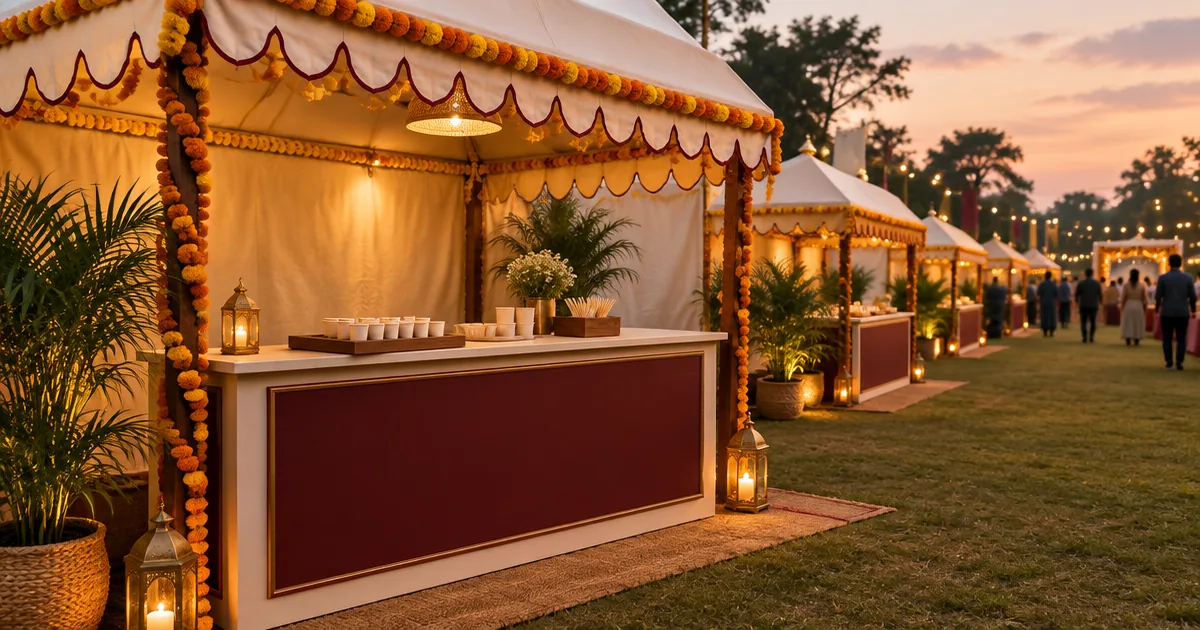
A pandal stall is usually a marked ground position, and often nothing more. Understand precisely what is included before you budget.
Commonly included: the floor space, a defined position, permission to trade or sample there, and access for the festival duration.
Commonly not included, and each is a real cost: the structure or canopy, tables and chairs, a power point, lighting, branding and signage, staff, storage, and overnight security for anything you leave.
Ask for each of these in writing. "Stall space, ₹10,000" can mean a fully built branded kiosk or a chalk rectangle on grass, and the difference between those is thirty thousand rupees.
What it costs
| Position | Typical size | Indicative price, full festival | |---|---|---| | Neighbourhood puja, ground space | 6x6 ft – 10x10 ft | ₹3,000 – ₹12,000 | | Established puja, good footfall position | 10x10 ft | ₹10,000 – ₹40,000 | | Large puja, prime position near entry or exit | 10x10 ft – 20x10 ft | ₹40,000 – ₹1,50,000 | | Food and beverage pitches | varies | often priced higher, sometimes on a revenue share |
A live example on PujaSathi: a stall position on the free ground area at an established South Kolkata puja, full festival, at ₹10,000.
Then add your own costs. A realistic all in figure for a modest branded stall at a mid sized puja:
- Space: ₹10,000
- Canopy, table, branding, print: ₹8,000 – ₹15,000
- Two staff, five days, twelve hour shifts: ₹15,000 – ₹25,000
- Product samples, 3,000 units at ₹8: ₹24,000
- Transport, power, contingency: ₹5,000
Total: roughly ₹62,000 – ₹79,000 against a ₹10,000 space fee.
That ratio is the single most important thing on this page. The space is the cheapest part of a stall. Brands that budget only for the space end up with an unstaffed table and no samples by day three.
Position is most of the value
Not all ground inside a pandal is equal, and committees do not always price the difference.
Best: immediately after the exit, where visitors have finished the darshan, are relaxed, and are looking for food and somewhere to stand. This is the position to pay extra for.
Good: along the queue line, where people are stationary and bored. Excellent for sampling, poor for anything needing a conversation, since they will not leave the queue.
Acceptable: the general ground or fairground area, where visitors are browsing.
Avoid: anywhere before the entrance queue, where visitors are focused on getting in and will not stop, and any position facing away from the main flow.
Ask to see a site map, or last year's photographs showing where the crowd actually stands. Committees are usually honest about this if asked directly.
Sampling that works
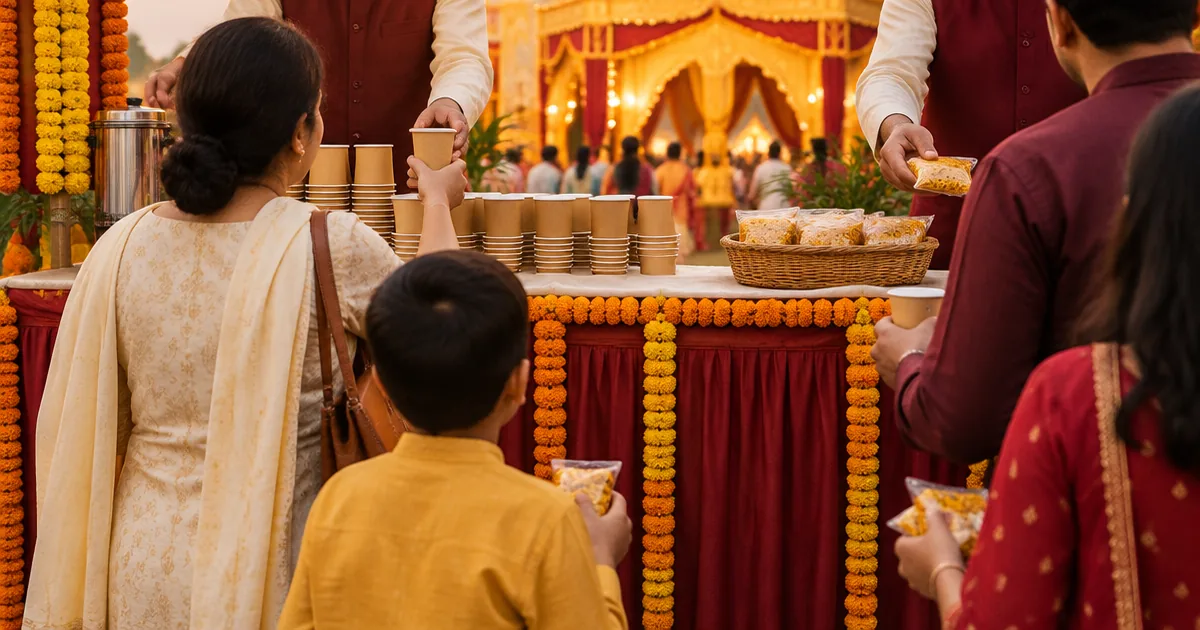
- Hand it over, do not display it. Passive tables get ignored. A person offering a sample directly converts many times better.
- Small, immediate, consumable. Things people use on the spot outperform take home packs, which are dropped or forgotten.
- Plan for 15 to 25 per cent of footfall if actively sampling at a good position. On a 5,000 per day pandal, that is 750 to 1,250 units daily. Running out on day two is the most common failure.
- Staff properly. Two people minimum per shift, so the stall is never unattended. Twelve hour festival days need two shifts, which means four people.
- Give a reason to stop. A game, a photo frame, a spin wheel, anything with a five second payoff. Standing behind a table hoping is not a plan.
Capturing something you can use later
A stall is the only festival unit that can produce data. Most brands waste this.
What works: a QR to a short form with a genuine incentive; a printed photo the visitor takes away with your branding on it; a WhatsApp opt in for an offer redeemable at your nearby outlet within seven days.
What does not: a paper form, a fishbowl of business cards, or asking for a phone number with nothing offered in return.
If you collect personal data, you are a data fiduciary under India's Digital Personal Data Protection Act, 2023. Take a clear consent, state the purpose, and do not use the numbers for anything else. This is not a formality — see our privacy policy for how we treat the same obligation.
Compliance you must not skip
Stalls carry obligations that banners do not.
- Food. Sampling any edible product requires an FSSAI registration or licence appropriate to the activity. Committees will not check. Authorities occasionally do.
- Sale versus sampling. Selling from the stall is trade, with GST implications and possibly a temporary trade permission from the local body. Free sampling is not sale. Know which you are doing.
- Regulated categories. Tobacco and alcohol advertising is prohibited. Surrogate advertising invites both legal and reputational risk. Do not.
- Children. Pandals are full of them. If your activation involves children, supervision and consent are your responsibility, not the committee's.
- Fire and safety. No open flame, no unauthorised electrical load. Pandals are bamboo and cloth structures and this is taken seriously.
Committee permissions and the local regulatory picture are covered in more depth in our permissions and compliance guide.
Who should book a stall
Strong fit: FMCG launching or driving trial; food and beverage; telecom and financial services with an app install or sign up; local retailers with an outlet within walking distance; anything where trying it is the argument.
Poor fit: considered high value purchases nobody decides at a festival; brands without staff to run it; anyone whose budget covers the space but not the operation.
Frequently asked questions
How much does a stall at a Durga Puja pandal cost?
Ground space commonly runs ₹3,000 to ₹12,000 at neighbourhood pujas and ₹10,000 to ₹40,000 at established ones. A stall position at an established South Kolkata puja is currently listed at ₹10,000 for the full festival. Budget three to six times the space fee for the total activation.
What does the committee provide with a stall?
Usually only the marked space and permission. Canopy, furniture, power, lighting, branding, staff and security are normally yours. Confirm each item in writing before booking.
How many samples should I carry?
Plan for 15 to 25 per cent of daily footfall at a good position with active sampling. For a pandal drawing 5,000 a day, that is 750 to 1,250 units per day.
Do I need an FSSAI licence to sample food?
Yes. Distributing any edible product requires appropriate FSSAI registration or licensing. The committee will not verify it; the responsibility is yours.
Can I sell products from a festival stall?
Sometimes, but selling is trade rather than sampling and brings GST and possibly local trade permission into scope. Confirm with the committee and your accountant before assuming you can.
Where is the best position for a stall?
Immediately after the pandal exit, where visitors have completed the darshan and are relaxed. Queue line positions are excellent for sampling but poor for conversation.
The short version
A stall is the only festival unit that puts your product in a hand and can produce data you keep. It is also the only one that needs staff, stock, structure and compliance. The space fee is the smallest line in the budget. Plan the other five, or do not book it.
**Browse pandals with stall positions available**
Related: [Gate and arch branding](/blog/festival-gate-arch-branding-guide) · [Sponsoring a local puja under ₹25,000](/blog/sponsor-local-puja-under-25000-small-business) · [More guides for brands](/blog/category/for-brands-advertisers)
PujaSathi is a product of Tracetex 360 Innovations (OPC) Private Limited. Prices quoted are indicative ranges observed on listed pandals; each committee sets its own rates. This article is general information, not legal or tax advice.