14 Ways Indian Brands Waste Their Festival Advertising Budget
Not exotic failures — the ordinary, repeated ones. Buying the famous pandal, printing thin type, booking in September, and eleven more that cost real money every season.
None of these are exotic. They are the ordinary, repeated mistakes that cost Indian brands real money every festival season, listed roughly in order of how much they cost.
If you recognise three or more, there is a straightforward season of improvement available to you at no extra budget.
1. Booking in September
The most expensive mistake on the list, and the most common.
By September the good positions are sold, print schedules are closed, and souvenir booklets have gone to press. You are choosing from what nobody else wanted, at rates set by scarcity rather than negotiation.
Committees confirm sponsors two to four months ahead, because their own deposits depend on it. In June, everything is available and rates are negotiable — the committee needs the certainty more than you do.
Fix: anchor positions in June, volume in July, artwork in August.
2. Buying the famous pandal
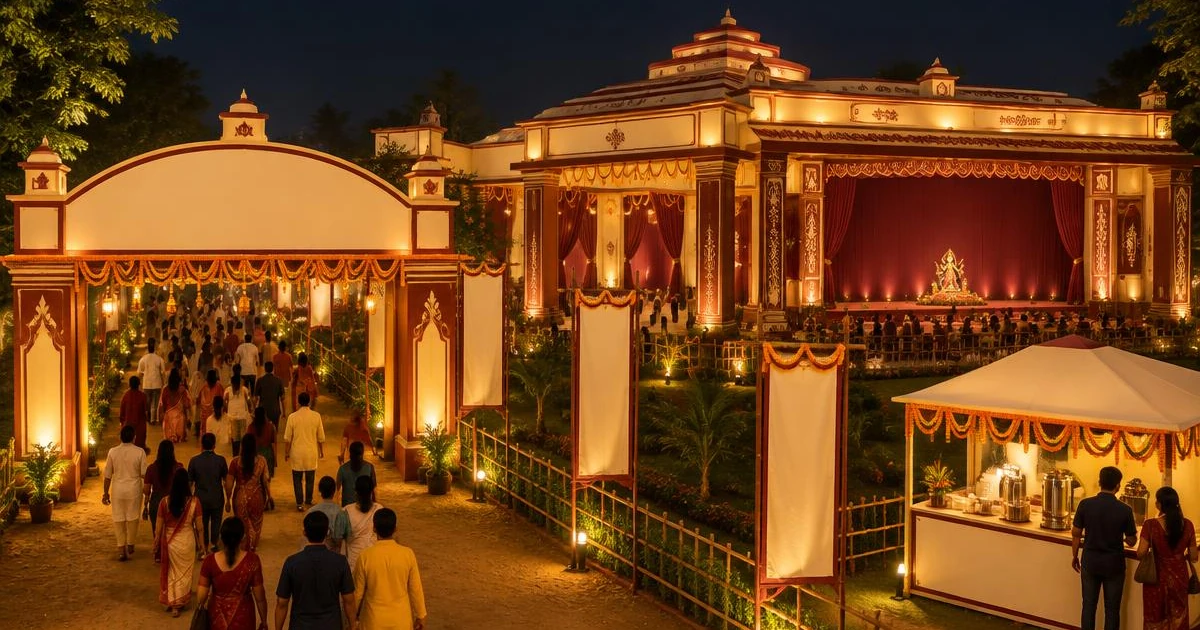
The instinct is to buy the biggest, most photographed Puja in the city.
For most brands this is wrong. Landmark pandals draw crowds from across the metro and beyond — impressive raw footfall, poor concentration, maximum competition from other sponsors, and the highest price in the market.
A visitor who travelled twenty kilometres to see a famous pandal is not detouring to your showroom.
Fix: buy your catchment. Five to eight neighbourhood venues around each outlet will usually beat one landmark on everything that matters, and cost less.
3. Buying a name instead of a specification
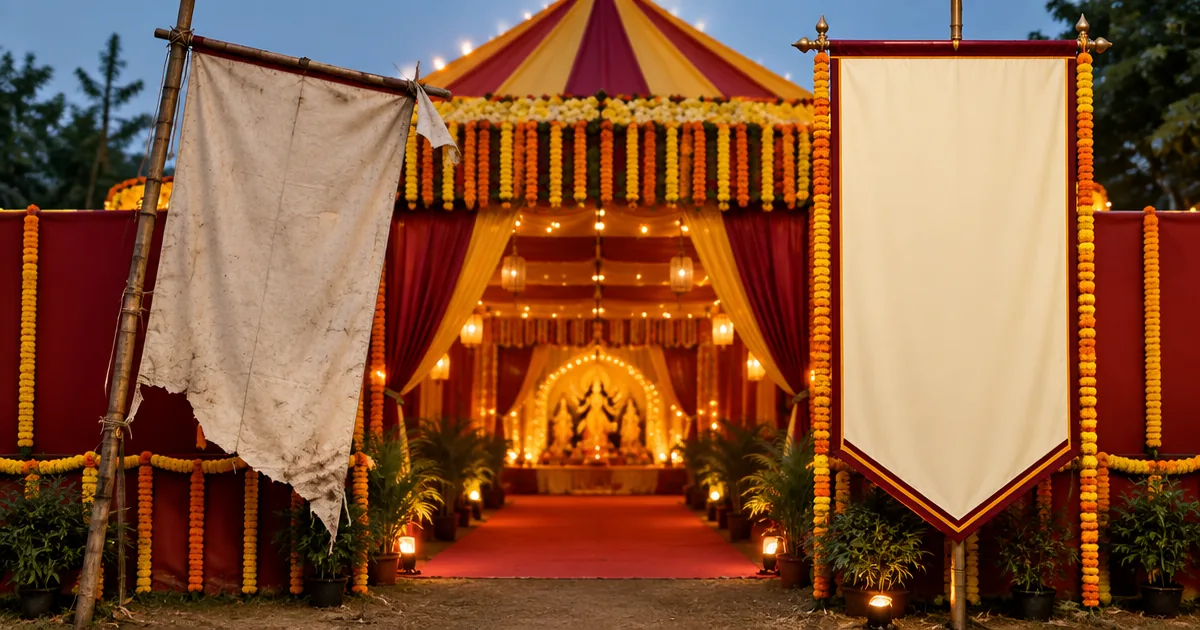
"Gate branding — ₹40,000" is not a product.
You can end up with a banner beside the gate, facing away from the approach, behind a barricade nobody walks past — and the committee will believe, sincerely, that they delivered gate branding.
Fix: buy sentences like this one — "8ft × 3ft banner, left pillar of the main entrance arch, facing the approach road, Shashthi to Dashami." If a listing cannot state size, position and duration, the committee has not decided what it is selling.
4. Designing for a monitor instead of a pandal
Approved at arm's length, in daylight, on a calibrated screen. Seen from ten metres, at night, under coloured lighting, by someone walking.
Thin type disappears. Mid-tones flatten. Subtle colour distinctions vanish under red and green lights.
Fix: heavy weights only, maximum contrast, and the A4-at-three-metres squint test before the file leaves your building.
5. Too many words on the gate
A gate banner gets about a second and a half of attention. Brands routinely put a paragraph on one.
Fix: six words maximum on a gate. Put the detail on a queue banner instead — a darshan queue is the only position at a pandal where people stand still and genuinely read.
6. Ignoring the queue entirely
The most underrated position in Indian festival advertising, and it is usually cheap.
People stand in a pushpanjali or darshan queue for minutes with nothing to look at. It is the one place your rate table, EMI figure, address or terms will actually be read rather than glanced at.
Fix: buy queue banners deliberately, and write them for a reader rather than a passer-by.
7. A stall with nobody good on it
A stall is the most expensive format at most venues and the one most often wasted.
A bored junior handing out leaflets for four days converts nothing. Worse, it occupies the format that could have produced real leads.
Fix: if you cannot staff it with someone senior who can answer real questions and capture a lead in fifteen seconds, do not buy the stall. Buy banners and spend the difference on more banners.
8. Missing the souvenir booklet deadline
The earliest hard deadline in the entire campaign — usually about a month before the festival — and the one nobody diarises.
The book goes to print without you. There is no late option.
Fix: collect every booklet deadline at the point of booking, not later. Across twelve cities you will have a dozen different ones.
9. Paying by card when bank transfer is free
Online payment carries a gateway fee of 2.596%. Bank transfer carries none. The committee receives exactly the same amount either way.
On a ₹1,00,000 slot that is ₹3,227 you kept for nothing. On a ₹50 lakh season, roughly ₹1.3 lakh.
Fix: bank transfer for anything above about ₹25,000.
10. Paying without an invoice
Cash to a receipt book feels cheaper. It is usually not.
For a GST-registered business, GST on advertising with a proper tax invoice is generally available as input credit. Without an invoice there is no credit, and the expense is harder to substantiate.
Fix: insist on a tax invoice with the supplier's GSTIN, your GSTIN, SAC 998361 and GST as a separate line. And give your GSTIN at booking — retro-fitting it onto an issued invoice is the most common way the credit is lost.
11. Never asking for the second festival
Most committees run more than one. Durga Puja and Kali Puja. Navratri and Diwali. Ganesh Chaturthi and Navratri.
Ask for a combined rate in June and most will discount it. Almost no brand asks.
Kali Puja in particular is the cheapest good inventory in Bengal — same committees, same neighbourhoods, a fraction of the rate, and it coincides with Dhanteras.
Fix: negotiate both seasons in one conversation.
12. Translating the copy instead of writing it
A Bengali line run through translation reads exactly like a Bengali line run through translation. Audiences notice immediately, and it undoes the local credibility the placement was bought for.
Fix: have a native speaker write the line, not check it. It costs almost nothing.
And match the greeting to the festival — a generic "Happy Festive Season" at a Ganesh mandal wastes a free opportunity to say Ganpati Bappa Morya.
13. No response mechanism, or one shared across every venue
A single campaign phone number across forty venues tells you the campaign worked. It does not tell you which venues worked, which is the only thing you can act on next year.
Fix: a unique code, number or QR per venue. It undercounts — everyone's does — but comparatively it is reliable, and comparison is what you need.
And size the QR properly: roughly a tenth of the intended scanning distance, at eye level, tested in print at night.
14. Not looking at the proof photographs
Every booking returns three to seven photographs from different angles and a video of the material installed, with location.
Brands file them as verification and never open them. That is a wasted asset.
Fix: read them as data. Is the banner where you specified? Is it lit? Is it visible, or behind a barricade? Did the eyelets cut off your phone number?
A venue with strong footfall and your banner in a dead corner did not deliver the exposure you paid for — and the photographs are the only way you will ever know. This is what makes next year's buy better than this year's.
The three that cost the most
If you fix only three:
Book in June, not September. Everything else on this list gets easier when you are choosing from full inventory instead of leftovers.
Buy your catchment, not the famous venue. Concentration beats raw footfall for anyone with a physical location.
Use a unique response code per venue, and read the proof photographs. Without these two, you will run the same campaign next year with no more information than you had this year.
Start earlier this time: browse festivals by city, region, footfall and budget — exact specifications, transparent fees, and proof on every booking.