Festival Gate and Arch Branding: What It Costs and How It Works
The premium unit of pandal advertising explained — where the gate sits, typical sizes, real price ranges, sole versus shared exclusivity, artwork specs and proof of display.
Every pandal has one. Most brands never think to buy it.
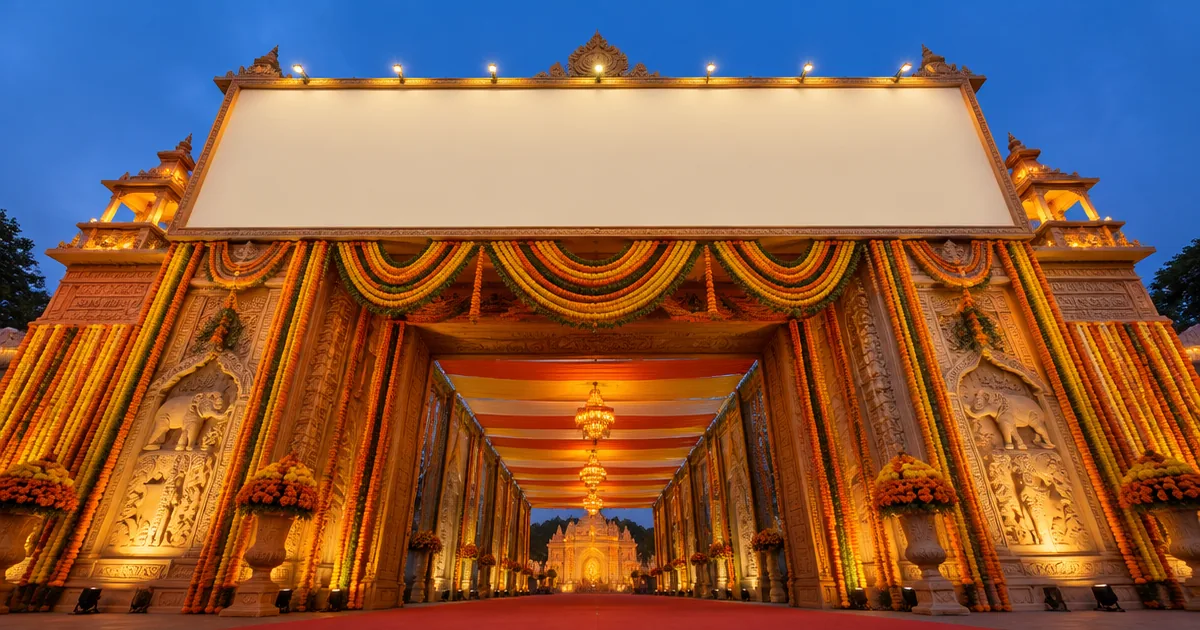
The gate — the torana, the arch, the entrance structure — is the one piece of festival inventory that every single visitor passes under, and passes under twice. There is no route into a pandal that avoids the gate.
That single fact makes it the most valuable unit on the site, and it is why committees sell it first.
What gate branding actually is
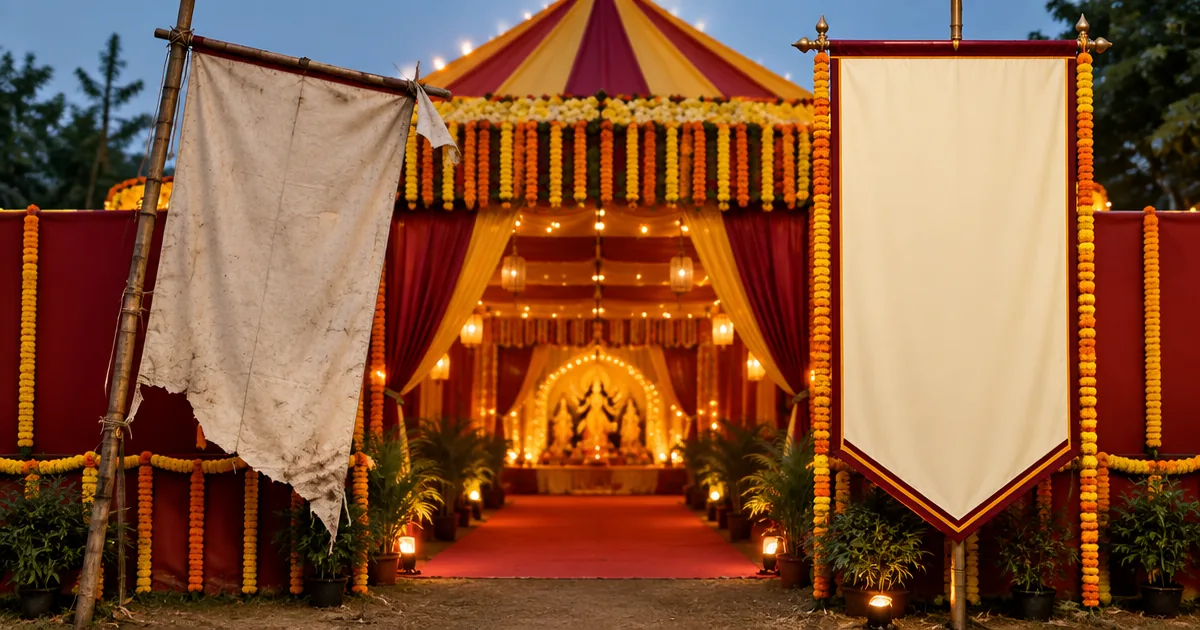
A pandal gate is a temporary architectural structure, usually bamboo or steel framed, spanning the entrance to the pandal or the street leading to it. Large pujas often build several: a main road gate a hundred metres out, a secondary gate at the lane entrance, and the pandal entrance itself.
Branding on it takes three forms:
- Flex or vinyl panels mounted onto the gate frame, on one or both faces
- Printed fabric or canvas wrapped around the structure, common where the committee wants the gate to look integrated rather than commercial
- Backlit or edge-lit panels, on larger urban gates with a power supply
Most committees sell the gate as a single named position — "Main Gate", "Approach Gate", "Pandal Entrance" — rather than by square footage.
Why it commands a premium
Compare it honestly against the other things you could buy on the same site.
Unavoidable exposure. A banner inside the pandal is seen by people who look at it. A gate is seen by everyone, because they walk through it. On a puja drawing 20,000 visitors over five days, gate impressions are effectively equal to total footfall, doubled for the exit.
Viewed while stationary. Queues form at gates. A visitor waiting to enter spends thirty seconds to several minutes looking at the structure directly in front of them. Compare that with the one to three seconds a hoarding gets from a moving vehicle.
It is what gets photographed. Visitors take photographs at the gate because it frames the group. Those photographs go to WhatsApp and Instagram with your branding in them, at no additional cost. No other festival unit produces this effect reliably.
Association, not just exposure. The gate reads as the puja's gate. A brand on it is understood as a supporter of the celebration rather than an advertiser renting space nearby. That is a different relationship with the viewer, and it is the actual product.
What it costs
Prices are set by each committee, not by PujaSathi, and they vary enormously with footfall and location. As a working reference, these are the bands we see on listed pandals:
| Pandal profile | Typical daily footfall | Main gate, full festival | |---|---|---| | Neighbourhood para puja | 2,000 – 5,000 | ₹5,000 – ₹15,000 | | Established locality puja | 5,000 – 20,000 | ₹15,000 – ₹40,000 | | Well known city puja | 20,000 – 75,000 | ₹40,000 – ₹2,00,000 | | Marquee Kolkata puja | 100,000+ | ₹2,00,000 upward, usually pre sold |
A live example currently listed on PujaSathi: a main gate at an established South Kolkata puja, full festival duration, at ₹25,000.
Two things worth understanding about these numbers.
Marquee pandals are not really available. The famous names sell their gates months ahead, often to the same sponsor every year, frequently through a relationship rather than a rate card. If your plan depends on a specific famous puja, start in June.
The value is in the middle band. A ₹25,000 gate at a puja drawing 20,000 visitors over five days is reaching a genuinely local, high intent audience at a cost per thousand that compares favourably with almost any outdoor buy. We work through that arithmetic in the advertising cost guide.
Sole versus shared
This is the term that matters most and the one most often left vague.
Sole gate sponsorship means yours is the only brand on the structure. It costs two to three times a shared arrangement and it is the only version that delivers the association effect properly.
Shared means your panel sits alongside two, three, sometimes six other brands. Cheaper, and still worth buying, but understand what you are getting: presence, not ownership.
Always confirm which one you are buying, in writing, before paying. A gate listing that does not state exclusivity is a listing to ask about. On PujaSathi every slot carries an explicit exclusivity field.
Artwork: what to prepare
Committees print locally, and the print shop will accept almost anything, which is exactly the problem. Send files that cannot be got wrong.
- Format: PDF or AI with outlined fonts. Not JPEG, not a screenshot, not a WhatsApp forward.
- Resolution: 72 dpi at full size is adequate for large format flex viewed from three metres or more. 150 dpi if the gate is close range.
- Colour: CMYK, and expect a shift. Festival flex printing is not a calibrated process. If your brand red matters, specify the ink reference and accept it will be approximate.
- Bleed: 3 inches minimum. Gate panels get trimmed and stretched on site.
- Safe area: keep logos and text at least 6 inches inside the edge. The frame will eat some of your artwork.
- Deadline: artwork with the committee at least seven days before the first day. Printing and mounting both take longer than anyone plans for.
If you do not have artwork, most committees will have it designed locally for a small fee. Quality varies. Budget for doing it yourself.
What proof you should get
This is where most informal festival sponsorship falls down. Money changes hands, the branding may or may not go up, and the brand finds out from a friend who happened to visit.
Under the PujaSathi proof of display standard, a gate booking requires the committee to submit photographs after installation showing the branding in place, including wide context shots that establish it is the gate you paid for and not a panel propped against a wall. Payment to the committee is staged around that evidence, as set out in the payout and settlement policy.
If you are buying a gate directly from a committee rather than through a platform, write the photograph requirement into your agreement, with dates. It is the single most useful clause you can add.
Who should buy a gate
Good fit:
- Local businesses within roughly two kilometres — jewellers, sweet shops, showrooms, clinics, coaching centres, real estate offices. The gate is a landmark and so are you.
- Regional brands wanting depth in one city rather than thin presence across many
- Anyone whose product is bought in person nearby, where a visitor walking past your actual shop the next day is the conversion
Poor fit:
- Brands needing precise attribution and click level measurement. This is a reach and association buy. You can measure it, but not the way you measure a performance campaign — see how to measure festival sponsorship ROI.
- Campaigns needing a long message. A gate holds a logo, a line, and a location. Anything more is unread.
- Anyone booking in the last ten days who needs a specific famous pandal
How to book
- Browse pandals by city and festival on PujaSathi and filter for gate positions
- Check footfall, last year's photographs and whether the committee is verified
- Confirm exclusivity and duration before paying
- Pay through the platform — the total, including fees, is shown before you confirm
- Upload artwork through the booking, and approve the committee's design proof
- Receive installation photographs, and raise any issue within the window in the proof standard
Frequently asked questions
How much does pandal gate branding cost?
Committee set and footfall dependent. Neighbourhood pujas commonly list gates between ₹5,000 and ₹15,000; established locality pujas ₹15,000 to ₹40,000; well known city pujas from ₹40,000 upward. A main gate at an established South Kolkata puja is currently listed at ₹25,000.
Can I get exclusive branding on a pandal gate?
Yes, where the committee offers sole exclusivity. It typically costs two to three times a shared placement and is the only arrangement where the gate reads as sponsored by your brand alone. Confirm it in writing before paying.
When should I book a gate for Durga Puja?
June to August for the October festival. Gates are the first inventory committees sell. By late September the remaining gates are at smaller pujas, though those can still be good value.
What artwork do committees need?
A print ready PDF with outlined fonts, CMYK, 3 inch bleed, and logos kept 6 inches inside the edge. Deliver at least seven days before the festival opens.
How do I know the branding actually went up?
Require dated installation photographs as a condition of payment. Bookings made through PujaSathi require photographic proof from the committee before the balance is released.
Is a gate better value than a hoarding?
Usually, for local reach — dwell time is measured in minutes rather than seconds, and the association with the celebration is something a rented wall cannot provide. A hoarding still wins for pure daily reach along a commuter corridor over a longer period.
The short version
The gate is the one unit everybody sees, the one that gets photographed, and the one that reads as sponsorship rather than advertising. It is priced accordingly, it sells first, and at a mid sized neighbourhood puja it remains one of the more sensible local media buys available in India.
**Browse pandals with gate positions available**
Related: [LED and digital screen advertising](/blog/festival-led-digital-screen-advertising) · [Hoardings and flex at festival venues](/blog/festival-hoarding-flex-advertising) · [More guides for brands](/blog/category/for-brands-advertisers)
PujaSathi is a product of Tracetex 360 Innovations (OPC) Private Limited. Prices quoted are indicative ranges observed on listed pandals; each committee sets its own rates.