How to Measure ROI on Festival Sponsorship (A Practical Framework)
Festival sponsorship is not unmeasurable — most brands just never set it up. Six tracking methods, the maths that works, and what to demand from committees.
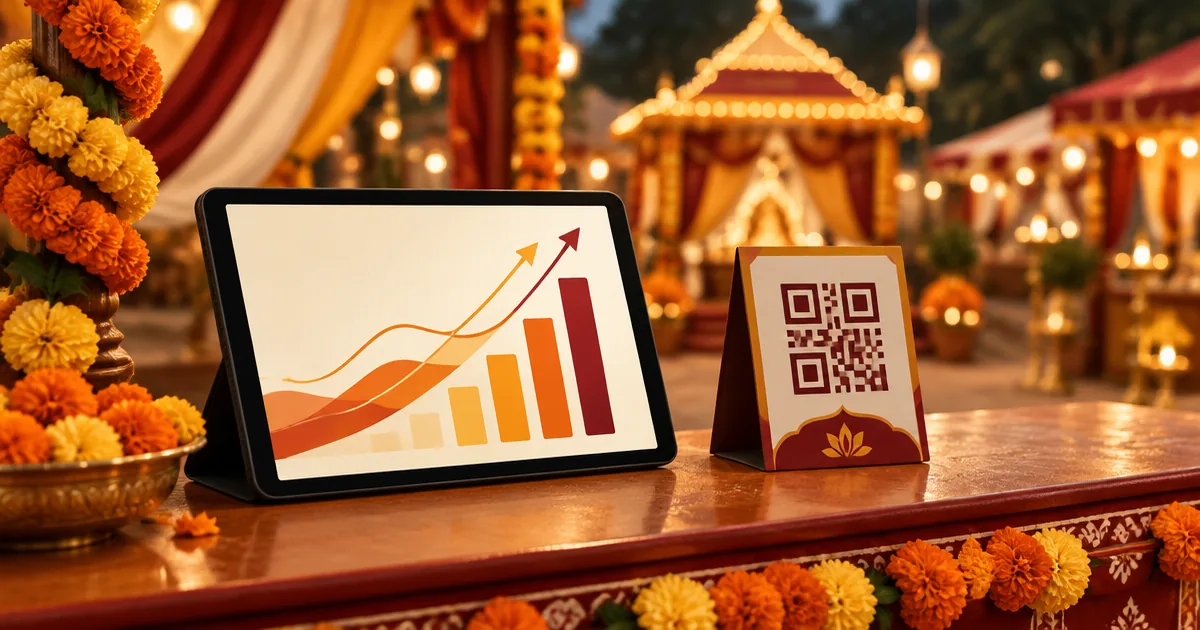
"We can't measure it" is the most common reason brands skip festival sponsorship. It is also, in most cases, untrue.
Festival sponsorship is not inherently unmeasurable. It is usually unmeasured, because nobody set up tracking before the banner went up. Digital feels measurable because the tracking is built in by default. Festival inventory requires you to build it yourself — which takes about an hour.
Here is the framework.
Decide what you are actually buying
Measurement fails when the objective is vague. Pick one primary goal before you sign anything:
- Awareness — you want people in a catchment to know you exist
- Footfall — you want visits to a specific store
- Sales — you want transactions attributable to the sponsorship
- Sampling — you want product in hands
- Data — you want phone numbers for a WhatsApp list
Each of these needs a different measurement method. Trying to measure all five at once produces numbers you cannot act on.
Six tracking methods that work
1. A unique QR code per pandal Print a different QR on each pandal's branding, all pointing to the same offer page with a different tracking parameter. You then know precisely which pandal drove traffic. This is the single highest-value thing you can do, and it costs nothing.
2. Festival-specific promo codes "PUJA25" at your counter or checkout. Works offline and online, tracks all the way to redemption, and gives visitors a reason to act rather than just notice.
3. Footfall lift in the catchment Count store visits during festival week against a baseline week earlier in the month. Crude, but directional — and if you sponsored in one neighbourhood but not another, compare the two.
4. Impression estimates from honest footfall Ask the committee for their daily count and how they arrived at it. Multiply by days, and by two for gate positions (visitors pass entering and leaving). This gives you a defensible impressions number for internal reporting.
5. Proof photographs Not a performance metric, but a delivery metric — and the one most brands forget. Without dated photos of your branding installed, you cannot verify you got what you paid for, and you cannot justify the spend internally.
6. Post-festival recall survey Fifty short intercepts in the neighbourhood a week after: "Do you remember any brands at the puja?" Unprompted recall is the truest awareness measure available, and it costs almost nothing.
The maths
Cost per thousand exposures (CPM)
CPM = (Amount paid ÷ Total exposures) × 1,000
Worked example: ₹25,000 gate branding, 30,000 visitors over five days, each passing twice = 60,000 exposures. CPM = (25,000 ÷ 60,000) × 1,000 = ₹417
For context, 2026 India benchmarks put Meta at roughly ₹30–400 CPM and premium programmatic at ₹300–800. Festival inventory sits in the premium band — so justify it on attention quality, not raw cost.
Cost per acquisition
CPA = Amount paid ÷ Attributed customers
If ₹25,000 produced 120 code redemptions, CPA = ₹208. Compare that against your CPA on Meta or Google. This is the number your finance team will actually respond to.
Return on ad spend
ROAS = Attributed revenue ÷ Amount paid
If those 120 customers spent ₹1,800 on average, that is ₹2,16,000 attributed revenue on ₹25,000 spent — ROAS of 8.6×. Be honest about attribution here: some of those customers would have come anyway.
Set it up before, not after
The entire framework collapses if you start thinking about measurement after the festival. Before you sign:
- Agree the exact position, size and duration in writing
- Agree proof photographs as a deliverable, with a deadline
- Ask for the committee's daily footfall estimate and method
- Finalise your QR or promo code and get it into the artwork
- Record a baseline for whatever you plan to measure — store footfall, weekly sales
- If sponsoring multiple pandals, use different codes for each
What to demand from the committee
Reasonable, and most good committees expect it:
- Dated photographs of your branding installed, wide and close-up
- Their honest daily footfall figure, with the counting method
- Confirmation of installation date
- A short post-festival note confirming dates and placement
If a committee resists all of this, that itself is information.
Be honest about attribution
Festival sponsorship works alongside everything else you are running during the same weeks. Some cautions worth holding:
- A customer who redeems your code may have seen your Instagram ad too
- Festive weeks lift sales anyway — compare against last year's festive week, not a quiet Tuesday
- Recall surveys are affected by who you ask and where
- Small samples produce noisy numbers
The goal is not scientific precision. It is a defensible number that helps you decide whether to spend more or less next year.
What good looks like
For a local or regional brand at a neighbourhood festival, a reasonable outcome:
- CPM in the ₹300–600 range
- 1–3% of visitors engaging with a code or QR
- Measurable footfall lift in the catchment during festival week
- Unprompted recall in double-digit percentages locally
- Proof photographs received within a week
If you hit those, sponsor again next year — and book earlier for a better position.
Frequently asked questions
What if the committee cannot give reliable footfall numbers?
Estimate it yourself. Visit at peak hour, count people passing the gate for five minutes, multiply out. Rough is fine; invented is not.
Is a QR code realistic at a festival?
Yes, if the offer is worth scanning. "Scan for 10% off" works. "Scan to visit our website" does not.
How do I compare this against digital?
Use CPA, not CPM. CPM comparisons favour digital on raw cost while ignoring attention quality. CPA is closer to business reality.
Should I run a control?
If you sponsor in one neighbourhood and not another comparable one, you effectively have a natural control. Compare store performance in both.
How long should I measure for?
Through the festival and two weeks after. Awareness effects decay, but purchase decisions sometimes lag the exposure.
Book with proof built in
The measurement problem is mostly a process problem — which is why it should be part of the booking, not an afterthought.
**Browse festivals with published footfall and proof-of-display**
Related: [Durga Puja Advertising Cost Guide](/blog/durga-puja-advertising-cost-guide-brands) · [Pandal Sponsorship vs Hoardings](/blog/pandal-sponsorship-vs-hoardings-local-reach) · [Sponsor a Local Puja Under ₹25,000](/blog/sponsor-local-puja-under-25000-small-business)