Durga Puja Advertising: The Complete Cost Guide for Brands (2026)
What pandal advertising actually costs, how its CPM compares to Meta and programmatic, budget plans from ₹50,000 to ₹25 lakh, and how to measure ROI.
Every year around August, marketing teams across India ask the same question: we know festive works, but where exactly should the money go?
Most answers point to the obvious channels — Meta, Google, TV, hoardings. Almost nobody quantifies the one channel that is physically closest to the celebration itself: on-ground sponsorship of the pandals and mandaps people actually visit.
This guide fixes that. Real costs, an honest CPM comparison against digital, three budget plans, and how to measure whether it worked.
Why festivals deserve a serious line in your media plan
The numbers are not small:
- India's festive advertising market is heading toward ₹55,000 crore, with consumer brands raising festive spends by up to 20% year on year
- Bengal's Durga Puja economy alone is estimated at around ₹65,000 crore, with Kolkata contributing 65–70%
- 51% of festive marketing activity now happens outside Diwali — Navratri, Durga Puja and Dussehra together account for roughly 31% of festive campaign activity, Ganesh Chaturthi another 11%
- Kolkata alone had 248 officially registered Durga Puja pandals in 2025, each with its own crowd
That last point is the opportunity. Those 248 pandals are 248 separate high-footfall venues — and unlike a billboard, each one comes with a community that trusts it.
What you can actually buy at a pandal
Festival inventory is more varied than most brands realise:
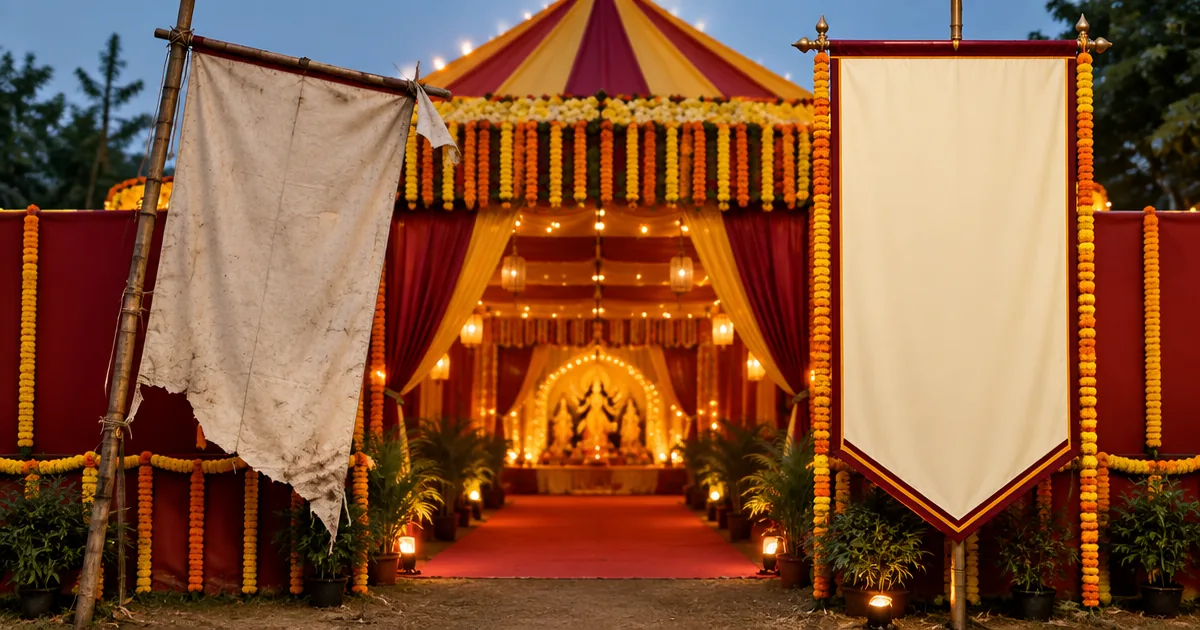
- Entry gate / arch branding — every visitor physically walks under it. The highest-impact position available.
- Stage backdrop — appears behind every cultural performance and in every photo taken on stage.
- Main hoarding / road-facing banner — reaches passers-by who never enter.
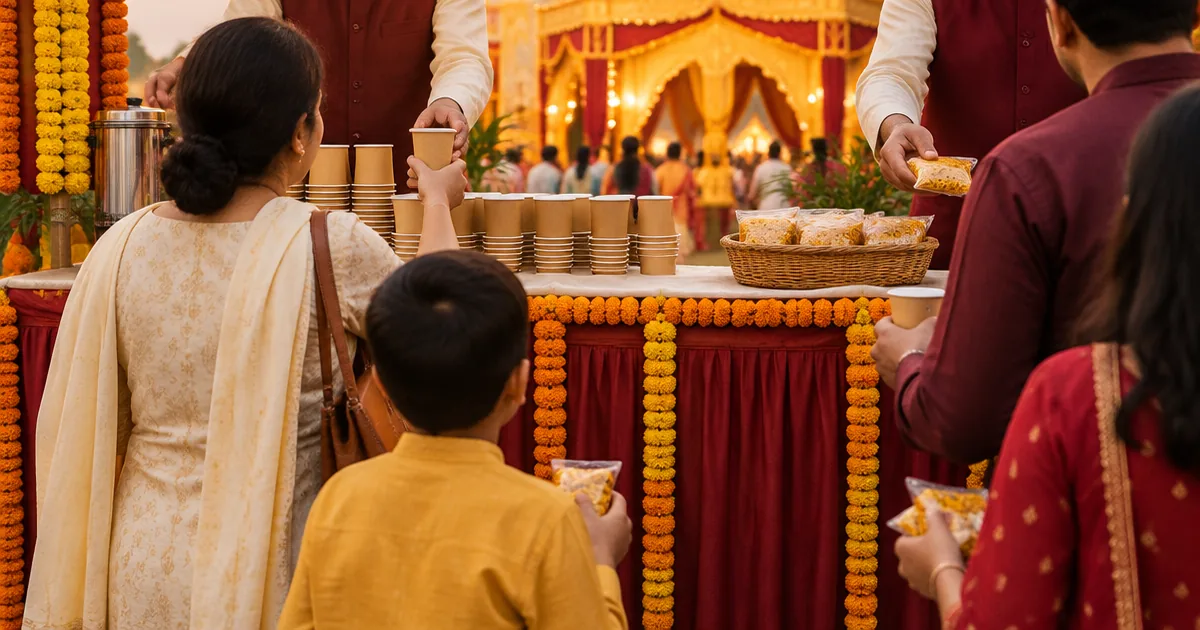
- Food stall / kiosk space — the only format where you can sample product and talk to people directly.
- Pillar and pole branding — repeatable, cheap, builds frequency inside the venue.
- Entry pass / coupon branding — goes home in a pocket and survives the festival.
- Prasad packet branding — handled with reverence, often kept for days.
- Cultural programme announcements — your name read aloud to the entire crowd, repeatedly.
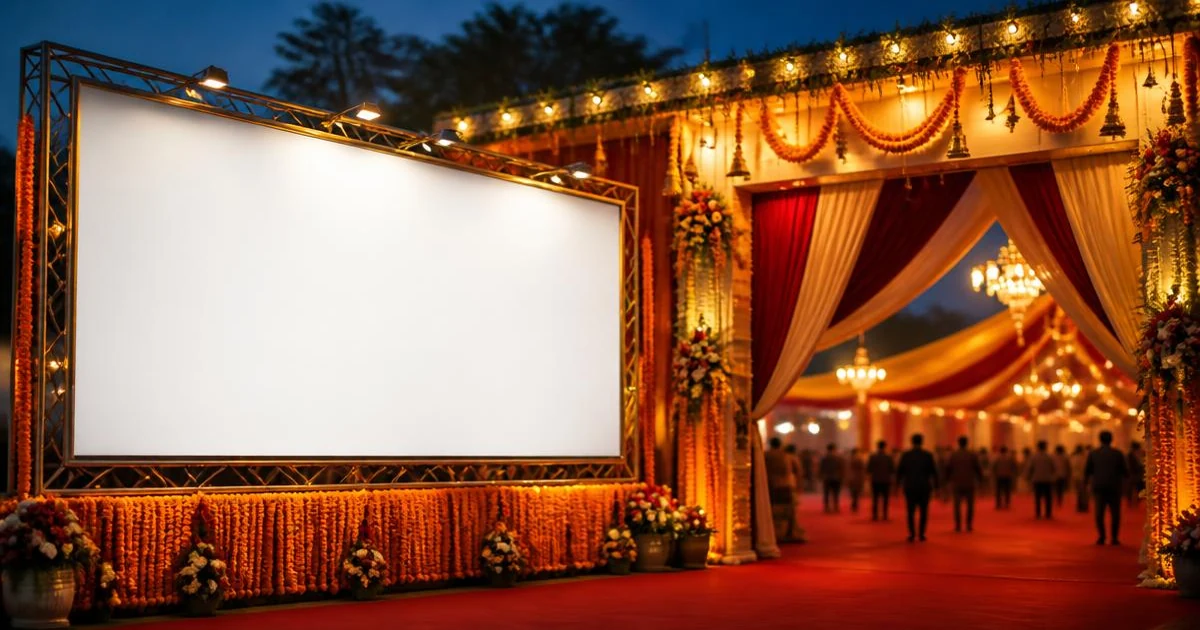
- Digital LED screens — available at larger pandals.
What it costs
Indicative 2027 ranges. Small pandal ≈ 3,000–8,000 daily footfall; mid ≈ 8,000–25,000; large = a landmark pandal drawing city-wide crowds.
Entry gate / arch branding
- Small: ₹8,000 – 25,000 · Mid: ₹25,000 – 1,00,000 · Large: ₹1,00,000 – 10,00,000+
Stage backdrop
- Small: ₹5,000 – 15,000 · Mid: ₹15,000 – 60,000 · Large: ₹60,000 – 5,00,000
Main hoarding
- Small: ₹3,000 – 10,000 · Mid: ₹10,000 – 40,000 · Large: ₹40,000 – 2,00,000
Food stall / kiosk (full festival)
- Small: ₹5,000 – 15,000 · Mid: ₹15,000 – 50,000 · Large: ₹50,000 – 2,00,000
Pillar branding (per unit): ₹1,000 – 25,000 Entry pass branding (per 1,000): ₹2,000 – 15,000 Prasad packet branding (per 1,000): ₹3,000 – 20,000 Programme announcements (per day): ₹1,000 – 10,000
At the very top of the market, marquee pandals have commanded ₹5 lakh for a banner and up to ₹25 lakh for front-gate branding. Most brands will operate far below that — and the mid-tier is where the value sits.
The honest CPM comparison
Here is the calculation almost nobody does. Take a mid-size pandal: 30,000 total visitors across five days, gate branding at ₹25,000. Each visitor passes the gate at least twice (entering and leaving), giving roughly 60,000 exposures.
Pandal gate branding CPM ≈ ₹417 per thousand exposures.
Now compare against 2026 India benchmarks:
- Meta (Facebook/Instagram): roughly ₹30–400 CPM
- Programmatic display, run-of-network: roughly ₹80–150 CPM
- Programmatic with contextual targeting: roughly ₹150–280 CPM
- Premium publisher, programmatic guaranteed: roughly ₹300–800 CPM
So pandal branding sits in the same band as premium digital inventory — not cheaper on raw CPM, and any agency claiming otherwise is selling you something.
The difference is what an impression means. A digital impression is often a sub-second scroll past an ad the user has trained themselves to ignore. A pandal impression is a physical structure someone walks under, in a space where they linger 30–60 minutes, with family, in a positive emotional state — and frequently photograph.
If you value attention rather than counting impressions, festival inventory is priced fairly and often underpriced at the local level. If you only optimise for cheapest CPM, buy digital and skip this channel entirely. Be honest with yourself about which you're doing.
Three budget plans
₹50,000 — hyperlocal test One mid-size pandal in your priority neighbourhood. Take gate branding or a stall. Objective: prove footfall-to-store conversion in one catchment. Measure with a QR code or a festival-specific offer code.
₹5,00,000 — city cluster Eight to twelve mid-size pandals across one city, mixing gate branding and stalls, concentrated in the neighbourhoods that matter to your distribution. This is usually the sweet spot: enough presence to feel citywide, small enough to manage and measure.
₹25,00,000 — regional dominance One or two marquee pandals for prestige and press coverage, plus 30–50 neighbourhood pandals for reach. Add proof-photo documentation and a light influencer layer. This buys genuine share of voice through an entire festival season.
A useful rule: spread beats concentration for most categories. Ten neighbourhood pandals at ₹25,000 usually outperform one marquee pandal at ₹2.5 lakh, unless you specifically need the PR value of a famous name.
How to measure it
Festival sponsorship has a reputation for being unmeasurable. That's a process failure, not a channel failure.
- Unique QR codes per pandal — landing on an offer page. This alone tells you which pandals drove traffic.
- Festival-specific promo codes — trackable to redemption, works offline and online.
- Footfall × days for impression estimates — ask the committee for their honest count.
- Proof photographs — insist on dated photos of your branding installed. Non-negotiable.
- Store footfall lift in the catchment during festival week versus a baseline week.
- Post-festival brand recall — a 50-response survey in the neighbourhood costs very little and tells you a lot.
Make proof photos a written condition of the deal. Reputable committees expect this; the ones that resist are telling you something useful.
Common mistakes brands make
- Booking too late. Premium positions at good pandals are gone by early August for Durga Puja. Budget approvals should happen in June.
- Only buying marquee pandals. Expensive, crowded with other sponsors, and your share of voice is diluted.
- Ignoring the catchment. A famous pandal 15 km from your store is worse than an ordinary one next door.
- No proof documentation. Without photos you cannot verify delivery or justify the spend internally.
- Treating it as CSR. It's a media buy. Set objectives, measure, and expect returns.
- One-year thinking. Committees reward returning sponsors with better positions and better rates.
- Culturally tone-deaf creative. Festival audiences notice. Respect the occasion; don't just paste your standard banner.
When to plan
| Festival | When it happens | When to book | |---|---|---| | Ganesh Chaturthi | Aug–Sep | May–July | | Durga Puja / Navratri / Dussehra | Sep–Oct | June–August | | Kali Puja / Diwali | Oct–Nov | July–September | | Chhath Puja | Oct–Nov | August–September | | Saraswati Puja | Jan–Feb | Nov–December | | Holi | March | Jan–February |
Frequently asked questions
Is festival sponsorship better than a hoarding?
For local reach, usually yes. A hoarding gets a two-second glance from someone driving past. Pandal branding gets 30–60 minutes of proximity from someone standing still, with family, in a good mood. For pure highway reach, hoardings still win.
How do I verify a committee is genuine?
Ask for last year's photographs, registration details, a committee bank account, and references from previous sponsors. On a marketplace, look for verified badges, past-year galleries and published footfall.
What is the minimum realistic budget?
You can sponsor meaningfully at a neighbourhood pandal from around ₹10,000–25,000. That's a genuine test, not a token gesture.
Do we get an invoice and GST?
It depends on the committee. Larger registered committees can invoice properly; smaller ones may not be GST-registered. Confirm before you commit, especially if you need input credit.
How many pandals should we book?
For a single city with a ₹5 lakh budget, eight to twelve mid-size pandals in your priority catchments is a solid structure.
Can we sample or sell product on site?
Yes — stall and kiosk space exists precisely for that, and it's often the highest-ROI format for FMCG, food and D2C brands.
What creative works at festivals?
Warm, respectful, occasion-specific. Festival greetings with your logo outperform hard-sell product creative in this context almost every time.
Find and book festivals in one place
The hardest part of festival advertising has never been the money — it's the fragmentation. Hundreds of committees, no central list, no published rates, no way to compare.
**Browse festivals open for sponsorship on PujaSathi** — filter by city, footfall and budget, see each committee's ad spaces with prices and last year's photographs, and book directly with proof-of-display built in.
Related: [How Much Should You Charge for Pandal Ad Space?](/blog/how-much-to-charge-pandal-ad-space) · [How to Get Sponsorship for Your Durga Puja](/blog/how-to-get-sponsorship-for-durga-puja) · [Guides for brands](/blog/category/for-brands-advertisers)
Costs are indicative ranges compiled from publicly reported festival advertising rates and market practice; digital CPM figures are 2026 India benchmarks. Actual rates vary by city, pandal, crowd and year.