Pandal Sponsorship vs Hoardings: Which Wins for Local Reach?
An honest comparison of festival sponsorship against outdoor hoardings — dwell time, trust, cost, measurability, and when a hoarding is still the better buy.
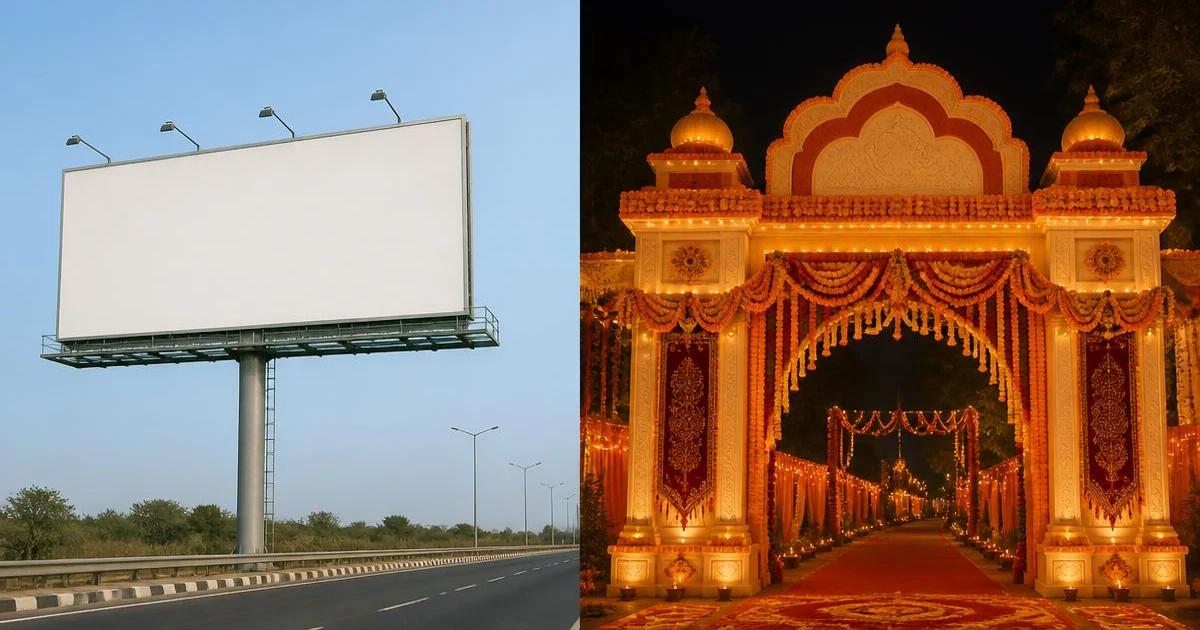
If you run marketing for a regional brand, you have almost certainly bought hoardings. You may never have bought a pandal.
That's not because hoardings are better. It's because hoardings have salespeople, rate cards and agencies, while festival sponsorship has none of those — it has 248 separate committees in Kolkata alone, each with a WhatsApp number.
This article compares the two properly, including the cases where the hoarding genuinely wins.
The core difference: passing versus staying
A hoarding interrupts someone in motion. A pandal reaches someone at rest.
- Hoarding: viewed for 1–3 seconds, usually from a moving vehicle, often while the viewer is thinking about traffic
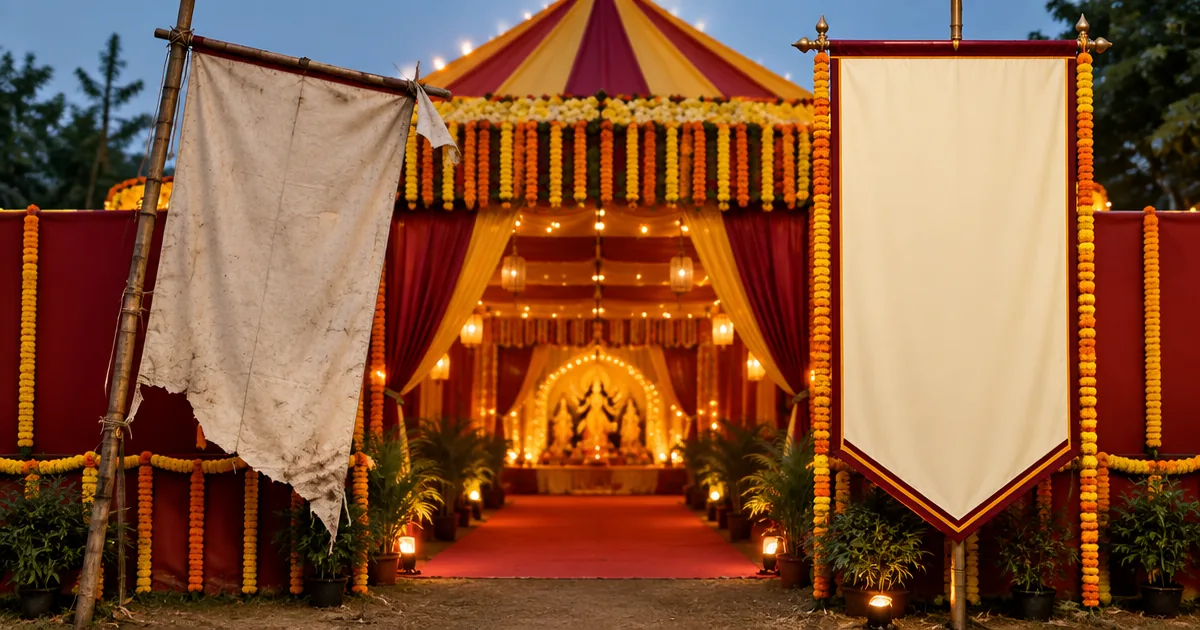
- Pandal: the visitor spends 30–60 minutes inside the venue, walks under the gate at least twice, and is standing still while doing it
That single difference drives everything else below.
Head to head
Attention quality Hoarding: low. Peripheral vision, split attention, high ad-blindness. Pandal: high. The branding is part of the environment the visitor came to look at.
Emotional context Hoarding: neutral to negative — stuck in traffic is nobody's happy place. Pandal: strongly positive. Festival, family, celebration. Your brand borrows that mood.
Trust transfer Hoarding: none. Renting a wall confers no credibility. Pandal: significant. The committee is a trusted local institution, and visitors read sponsorship as community support rather than advertising.
Local precision Hoarding: decent, but you buy a road, not a neighbourhood. Pandal: excellent. You buy a specific catchment — the exact few thousand households around your store.
Cost entry point Hoarding: typically a month-long commitment on a fixed rate card. Pandal: from around ₹10,000–25,000 for a neighbourhood puja.
Photo and social multiplier Hoarding: essentially zero. Nobody photographs a billboard. Pandal: substantial. Visitors photograph gates, pandals and stages constantly — your branding travels into their feeds for free.
Measurability Hoarding: weak. Traffic estimates and little else. Pandal: better than reputation suggests — QR codes per pandal, festival-specific promo codes, footfall counts, and proof photographs.
Physical interaction Hoarding: impossible. Pandal: available. Stall and kiosk space lets you sample, demo and actually talk to people.
The cost question, honestly
On raw CPM, festival branding is not dramatically cheaper than outdoor. Take a mid-size pandal: 30,000 visitors, gate branding at ₹25,000, roughly 60,000 exposures — about ₹417 per thousand.
That's in the same band as premium digital inventory, and comparable to good outdoor placements. Anyone telling you festival sponsorship is a bargain on impressions alone is overselling.
The value is in what those impressions are worth, not how many you get. A thousand exposures to people standing still, in a good mood, with their families, in a venue they trust, are not equivalent to a thousand glances from moving cars. Price the attention, not the count.
When the hoarding is genuinely the better buy
Be wary of anyone who tells you one channel always wins. Choose the hoarding when:
- You need highway or arterial-road reach — commuters who never enter a neighbourhood venue
- Your campaign runs year-round, not seasonally — pandals exist for days, hoardings for months
- You need guaranteed, contractual delivery with a formal vendor, invoice and SLA
- Your audience is city-wide and undifferentiated rather than concentrated in specific catchments
- You have no time to coordinate with multiple committees and need one purchase order
Festival sponsorship is a seasonal, local, high-attention buy. It complements outdoor; it doesn't replace it.
The strongest play: use both
The most effective regional campaigns we see combine them:
- Hoardings on the arterial roads for broad awareness through the season
- Pandal sponsorship in your five to ten priority catchments for depth, trust and sampling
- Digital retargeting around those same pincodes during festival week
Broad reach from outdoor, deep engagement from the pandal, and digital to close the loop. Each covers the others' weakness.
What to watch out for at pandals
Festival sponsorship has real risks that hoardings don't:
- Delivery is less formal. Insist on written terms and dated proof photographs.
- Committee quality varies. Ask for last year's photos, registration details and previous sponsor references.
- Invoicing is inconsistent. Larger registered committees can invoice properly; smaller ones may not be GST-registered. Confirm before committing if you need input credit.
- Inventory sells out early. Premium gates at good pandals are gone by early August for Durga Puja.
- Footfall claims can be inflated. Ask how the number was counted.
These are solvable with basic diligence — but pretending they don't exist would be dishonest.
Frequently asked questions
Is pandal sponsorship cheaper than a hoarding?
Not necessarily on CPM. The entry ticket is lower — you can start at ₹10,000–25,000 versus a month-long hoarding contract — but per impression they're broadly comparable. The advantage is attention quality and local precision, not raw cost.
How many pandals equal one good hoarding?
For local reach in a specific catchment, a handful of neighbourhood pandals will usually outperform one hoarding. For city-wide awareness, the hoarding still has the edge.
Can I get guaranteed delivery like an outdoor contract?
Increasingly, yes. Book through a platform that requires proof-of-display photographs, or write that requirement into your agreement directly with the committee.
What about brand safety?
Festival environments are family settings with generally strong brand safety — arguably better than programmatic display. Just ensure your creative respects the occasion.
Does this work for national brands?
Yes, but structure it as a cluster buy across many neighbourhood pandals rather than a few famous ones. Reach comes from spread.
See what's actually available
The reason most brands default to hoardings is simply that hoardings are easy to buy. Festival inventory has been invisible — until now.
**Browse festivals open for sponsorship on PujaSathi** — filter by city, footfall and budget, see published prices and last year's photographs, and book with proof-of-display built in.
Related: [Durga Puja Advertising Cost Guide for Brands](/blog/durga-puja-advertising-cost-guide-brands) · [How Much Should You Charge for Pandal Ad Space?](/blog/how-much-to-charge-pandal-ad-space) · [Guides for brands](/blog/category/for-brands-advertisers)
Cost figures are indicative ranges compiled from publicly reported rates and market practice, and vary by city, venue and year.