Hoardings and Flex Advertising at Festival Venues
The workhorse of pandal advertising — approach road hoardings and flex panels. What they cost, where they should be placed, the municipal permission question, and why cheap flex is often the smartest festival buy.
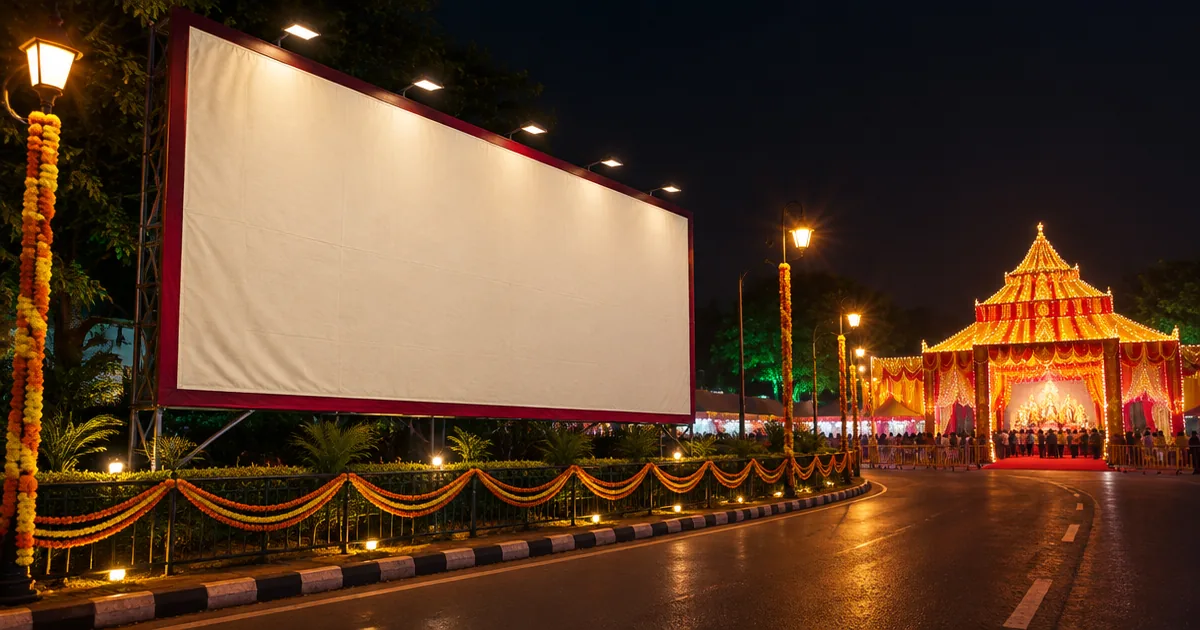
Flex is the unglamorous end of festival advertising, and it is where most of the volume actually is.
A gate is one position. A stage is one audience. Flex hoardings are the units a committee can place in twenty locations along the approach roads, catching people who never enter the pandal at all — which, in a busy locality during Durga Puja, is most of the people passing through it.
Festival flex is not the same as an outdoor hoarding
The word causes confusion, so be precise about what you are buying.
A commercial hoarding is a permanent structure owned by a media company or licensed by the municipality, rented by the month, with a rate card and a permit.
A festival flex hoarding is a temporary printed panel, mounted on a bamboo or steel frame, erected by the committee for the festival period only, on or near the pandal and along its approach roads. It exists for a week and comes down.
These have different economics, different permissions and different value. This article is about the second. For a comparison with permanent outdoor, see pandal sponsorship versus hoardings.
The formats
- Approach road panels — 10x5 ft to 20x10 ft, mounted along the roads leading to the pandal, often several hundred metres out. These catch vehicular and pedestrian traffic that never enters.
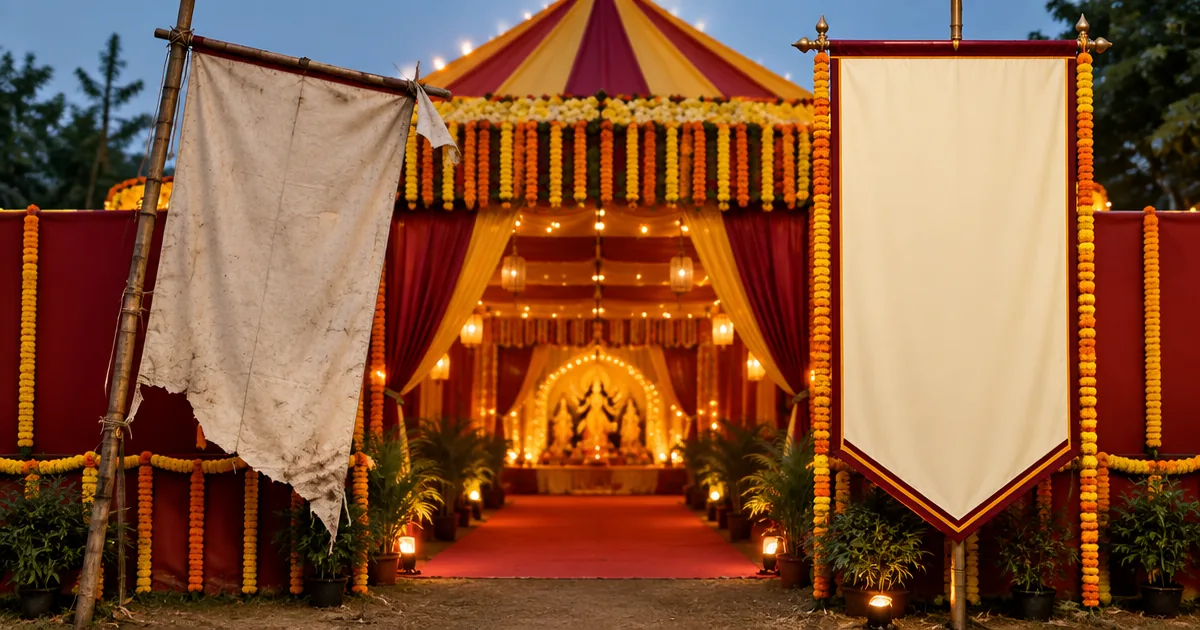
- Perimeter flex — wrapped around the pandal structure or the boundary, seen by everyone in the queue.
- Overhead street spanning banners — across the road, high impact, and the format most likely to need a municipal permission.
- Gully and lane panels — small, cheap, numerous, deep in residential lanes. Undervalued for genuinely local businesses.
- Backdrop and directional signage — arrows, parking, exits, with your branding attached to something useful.
That last one deserves attention. Branding attached to a useful function is read more and resented less. A "Parking this way" board with your logo gets looked at deliberately, which a pure advertisement does not.
What it costs
| Format | Typical size | Indicative price, full festival | |---|---|---| | Single lane or gully panel | 6x4 ft | ₹1,000 – ₹4,000 | | Standard pandal flex | 10x5 ft | ₹3,000 – ₹12,000 | | Approach road panel, good position | 15x8 ft | ₹8,000 – ₹30,000 | | Street spanning overhead banner | 30x4 ft | ₹10,000 – ₹40,000 | | Multi panel package | 5–10 positions | often discounted 20–40% |
A live example on PujaSathi: a flex hoarding position at an established South Kolkata puja, full festival, at ₹5,000 — and a banner package covering positions all around the pandal and the main road, also at ₹5,000.
That second listing illustrates why flex is worth a serious look. Multiple positions at ₹5,000, at a puja drawing thousands daily, is the cheapest genuine reach available at a festival. It is not prestigious. It works.
Placement is everything
The same panel at ₹5,000 is either excellent or wasted depending entirely on where it goes.
Ask for specific positions, not a quantity. "Five flex panels" tells you nothing. "Two on the approach road at the junction, two on the queue line, one at the exit" is a media plan.
The best positions:
- Junctions where traffic slows or stops — a stationary viewer is worth several moving ones
- The queue line, where people are standing still for twenty minutes with nothing to look at
- The exit, where visitors are relaxed and heading somewhere, possibly past your shop
- Approach roads 200 to 500 metres out, catching people deciding where to go
Weak positions: high on the pandal where nobody looks up, behind the main structure, facing away from pedestrian flow, or clustered with fifteen other brands.
Walk the site if you can. A twenty minute visit before booking tells you more than any listing. If you cannot visit, ask for photographs of the proposed positions from last year.
Creative for flex
Flex is a distance medium and gets about two seconds. Design accordingly.
- Six words maximum. Brand, offer, location. That is the whole message.
- Type large enough to read at thirty metres. Roughly one sixth of panel height for the main line.
- One phone number or one landmark direction. "Opposite the post office" beats a URL every time, because nobody types a URL from a banner.
- High contrast. These are viewed at dusk, at night under sodium lighting, and in rain.
- 72 dpi at full size, CMYK, 3 inch bleed, fonts outlined. Large format flex needs no more resolution than that.
- Expect colour shift. Festival flex printing is not colour managed. If exact brand colour matters, supply an ink reference and accept approximation.
The permission question
This matters and most brands never ask.
Temporary festival hoardings on public land, road spanning banners and panels on municipal property generally require permission from the local body, and many municipalities levy an advertisement tax. In practice committees handle this, or in some localities do not, and enforcement varies widely by city and year.
Your exposure is real but limited. The panel is erected by the committee on their permission. However, a brand whose banner is removed by the municipality mid festival has paid for nothing, and in some cities the advertiser named on an unauthorised hoarding can be pursued.
What to do: ask the committee directly whether their hoarding positions are permitted, and get the answer in writing. It costs you one message. Our permissions and compliance guide for West Bengal covers the committee side of this in more detail.
Why flex is often the smartest buy
Set aside prestige and look at the arithmetic.
A ₹25,000 gate reaches everyone who enters the pandal. A ₹5,000 multi position flex package reaches everyone who enters, plus everyone who walks or drives past on the approach roads, plus residents of the surrounding lanes who see it for a week.
For a local business — a showroom, a clinic, a coaching centre, a restaurant — that wider catchment is frequently the more valuable audience, because it is the catchment you actually serve. The gate is the better brand statement. The flex package is often the better business.
The strongest small budget approach is usually both: one prominent position for credibility, and a spread of cheap panels for coverage.
Frequently asked questions
How much does festival flex advertising cost?
Small lane panels commonly run ₹1,000 to ₹4,000, standard pandal flex ₹3,000 to ₹12,000, and good approach road positions ₹8,000 to ₹30,000. A flex hoarding at an established South Kolkata puja is currently listed at ₹5,000 for the full festival.
What is the difference between a festival hoarding and a commercial hoarding?
A commercial hoarding is a permanent licensed structure rented by the month. A festival flex hoarding is a temporary panel erected by the committee for the festival week only, on or near the pandal and its approach roads.
Do festival hoardings need municipal permission?
Temporary hoardings on public land and road spanning banners generally do, and advertisement tax may apply. The committee normally handles this. Ask them to confirm in writing before you pay.
How many words should be on a festival banner?
Six or fewer. It is read from a distance in about two seconds. Brand, one line, and a landmark or phone number.
What size should the artwork be?
Supply at full panel size, 72 dpi, CMYK, with 3 inch bleed and fonts outlined. Large format flex does not need higher resolution.
Is flex better value than a pandal gate?
For pure local reach per rupee, usually yes, because flex extends beyond the pandal to the approach roads. The gate is the stronger brand statement. Many advertisers with a modest budget buy one prominent position plus several cheap panels.
The short version
Flex is the least glamorous festival unit and frequently the most efficient. Buy specific positions rather than a quantity, put panels where people are stationary, keep the message to six words, and ask the committee to confirm permissions in writing. At ₹5,000 for multiple positions around a busy pandal, it is the cheapest real reach in Indian festival advertising.
**Browse pandals with flex and hoarding positions**
Related: [Gate and arch branding](/blog/festival-gate-arch-branding-guide) · [Banner and pillar branding](/blog/pandal-banner-pillar-branding) · [More guides for brands](/blog/category/for-brands-advertisers)
PujaSathi is a product of Tracetex 360 Innovations (OPC) Private Limited. Prices quoted are indicative ranges observed on listed pandals; each committee sets its own rates. This article is general information, not legal advice.