Diwali Sponsorship: What to Book When the Festival Has No Pandal
Diwali is the biggest festival in India and the hardest to buy inventory for, because there is no single venue. Here is where the crowds actually gather, and what it costs to reach them.
Diwali is the largest consumer occasion in India, and the most awkward one to advertise at on the ground.
Durga Puja gives you a pandal. Ganesh Chaturthi gives you a mandal. Navratri gives you a ticketed ground.
Diwali gives you a household. People celebrate at home, with family, behind a closed door. There is no venue, no gate, no queue, no stage.
Which is why most Diwali advertising is television, print and digital — and why the on-ground opportunity, which is real and substantial, gets overlooked.
Diwali 2026 falls on Sunday 8 November, with Dhanteras on Friday 6 November. In 2027, Diwali falls on Friday 29 October.
Where the crowds actually are
There is no single Diwali venue. There are seven, and they are all buyable.
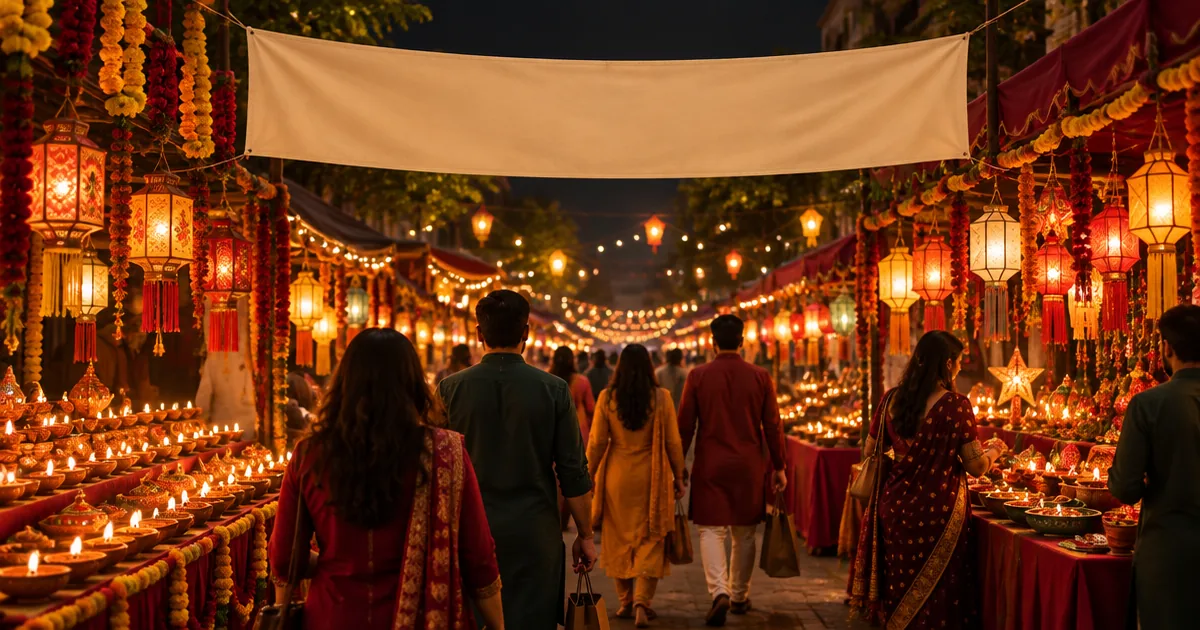
1. Diwali melas and fairs
Organised community fairs in the run-up, held in grounds, clubs, housing societies and community centres. Stalls, food, shopping, cultural programmes, and sometimes several days long.
This is the closest Diwali has to a pandal, and it is the primary on-ground inventory.
2. Housing society celebrations
Large residential complexes run their own Diwali events — lighting, rangoli competitions, cultural evenings, and often a fair. Small individually, enormous in aggregate, extremely local, and almost never sold to advertisers.
For a business with a defined neighbourhood catchment, these are the cheapest and most precisely targeted inventory in the entire festival calendar.
3. Market and bazaar associations
Shopping districts decorate and light up for Diwali, often coordinated by a traders' association. Footfall in the ten days before Diwali is the heaviest of the year in any commercial area.
Association-managed lighting, arches and street decoration frequently carry sponsor branding — and the association will usually sell it.
4. Temple celebrations
Lakshmi Puja on Diwali night draws very large crowds to temples, and the larger temple complexes run multi-day programmes.
5. Corporate and club events
Diwali parties, cultural evenings and family days. A smaller, higher-income, captive audience.
6. Chhoti Diwali and Dhanteras retail
Not events as such, but the two heaviest retail days of the year. Where a market association or a mall runs coordinated activity, this is where footfall peaks.
7. Public firework and lighting displays
Where a municipality or an association organises one, it draws a large crowd for a short, high-attention period.
What to buy, and what it costs
Stalls at Diwali melas — ₹2,000 to ₹1,50,000. The primary format. A mela stall reaches a shopping-minded crowd in the days when they are actively buying.
Gate or entrance arch at a mela — ₹5,000 to ₹2,00,000.
Stage backdrop — ₹5,000 to ₹1,20,000. Melas and society events run cultural programmes.
Banners and street signage — ₹800 to ₹90,000. Market associations, mela perimeters, society entrances.
Digital LED screens — ₹8,000 to ₹2,00,000.
Prasad, gift-hamper and entry-pass branding — ₹2,500 to ₹1,50,000. Diwali is a gifting festival, and branding on something given away is well received in a way it is not at other times.
Title sponsorship — ₹25,000 upward. Melas, society events and market association displays all sell it, and at the society level it is inexpensive.
The society opportunity, in detail
Worth expanding on, because it is the most overlooked inventory in the Indian festival calendar.
A large residential complex might hold a thousand families. Its Diwali event draws most of them, over one or two evenings, in a single compound.
For:
- a restaurant within delivery distance
- a jeweller or clothing store in the local market
- a bank branch or NBFC nearby
- a hospital or diagnostic centre in the area
- a car or two-wheeler dealership in the catchment
- a coaching centre serving those children
...that is a near-perfect audience. Everyone is a plausible customer, they all live within a fixed radius, and the cost of a banner or a small stall at a society event is a fraction of anything comparable.
Buy several. Ten society events across a catchment will typically outperform one large mela on relevance, and often on total cost too.
When to book
Diwali has a shorter lead time than the pandal festivals, because the events are smaller and organised later.
| Timing | Status | |---|---| | Three months before | Large melas and market associations begin planning | | Two months before | Best time. Full inventory across melas and societies | | Six weeks before | Good positions still available | | One month before | Last practical window for printed material | | Two weeks before | Stalls and last-minute banners only | | Diwali week | Too late for most things |
For Diwali 2026 (8 November), you are now in the last two weeks: book mela stalls, society events and banners straight away, and start planning Diwali 2027 from August.
One important exception: if the same committee runs both Durga Puja and Diwali, or Navratri and Diwali, negotiate them together in June or July. You will get a better rate on both, and you will have the good positions locked before anyone else asks.
Which categories fit
Diwali is the broadest consumer occasion in India, so the list is long — but some fits are much stronger than others.
Consumer durables and electronics — the single largest Diwali category. Televisions, appliances, phones.
Jewellery and gold — Dhanteras is the most auspicious buying day of the year.
Automobiles — delivery on Dhanteras or Diwali is a widespread preference.
Sweets, dry fruits and gifting — the core gifting categories.
Clothing and ethnic wear.
Home improvement, paint, furnishings and cleaning — Diwali cleaning and repainting is near-universal, and it happens in the weeks before.
Banks, NBFCs and consumer finance — festival loan schemes fund most of the above.
FMCG — gifting packs and festival editions.
Fireworks retail, where permitted.
Insurance and investment — Muhurat trading and end-of-year financial planning.
Real estate — an auspicious booking occasion.
Creative
Warmth over urgency. Diwali advertising that shouts a discount reads badly next to advertising that reads as a greeting. The best-performing Diwali creative is usually a wish with an offer attached, not an offer with a wish attached.
One product, one price.
Design for light. Diwali events are extensively lit — often with strings of coloured bulbs that wash out mid-tones. High contrast survives. Subtle work does not.
Gifting language. A large share of Diwali purchases are for someone else. "Gift" outperforms "buy" in this season, consistently.
Landmark, not address.
The overseas Diwali
Diwali is the anchor of the diaspora calendar in a way Durga Puja is not.
It is a public holiday in Trinidad and Tobago, Fiji, Mauritius, Singapore, Malaysia and Nepal (as Tihar), and it is celebrated across every Indian regional community rather than one.
For the older diaspora — Mauritius, Fiji, Trinidad, South Africa — Diwali is the occasion, and it is national rather than communal. Diwali melas in these countries can be very large, and Trinidad's Divali Nagar runs as a multi-day festival site with stalls and nightly programmes.
For the recent diaspora — the UK, North America, Australia, the Gulf — Diwali melas are common, well attended and generally ticketed or registered, which makes footfall verifiable.
Committees abroad list in their own currency.
Plan your Diwali season: browse melas, societies and festivals by city — exact dimensions, position, duration and price on every listing.