Tier 2 and Tier 3 Cities: India's Cheapest Untapped Festival Reach
The same ₹10 lakh buys two landmark metro sponsorships or ninety venues across smaller cities. One of those is a much better deal, and almost nobody is bidding against you.
Indian brands spend their festival budgets where their offices are.
Mumbai, Delhi, Bengaluru, Kolkata, Hyderabad. The landmark pandals, the famous mandals, the events that get press coverage and that the marketing head can drive past on the way home.
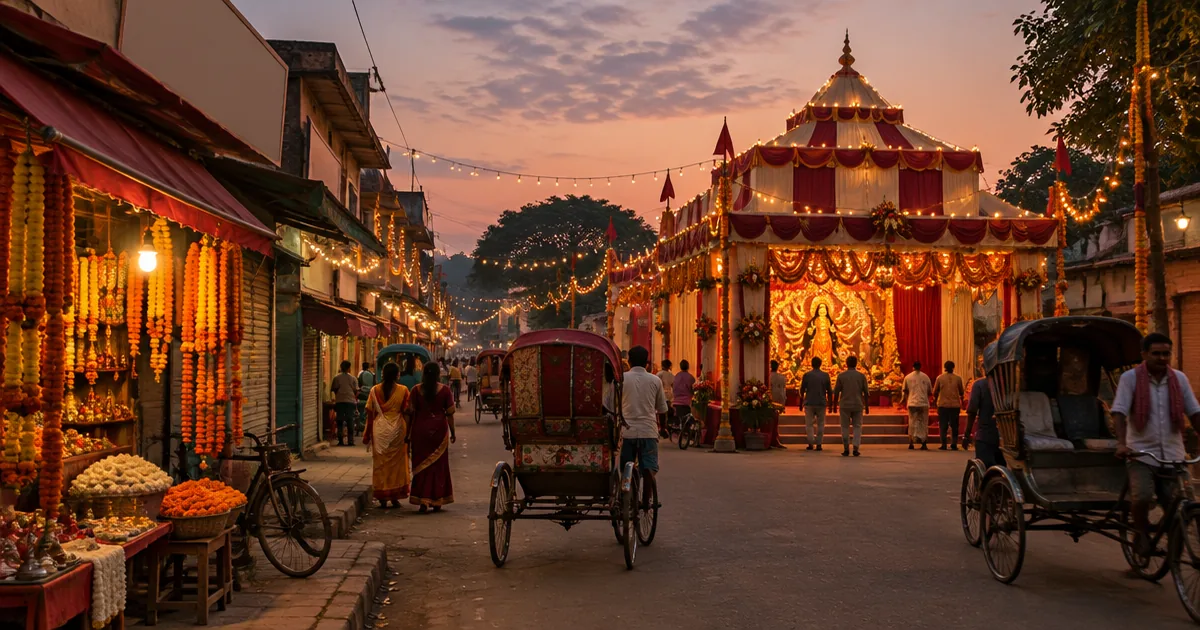
Meanwhile the festival happens everywhere else too — in several hundred cities where consumption is growing faster, media costs a fraction as much, and no national brand has put a banner up.
This is the case for spending a serious share of your festival budget outside the metros, and the practical detail of how to do it.
The arithmetic that starts the argument
Take ₹10,00,000 of slot budget.
Option A — the metro flagship. Two landmark title sponsorships at roughly ₹5,00,000 each. Two venues. Very high footfall at each. Press coverage. Prestige.
Option B — tier-2 and tier-3 coverage. Roughly ninety venues at around ₹11,000 each, spread across smaller cities.
Ninety venues will deliver several times the aggregate footfall of two, because a good district-town Puja draws tens of thousands of people and costs a fraction of a metro landmark position.
More importantly, in those ninety venues you are frequently the only national brand present. In the two metro flagships you are one of a dozen competing for attention, next to brands with larger budgets than yours.
Both purchases are defensible. What is not defensible is choosing A because head office will see it and skipping B because nobody in Mumbai will.
Why smaller cities are underpriced
Not because the audience is worth less. Because there is no market setting the price.
No competing bidders. In Kolkata or Pune, major committees run professional sponsorship operations with rate cards, because national brands have been buying from them for decades. In a district town, the committee has never had a national brand ask.
No agency coverage. Agencies sell what they can service. Servicing four hundred small-town committees is operationally miserable, so it does not get offered — which means it does not get bought, which means the price never rises.
Committees price against local costs. A pandal in a smaller city costs less to build, less to light and less to print for. The sponsorship rate reflects local economics, not the value of the audience to a national brand.
Nobody has counted the audience. A district Puja drawing thirty thousand people over five days has thirty thousand people whether or not a media plan has ever acknowledged them.
What is actually true about the audience
Worth being accurate rather than enthusiastic, because "tier-2 is the future" has been said badly for twenty years.
What is genuinely true:
Consumption growth is faster off a smaller base. Categories that are saturated in metros — smartphones, two-wheelers, consumer durables, branded apparel, organised retail — still have headroom in smaller cities.
Digital penetration has closed most of the information gap. A buyer in a district town researches the same way a metro buyer does. What has not closed is the distribution and trust gap, and on-ground presence addresses exactly that.
Festival participation is proportionally higher. In a metro, the festival competes with a hundred other things to do. In a smaller city, the Puja or the mandal is genuinely the event of the year, and participation rates are correspondingly higher.
Brand presence signals credibility disproportionately. A national brand's name on the local Puja gate is read, in a smaller market, as evidence that the brand takes the town seriously. That signal is weak in Mumbai and strong in Purulia.
What is not true:
It is not the same customer at a lower price. Price sensitivity, preferred pack sizes, financing needs and channel behaviour all differ. A campaign lifted unchanged from a metro plan will underperform.
It is not operationally free. Ninety venues is ninety pieces of coordination. That is the real cost, and it is the reason the opportunity persists.
The operational problem, stated honestly
Here is why this budget line is usually skipped, and it has nothing to do with the audience.
To buy ninety small-town venues directly you must find ninety committees who have no website, verify ninety committees you have never heard of, agree ninety prices with no reference rates, pay ninety times to accounts that may not exist in the committee's name, collect ninety invoices, and confirm ninety installations in towns nobody from your team will visit.
That is not a marketing problem. It is a logistics problem, and it is why the inventory stays unsold.
It is also precisely the problem a marketplace exists to solve. Committees are verified before they appear, listings must state exact dimensions, position and duration or they are rejected, payment goes to verified committee accounts, one tax invoice format applies to everything, and every booking returns three to seven photographs and a video of the material installed, with location.
Ninety venues become ninety line items rather than ninety relationships. That is the entire unlock.
How to choose which cities
Do not buy tier-2 as a category. Buy specific places for specific reasons.
Follow your distribution. The first and best filter. Where do you already have dealers, stockists, branches or service centres who would benefit from local presence? On-ground advertising that supports an existing distribution point converts. Advertising into a town where the customer cannot buy your product does not.
Follow your service radius. For a hospital group, a dealership or an education chain, the question is which towns feed your existing centre.
Follow the regional festival, not the national one. This is where brands most often misfire. The festival that matters differs sharply by state:
| Region | The festival that owns the season | |---|---| | West Bengal, Assam, Odisha, Tripura | Durga Puja, then Kali Puja | | Maharashtra, Goa, coastal Karnataka | Ganesh Chaturthi | | Gujarat, Rajasthan, MP | Navratri and garba | | Telangana, Andhra Pradesh | Ganesh Chaturthi, Bonalu, Bathukamma | | Tamil Nadu | Deepavali, Pongal, temple festivals | | Kerala | Onam | | Bihar, Jharkhand, eastern UP | Chhath, Durga Puja, Ramlila | | Delhi NCR, Haryana, western UP | Ramlila and Dussehra, Diwali | | Punjab | Diwali, Baisakhi |
Buying Durga Puja inventory in Pune, or Ganesh Chaturthi inventory in Siliguri, is spending money in the wrong week.
Check the state's own calendar before planning the buy. Our regional festival guide and the 2027 festival calendar map this properly.
What to buy in a smaller city
The mix should differ from your metro plan.
Buy gates, not perimeter banners. At a smaller venue the gate is affordable, and the difference in visibility between the gate and a side banner is proportionally much larger than at a big venue.
Buy more venues, smaller positions. Coverage across a town beats dominance at one pandal.
Buy the souvenir booklet everywhere. It costs very little, it is kept, and in a smaller town the local Puja souvenir has a readership and a longevity that surprises people.
Buy stalls where you have distribution. A stall next to a dealer who can actually sell is a strong combination. A stall with no local fulfilment is a leaflet exercise.
Consider title sponsorship — it is affordable here. A title sponsorship at a district-town Puja may cost less than a perimeter banner at a metro landmark, and it puts your name on everything, announced from the stage, for the whole festival. For a brand building local credibility this is the best value in the entire festival market.
Creative that works outside the metros
Use the local language. Not a translation of your national line — a line written in the language. This is the most common and most damaging shortcut.
Lead with price or EMI. Price sensitivity is genuinely higher. A visible number outperforms a brand line.
Name the local dealer or branch. "Available at [dealer name], [landmark]." National advertising without a local purchase point wastes the impression.
Keep it simple and high contrast. Pandal lighting in smaller towns is often less controlled. Heavy type, strong contrast, no fine detail.
Do not condescend. Creative that talks down to a smaller-town audience is noticed immediately and remembered badly.
A reasonable first-year allocation
If you have never bought outside the metros, do not restructure the whole plan. Test it properly:
| | Share of festival budget | |---|---| | Metro flagship and coverage | 70% | | Tier-2 and tier-3 test | 25% | | Reserve | 5% |
Spend the 25% across two or three states you already distribute in, at thirty to fifty venues, with a unique response code per city.
Then compare cost per thousand and response rate against your metro venues. The comparison is the point — you are buying information as much as reach, and next year's allocation writes itself.
Find inventory outside the metros: browse festivals by region, city and footfall — every listing carries exact dimensions, position, duration, price and proof photographs after installation.