Festival Advertising Glossary: Every Term Explained
Gate arch, exclusivity, footfall, CPM, visarjan branding, proof of display — a plain-English glossary for puja committees and brands buying festival sponsorship.

Festival sponsorship has its own vocabulary, and half the confusion in negotiations comes from two sides using the same word to mean different things.
This glossary covers the terms that actually come up.
Inventory and positions
Ad slot — Any specific, sellable advertising position at a festival. A committee does not sell "sponsorship"; it sells individual slots.
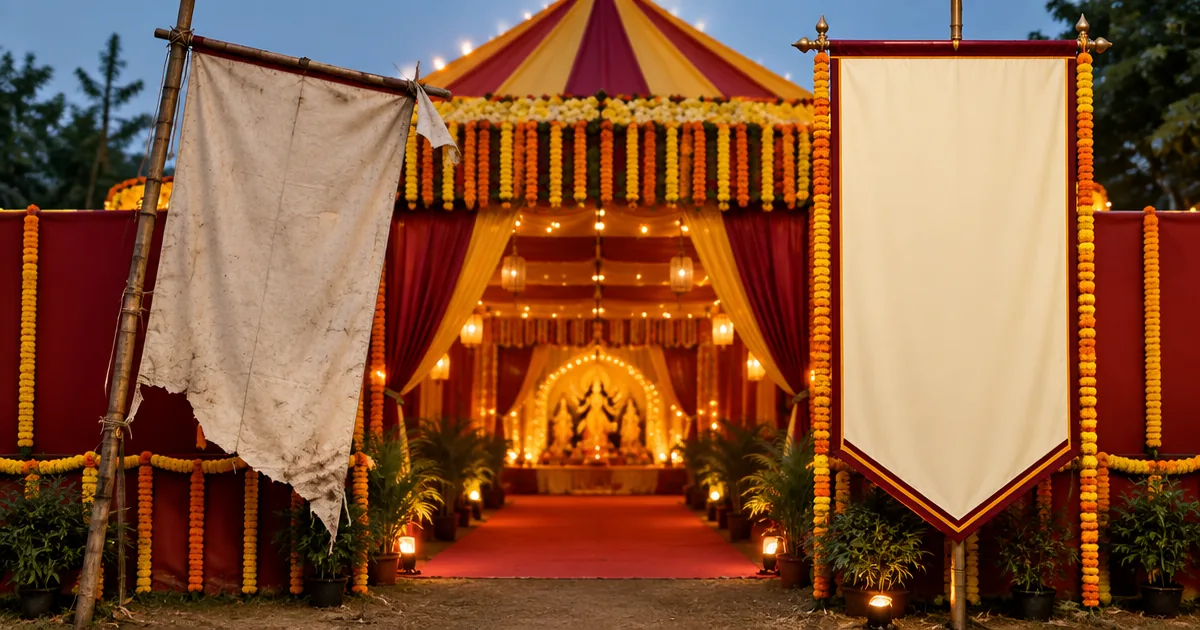
Gate arch / entry gate branding — Branding on the decorated entrance structure. Usually the most valuable position, because every visitor physically passes under it.
Stage backdrop — The panel behind the cultural programme stage. Appears in performance photos, videos and live streams.
Hoarding — A large road-facing board. At a festival it reaches passers-by who never enter the venue.
Kiosk / stall space — A physical booth for the brand to sample products, demo, or talk to visitors. The only format that allows direct interaction.
Pillar branding — Branding on the poles and pillars inside the venue. Cheap, repeatable, good for building frequency.
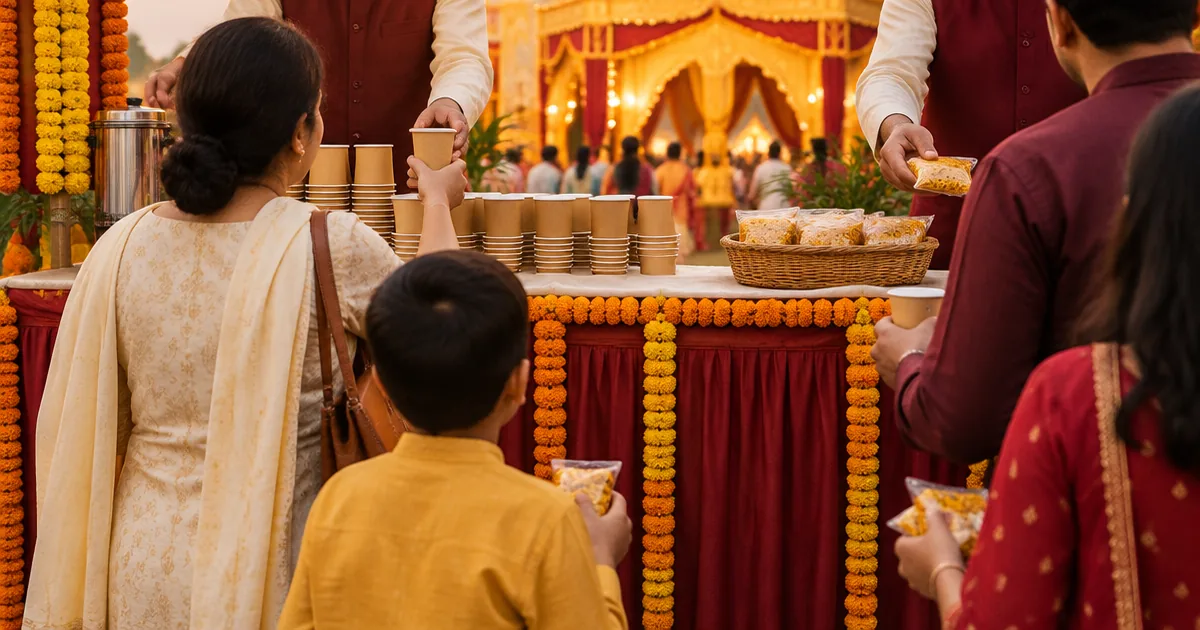
Prasad packet branding — The brand printed on the packets in which prasad or offerings are distributed. High emotional value; often kept.
Entry pass branding — Branding on entry passes, coupons or wristbands. Travels home with the visitor.
Visarjan branding — Branding on the immersion procession — vehicles, route banners, boards. Specific to Ganesh Utsav and Durga Puja, and frequently under-sold relative to its reach.
Photo booth / selfie zone — A branded backdrop where attendees photograph themselves. Common at Garba; generates organic social reach at no extra cost.
Title sponsorship — Naming rights: "[Brand] presents [Event]". The most expensive and most visible package.
Commercial terms
Footfall — The number of visitors, usually stated per day. The single most important number in any festival sponsorship conversation.
Exposures — Total viewing opportunities. Not the same as footfall: a gate position is typically counted at two exposures per visitor, since people pass it entering and leaving.
Dwell time — How long a visitor spends at the venue. Festival dwell time (30–60 minutes) is what makes the inventory valuable compared to a roadside hoarding seen for two seconds.
Exclusivity — Whether a brand is the only sponsor in a position or category. Sole exclusivity typically commands 2–3× the price of a shared arrangement.
Sole sponsor — The only brand in a given position or across the whole event.
Catchment — The geographic area a venue's visitors come from. For local businesses, catchment matters far more than total footfall.
Slot inventory — The complete list of sellable positions a committee has. Most committees sell one banner when they hold eight to ten sellable positions.
Proof of display — Photographic evidence that a sponsor's branding was installed as agreed. Should be a written condition of every deal.
Measurement terms
CPM (cost per mille) — Cost per thousand exposures. CPM = (amount paid ÷ exposures) × 1,000. Used to compare festival inventory against digital and outdoor.
CPA (cost per acquisition) — Cost per customer actually acquired. CPA = amount paid ÷ attributed customers. Usually a more meaningful comparison than CPM.
ROAS (return on ad spend) — Attributed revenue divided by amount spent.
Attribution — Assigning a customer or sale to a specific marketing activity. Genuinely hard at festivals, which is why QR codes and promo codes matter.
Impression — One viewing opportunity. A digital impression and a festival impression are not equivalent units, despite being counted the same way.
Recall — Whether someone remembers seeing your brand. Unprompted recall is the strongest awareness measure.
Festival terms
Pandal — The temporary decorated structure housing the idol, mainly used in eastern India.
Mandap / mandal — The equivalent structure and organising body in Maharashtra, especially for Ganesh Utsav. "Mandal" refers to the organising committee.
Committee — The body organising a puja. Also called samiti, sangha, or barwari depending on region and type.
Sarbojanin — Literally "for all". A community puja open to everyone, as opposed to a family or household puja.
Barwari — A community-organised puja, historically funded by public subscription.
Bonedi bari — Traditional aristocratic family pujas in Bengal, usually not open for commercial sponsorship.
Visarjan / immersion — The procession and ceremony where the idol is immersed at the end of the festival.
Chanda — Traditional door-to-door subscription collection. Distinct from sponsorship: chanda is a contribution, sponsorship is a paid advertising position.
Aarti — The devotional ritual performed daily, often with announcements where sponsors can be named.
Darshan — Viewing of the deity. "Live darshan streams" are increasingly sponsored digital inventory.
Commercial process terms
Rate card — A published list of positions and prices. Rare in festival sponsorship, which is precisely why pricing is so inconsistent.
Booking window — The period when sponsors actually commit budget, typically two to four months before the festival.
Activation — On-ground brand activity beyond static branding — sampling, demos, competitions, photo booths.
Sole vs shared — Whether a position carries one brand or several. Always clarify this before agreeing a price.
Season package — A bundle across multiple festivals, for example Durga Puja plus Kali Puja sold together.
Frequently asked questions
What is the difference between chanda and sponsorship?
Chanda is a voluntary community contribution with no defined return. Sponsorship is a commercial transaction: a specific position, for a specific duration, at an agreed price, with proof of delivery. Committees generally raise more by selling sponsorship than by asking for chanda.
Is a mandal the same as a committee?
Effectively yes. "Mandal" is the Maharashtrian term, most commonly used for Ganesh Utsav organising bodies. "Committee", "samiti" and "sangha" are used elsewhere.
Why are exposures higher than footfall?
Because visitors pass some positions more than once — typically entering and leaving. Gate positions are usually counted at two exposures per visitor.
What should proof of display include?
Dated photographs of the branding installed: one wide shot showing position in context, one close-up where the brand name is fully readable, ideally both day and night.
Do committees usually have rate cards?
Rarely, which is a large part of why identical positions can be priced wildly differently between neighbouring pujas.
See the terms in practice
**Browse festivals with published positions and prices** · **List your puja free**
Related: [How Much Should You Charge for Pandal Ad Space?](/blog/how-much-to-charge-pandal-ad-space) · [Durga Puja Advertising Cost Guide](/blog/durga-puja-advertising-cost-guide-brands) · [How to Measure Festival Sponsorship ROI](/blog/how-to-measure-festival-sponsorship-roi)