How Overseas Committees Get Paid: Currency, Tax and Timelines
A full worked example on a GBP 1,000 slot — every fee, every tax, the exchange rate used, and exactly when the money lands. No rounded totals hiding charges inside them.
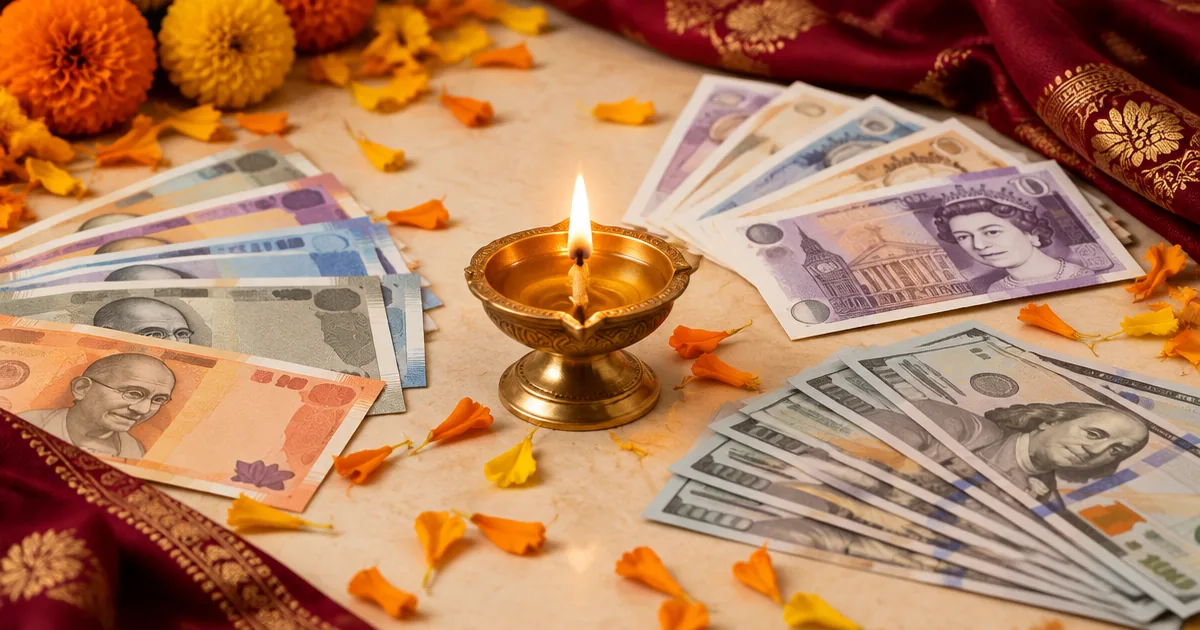
If you run a Puja outside India and someone offers to handle your advertising sales, the first question worth asking is not what they charge. It is what exactly happens to the money, and when.
This page answers that with real numbers from the live system, not an illustration.
The short version
- You list in your own currency
- An advertiser books and pays in that currency
- Indian GST and TCS are computed on the rupee value, at a published exchange rate printed on the invoice
- Your payout is released after KYC approval and installation proof approval
- Verified committees with approved KYC can apply for an advance of up to 50% of confirmed bookings, subject to approval and a per-committee limit
Now the detail.
Currencies you can list in
GBP, USD, EUR, CAD, AUD, SGD, AED, MYR, NPR, BDT and INR.
You set your price in the currency you actually spend in. The advertiser sees that price, in that currency, and pays it. Nobody has to convert anything in their head.
A complete worked example — a GBP 1,000 slot, paid online
Here is every line, exactly as the system computes it today.
| Line | Amount | Who pays it | |---|---|---| | Slot price | £1,000.00 | set by you | | Advertiser platform fee (5%) | £50.00 | advertiser | | GST on that fee (18%) | £9.00 | advertiser | | GST on the slot (18%) | £180.00 | advertiser | | TCS (1%) | £10.00 | advertiser | | Payment gateway (3.54% all-in) | £44.21 | advertiser | | Advertiser pays | £1,293.21 | |
And on your side:
| Line | Amount | |---|---| | Slot price | £1,000.00 | | Committee fee (9% overseas) | −£90.00 | | GST on that fee | −£16.20 | | You receive | £893.80 |
You keep 89.4% of your listed price.
That is the whole arithmetic. There is no separate charge for printing coordination, no listing fee, no annual fee, and nothing deducted at the far end that you were not shown at the near end.
The same slot paid by bank transfer
The gateway fee exists because a card network charges it. Take the card out and it disappears:
Advertiser pays £1,249.00 instead of £1,293.21. Your payout is unchanged at £893.80.
If a sponsor is booking a large slot, tell them this. Saving £44 on a £1,000 booking is real money and it costs you nothing.
Why Indian tax appears on a British invoice
Because PujaSathi is an Indian company. GST and TCS are Indian taxes we are required to collect and remit, and they are computed on the rupee value of the transaction.
The order of operations matters and we get it right. The base amount is converted to rupees first, then taxed. Taxing in pounds and converting afterwards produces a slightly different — and incorrect — figure. On a £1,000 slot the difference is small; on a £20,000 title sponsorship it is not.
The exchange rate
The rate is not typed in by anyone here.
- Source: European Central Bank daily reference rates
- Refreshed: automatically, every hour
- Printed on the invoice: the rate used and the date it was published
So when your treasurer reconciles the account in November, the number is checkable against a public source.
If no rate is available, the system does not guess. The booking is blocked rather than priced at an invented rate. This has happened, and it is deliberate.
When the money actually moves
Four gates, in order. None can be skipped, and none is discretionary.
Gate 1 — Committee verification
Your committee is checked before it appears publicly. Unverified committees are invisible to advertisers.
This is not bureaucracy for its own sake. An advertiser in Mumbai funding a Puja in Melbourne has no way to know you exist, let alone that you are real. Verification is what makes the listing worth anything.
Gate 2 — KYC and bank details
Identity, and the bank account the payout should reach.
This is the most common cause of delay, and it is entirely avoidable. Committees complete verification, list slots, take bookings, and then discover in October that no bank account is on file. Do it in July.
Gate 3 — Payment received
The advertiser's money must have cleared. Funds are held until the final gate.
Gate 4 — Installation proof approved
Before the payout is released, you upload:
- Three to seven photographs of the installed advertising, from different angles
- One short video of it in place
- A short note describing what was installed and where
Location is captured where the device allows it. If you are inside a covered hall with no signal, that is fine — it does not block the submission.
The advertiser reviews it. If they do not respond within five days, it is approved automatically, so an inattentive sponsor cannot leave you unpaid indefinitely.
And then the payout
Once all four gates are cleared, the payout is released to the bank account on file, in your currency.
The advance
Verified committees with approved KYC can apply for an advance of up to 50% of confirmed bookings, subject to approval and a per-committee limit.
Being straight about what this is: it is an application with an approval step and a cap, not an automatic entitlement that switches on when KYC clears. An advance is also recoverable if the festival does not take place.
Why it exists: your costs land months before your festival. Venue deposits, idol advances, printing. A booking confirmed in July that only pays out in November does not help you sign a hall contract in August. The advance is designed for exactly that gap.
What you are responsible for
State this to your committee clearly, because it decides how you price:
The price you set must cover printing, installation, upkeep for the whole festival, and removal afterwards. PujaSathi does not print and does not install. The advertiser supplies artwork only.
If your printing cost for a backdrop is £120 and you list it at £300, your revenue is £180 minus the platform fee — not £300.
This is not a hidden condition. It is the deal every festival committee has always operated under, written down.
Common mistakes, and what they cost
Converting Indian rates. A slot that sells for ₹10,000 in Kolkata is not £95 in Manchester. Your hall, your printer and your insurer all charge UK prices. Price from your costs upward.
Listing without photographs. Listings with photographs of last year's crowd get booked first. Every market, no exceptions. A brand that has never heard of your association has nothing else to judge you on.
Vague slot descriptions. "Banner — £200" is not a product. "8ft × 3ft vinyl banner, left of the main entrance, in place all four days" is. Incomplete listings are rejected by the system before they go live, and that is on purpose.
Leaving KYC to September. See Gate 2.
Photographing the installation badly. One dark photograph taken at an angle is not proof. Three to seven clear shots and a short video take four minutes and are the last thing standing between you and your money.
Ready to list? Register your committee and price in your own currency.
Questions about a specific currency or country? Every listing shows the full fee breakdown before you publish it — nothing is revealed only at payout.