Durga Puja Abroad: The Complete Sponsorship Guide for Overseas Committees
Running a Puja in London, Toronto, Sydney or Dubai? Here is what you can actually sell to sponsors, what to charge in your own currency, and how the money reaches your committee account.
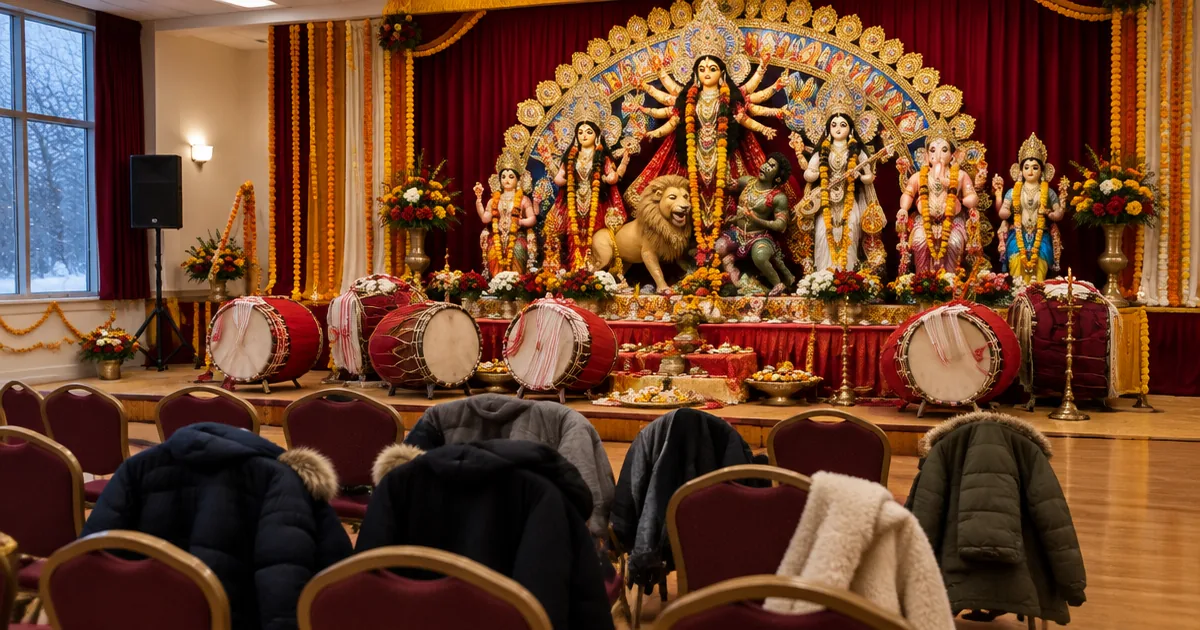
Every year, a few hundred committees outside India put on a Durga Puja that would not embarrass Kolkata. A hired hall in Wembley. A community centre in Edison, New Jersey. A temple ground in Toronto, a school gym in Melbourne, a banquet hall in Dubai.
And almost all of them fund it the same way: someone's uncle knows a restaurant owner, someone's colleague runs a travel agency, and a WhatsApp group does the rest.
That works. It also caps you at whoever your committee already knows.
This page is about the other option — selling advertising space properly, the way committees in India have done for decades, and getting paid in your own currency.
Why overseas Pujas are undersold
An overseas Durga Puja is, in advertising terms, an unusually good product that nobody has bothered to package.
Consider what you actually have for four days:
- A concentrated, self-selected audience. Several hundred to several thousand people who are Indian, largely Bengali, mostly families, with above-average household income in a high-income country.
- Dwell time that digital cannot buy. People do not visit a pandal for ninety seconds. They come, eat, sit, watch the cultural programme, queue for pushpanjali, and come back the next evening.
- Positive context. Nobody is irritated at your banner. They are in a good mood, with their families, at an event they chose to attend.
- Repeat exposure. The same people return across four or five days.
A brand trying to reach that same audience through Meta or Google is paying to interrupt them, one at a time, on a phone, with the sound off.
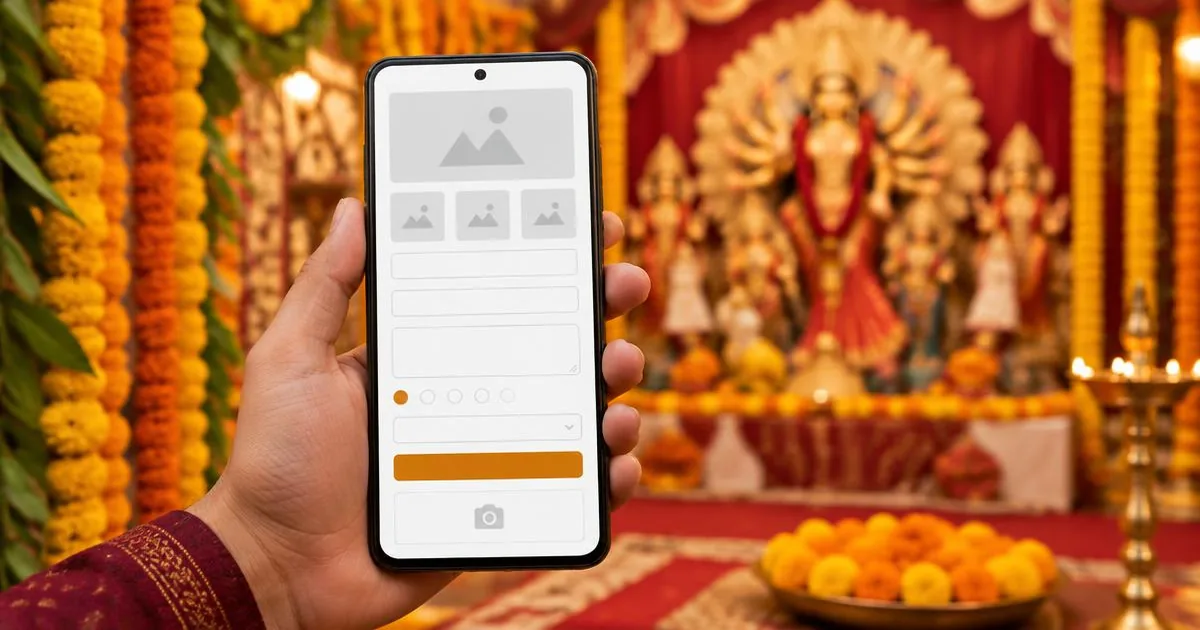
The reason overseas Pujas are undersold is not that the audience is weak. It is that there has never been an easy way for a business to find you, see what you are selling, and pay you.
Who buys advertising at an overseas Puja
This is the part most committees get wrong. They approach the same three Indian restaurants every year and stop there.
The actual buyer list is much wider, because your audience is valuable to a specific and well-funded set of businesses:
Money transfer and remittance. Wise, Remitly, Western Union and the rest compete hard for exactly this customer, and festival season is when remittance volume peaks. Their marketing budgets are not small.
Airlines and travel agents. Everyone in that hall is thinking about flying home. Some already have tickets. Several are about to book.
Indian real estate developers. Flats in Kolkata, Bangalore and Pune are sold to NRIs at events exactly like yours. A developer will fund a stall for the chance to talk to two hundred qualified buyers.
Jewellery. Gold buying peaks around the festivals. Any jeweller with a branch in your city — or one in India selling to NRIs — knows this.
Education and immigration consultants. Student visas, PR applications, university admissions. Diaspora families, gathered, for three hours.
Indian grocery chains and FMCG importers. Your audience is their entire customer base.
Telecom and international calling. Matrimonial services. Insurance brokers who specialise in NRI policies. Tax advisers who handle Indian income.
None of these are long shots. They are businesses whose customer definition is the list of people standing in your pandal.
What you can sell
You do not need to invent anything. The formats that work in India work abroad, scaled to your venue:
Title sponsorship. Your Puja's name alongside theirs, on the banner, in the programme, announced from the stage. This is the biggest single line item and usually goes to one buyer.
Gate or entrance branding. The first thing everyone photographs. In a hired hall this is the entrance arch or the foyer backdrop.
Stage backdrop. Behind the cultural programme, in every photograph anyone takes of the performances, for four days.
Banners and standees. Around the hall, in the queue, near the food stalls.
Stalls. Food, clothing, jewellery, services. Often your second-largest revenue line after title sponsorship, and it doubles as an attraction.
Programme booklet. The souvenir. Full page, half page, back cover. Cheap to produce, and people keep it.
Prasad packet or entry-pass branding. A logo on something every single attendee physically holds.
Stage announcements. Between items, in the compere's script.
Digital screens, if your venue has them.
Pricing in your own currency
Here is where overseas committees most often lose money: they convert Indian rates into their own currency and quote that.
Do not do this. Your costs are local. Your audience's incomes are local. A hall in Birmingham costs what a hall in Birmingham costs, not what a pandal costs in Howrah.
Price against your own market, using the same logic committees use in India:
- Start from your costs. Venue, decoration, idol, priest, food, sound, licensing, insurance. Know your total before you price anything.
- Count your footfall honestly. Not the number on your WhatsApp group. The number of people who actually walk in. If you have not counted, count this year.
- Price per unit, not per lot. A banner is priced as one banner. If you have six, that is six units at that price — not the total divided up.
- Your price must cover the physical work. Printing, mounting, taking it down. If you quote £200 for a banner and printing costs you £60, you earned £140, not £200.
On PujaSathi you list in your own currency — pounds, dollars, Canadian dollars, Australian dollars, euros, dirhams, Singapore dollars, ringgit. The advertiser sees the price in that currency and pays in it.
How the money actually reaches you
This is the question every overseas committee asks first, and fairly.
You list in your currency. An advertiser books and pays in it. There is no conversion for them to puzzle over and none for you.
Indian GST and TCS are calculated on the rupee value, because PujaSathi is an Indian company and remits Indian tax. The exchange rate used, and the date it was published, are printed on the invoice. The rate comes from European Central Bank daily reference data, refreshed automatically — not a number somebody typed in.
Your payout is released after two things: your KYC is approved, and your installation proof is accepted. Which brings us to the part that protects you as much as the advertiser.
Proof — and why it is in your interest
Before a payout is released, the committee uploads proof that the advertising actually went up: three to seven photographs from different angles, a short video, and a line describing what was installed and where. Location is captured when the device allows it.
Committees sometimes read this as distrust. It is the opposite.
An advertiser in London who has never met you, funding a Puja they may not attend, is taking a leap. Photographic proof is what makes that leap reasonable — and it is what makes them book again next year without a phone call.
It is also your protection. When a sponsor asks in November whether their banner was really up, you have seven photographs and a video, time-stamped, rather than a memory.
Where PujaSathi now operates
Listings are open for committees in the United Kingdom, United States, Canada, Australia, New Zealand, Singapore, Malaysia, the United Arab Emirates, Germany, the Netherlands, Nepal, Sri Lanka, Bangladesh, Indonesia, Mauritius, Fiji, Trinidad and Tobago, and South Africa.
That list is deliberate. It covers both the recent diaspora — the UK, North America, Australia, the Gulf — and the much older one. There have been Indian communities in Mauritius, Fiji, Trinidad and South Africa for well over a century, several of them running Pujas older than most in the cities people think of first.
Getting listed
- Register your committee and complete verification. Unverified committees stay hidden — this is what makes the platform worth anything to advertisers.
- Submit KYC. Identity and the bank account the payout should reach. Nothing is released without it.
- Create your festival — dates, venue, expected footfall, photographs from last year. Listings with photographs get booked first, every time.
- List your slots. Exact size in feet, the precise position, how long it stays up, and a price that covers your printing and installation.
- Verified committees with approved KYC can apply for an advance of up to 50% of confirmed bookings, subject to approval and a per-committee limit. The balance follows once installation proof is accepted. For a committee paying a venue deposit in August for an October Puja, that timing matters.
One honest caution
Listing does not make sponsors appear. It makes you findable and payable, which are the two things the WhatsApp method cannot do.
The committees that do well are the ones who list early, photograph properly, describe exactly what they are selling, and price it against their own market rather than a converted Indian rate.
The ones who list three slots in September with no photographs and no sizes tend to sell nothing — abroad exactly as in India.
Running a Puja outside India? List your festival on PujaSathi and price it in your own currency.
Looking to reach the Indian diaspora? Browse overseas festivals and book on-ground space directly.