Sponsoring Your Para's Puja From Abroad: A Practical Guide
You live in Toronto. The Puja you grew up with is in Behala. You want to sponsor it, but sending money to a committee WhatsApp group is not a plan. Here is how to do it properly.
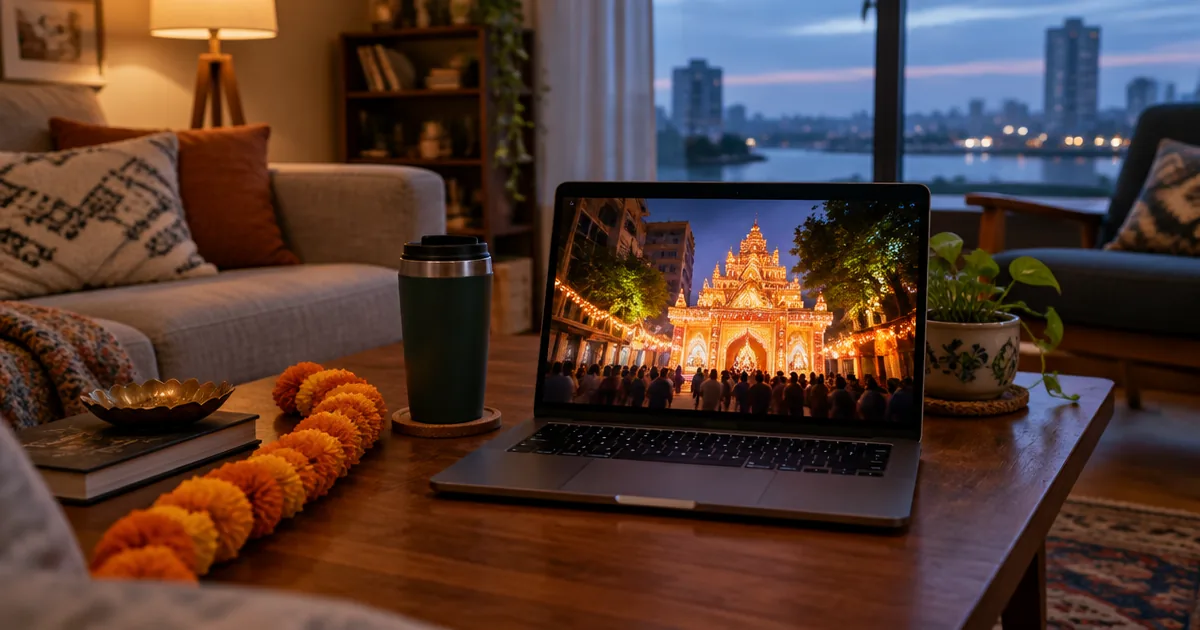
Every year, in October, the photographs start arriving. The pandal going up. The idol arriving. The para in the middle of the thing you grew up inside.
And every year some version of the same thought: I should send something.
Usually it stops there, or it becomes an awkward transfer to an uncle's account with no receipt and no idea what happened to it. Not because anyone is dishonest — because there has never been a sensible way to do it.
This is about the sensible way, and about the version of it that is better than a donation.
Donating versus sponsoring
Two quite different things, and it is worth being clear which you want.
A donation is money to the committee. It funds the Puja. It is anonymous unless someone reads your name out, and there is nothing to show for it.
A sponsorship buys something specific — a banner, a gate, a page in the souvenir book, a stall — and it comes with a name on it, a defined position, and photographic proof.
Both are legitimate. But sponsorship has three advantages that people abroad consistently underestimate:
It is visible to the people you want to see it. Your parents. Your school friends. The neighbours who watched you grow up. Your name on the gate of your para's Puja is read by several thousand people who actually know who you are.
It is verifiable. You get photographs of the thing you paid for, in place, at the venue. A donation gives you a thank-you message.
It can be a business expense. If you run a business, sponsorship is advertising — with an invoice showing GST. A donation is not.
Why it has been so hard
The obstacles are entirely practical and every one of them is familiar:
Finding the committee. Your para's Puja has no website. It has a Facebook page updated twice a year and a WhatsApp group you are not in.
Agreeing a price. Nobody wants to negotiate money with people who knew them as a child. The conversation is uncomfortable in both directions.
Sending the money. International transfer to a committee's account, which may be in the treasurer's name, with a purpose code nobody is sure about.
Knowing what happened. Did the banner go up? Where? What did it say? Did they spell the name right? You will not be there to see.
Showing your family. The main point, and the hardest part to arrange from six thousand miles away.
Doing it through a platform instead
Every one of those problems has the same shape — a missing intermediary. Here is how the process goes when there is one.
1. Find the Puja
Search by city, area or committee name. Listings show the committee, the festival dates, the venue, expected footfall and photographs from last year.
If your para's Puja is not listed yet, send them the link. Committees list free, and most are glad to — it is money they were not going to get otherwise.
2. See exactly what is available
Every slot states its exact dimensions in feet, its precise position, and how long it stays up. Incomplete listings are rejected before they go live, so you are not guessing.
Typical options, with wide price ranges depending on the Puja's size:
- Gate or entrance arch — the highest-visibility slot at most Pujas
- Banners — around the pandal, along the approach
- Stage backdrop — behind the cultural programme
- Souvenir booklet — full page, half page, back cover. Often the cheapest way to get a personal message printed, and people keep them
- Prasad packet branding — every attendee holds one
- Stalls — if you have a business with a presence in the city
- Title sponsorship — for the larger gesture
For a personal, non-commercial sponsorship, a souvenir booklet page or a banner is usually the right size of thing. A title sponsorship is a business decision.
3. Pay in your own currency
Book from Toronto and pay in Canadian dollars. From London, in pounds. From Dubai, in dirhams. From Sydney, in Australian dollars.
No SWIFT form, no purpose code, no transfer to an individual's account.
Every charge is itemised before you pay — slot price, platform fee, GST, TCS, gateway. Bank transfer carries no gateway fee, which on a larger sponsorship is worth choosing.
4. Send your artwork
You supply the artwork only. The committee prints it, installs it, keeps it up for the whole festival and takes it down afterwards — all at their cost, included in the price.
Image, PDF, video, or a Drive link for large print files.
If you are not a designer and just want a name and a line of text, say so. Most committees will set simple text themselves. Keep it short — a name, a family name, a line of dedication. Long text on a banner is unreadable from six feet away.
A note on dedications. A great many of these sponsorships are in memory of a parent or grandparent. Committees handle this with care, and it is one of the more moving things about the whole business. Say clearly what you want written and how the name should be spelt.
5. Get proof
Before the committee is paid, they upload three to seven photographs from different angles and a short video of the advertising in place, with location captured where possible.
You see them. You approve them.
Which means you get the thing you actually wanted: pictures of your name at your Puja, that you can send to your mother.
What it costs
Prices are set by each committee and vary enormously with the Puja's size and location. Broadly, across Indian listings:
| | Typical from | |---|---| | Souvenir booklet page | a few hundred rupees | | Banner | a few thousand rupees | | Gate or arch branding | five figures | | Stage backdrop | five figures | | Title sponsorship | upward of ₹25,000, and far higher at the large Pujas |
A banner or a booklet page at a neighbourhood Puja is a genuinely small amount of money by the standards of an income earned in pounds, dollars or dirhams. It is frequently less than a single evening out — and it is on a gate that a few thousand people who know your family walk past.
If you run a business
Then this is not sentiment, it is advertising, and it should be treated as such.
You get a proper tax invoice showing GST separately, with the SAC code, issued by an Indian company. For an Indian business that is an input credit; for a foreign one it is a clean documented expense.
The audience is genuinely valuable if you sell anything in that city. A neighbourhood Puja reaches the neighbourhood with a density no other medium matches.
And the local-connection story is real. A business run by someone who grew up in that para, sponsoring that para's Puja, is not a media buy that anyone reads as intrusive.
Practical advice
Book by July or August. Gate and backdrop slots at good Pujas go early. In late September you are choosing from what is left.
Ask your family which Puja. There is often more than one in a neighbourhood, and the one you remember may not be the one your parents attend now.
Keep the text short. A name and one line. Anything more will not be read.
Check the spelling twice. It is printed once.
Choose position over size. A small banner at the entrance beats a large one behind the food stalls.
Consider the booklet as well as the banner. The banner comes down on Dashami. The souvenir stays on a shelf.
Find your para's Puja: browse festivals by city.
Not listed yet? Send your committee this link — listing is free, and they keep the great majority of what they sell.