Festival Advertising for Saree and Ethnic Wear Brands
Puja shopping starts six weeks before the pandal goes up — which is exactly why most ethnic wear brands advertise too late. Here is the timing, the formats, and the mistake that costs the most.
Ethnic wear has a problem that jewellery does not: the buying happens before the festival, not after it.
Jewellery peaks on Dhanteras, two days before Diwali. New clothes are bought weeks earlier, because the whole point is to wear them during the festival. By the time a pandal is standing, the sarees have been bought, ironed and laid out.
Which means the standard festival-advertising instinct — buy the pandal, reach the crowd — is aimed at the wrong moment for this category.
Used correctly it still works extremely well. But the how is different.
Getting the timing right
Roughly how the season runs, working backward from the festival:
| Period | What is happening | |---|---| | Six to eight weeks before | Browsing starts. Collections launch. Comparison begins | | Four to six weeks before | Peak purchase window for the main outfit | | Two to four weeks before | Second wave — additional outfits, children's clothes, gifting | | One to two weeks before | Last-minute buying, tailoring, alterations, accessories | | Festival days | Almost no buying. Pure wearing | | Immediately after | Wedding season begins |
Two implications follow, and both are actionable.
Implication 1: advertise at the previous festival
If you want to reach a Durga Puja buyer at the moment she is deciding, the pandal she is standing in is too late.
But Janmashtami, Ganesh Chaturthi, Rath Yatra and the run of smaller occasions through late summer land squarely inside the browsing window — and are dramatically cheaper, because nobody plans for them.
A banner at a Ganesh Chaturthi celebration reaches the same woman four to six weeks before she buys her Puja saree, at a fraction of what the same visibility costs in October.
Implication 2: the festival itself sells the next purchase
Advertising at the Durga Puja pandal is not wasted. It is simply selling a different thing.
The crowd standing there is, within weeks, buying for:
- Diwali, if they are still shopping
- Kali Puja, Bhai Phota, Bhai Dooj
- Wedding season, which begins immediately after and is the largest single occasion for ethnic wear in the year
- Next year, as a brand impression formed while everyone around them is dressed up
And there is something a pandal offers no other medium can: your customer is standing in a crowd of several thousand people, all wearing the product category, comparing. There is no more receptive environment for a clothing brand anywhere.
What to buy
Stalls — the strongest format for this category
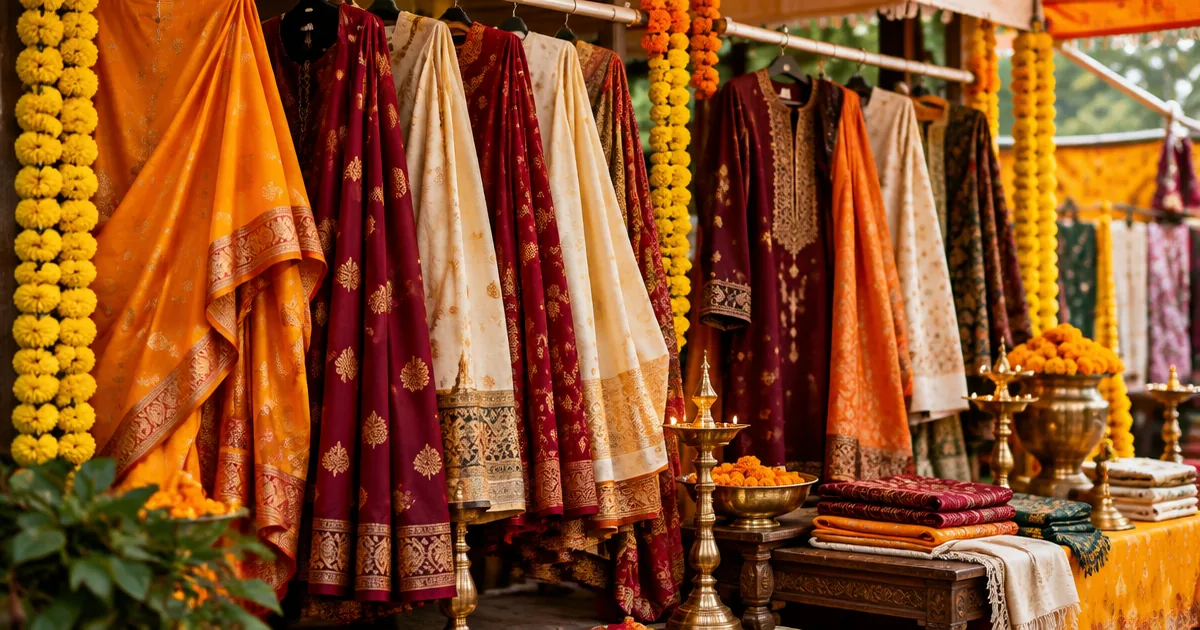
Ethnic wear sells by touch. Fabric, fall, weight, colour under real light. A stall lets people handle it.
Puja stalls also convert unusually well because attendees are in a spending frame of mind, are with the family members whose opinion they want, and have time.
Typical range: ₹2,000 to ₹1,50,000 depending on the Puja's size and the stall's position.
Practical notes. Stock the mid-range, not the flagship pieces — a pandal stall is not the setting for your most expensive work. Bring a mirror. Take payments digitally. Collect contact details for the wedding season that follows.
Stage backdrop
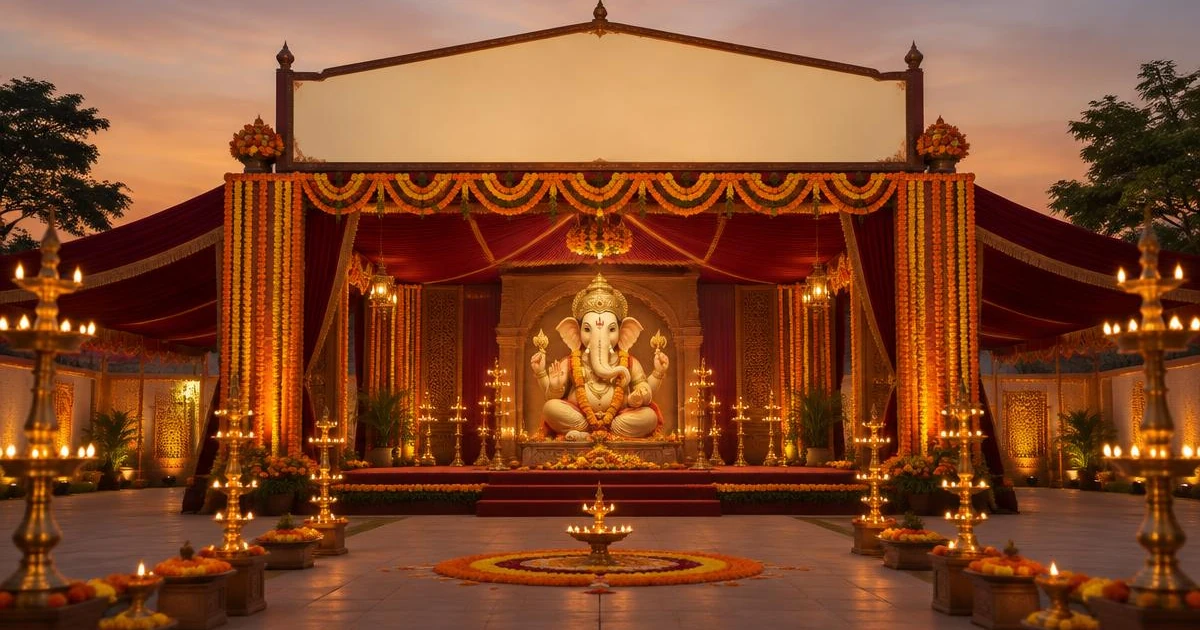
The strongest visibility placement for a clothing brand, for one specific reason: the cultural programme is where people dress up most and photograph each other most. Your backdrop is in every one of those pictures.
Typical range: ₹5,000 to ₹1,20,000.
Gate and entrance branding
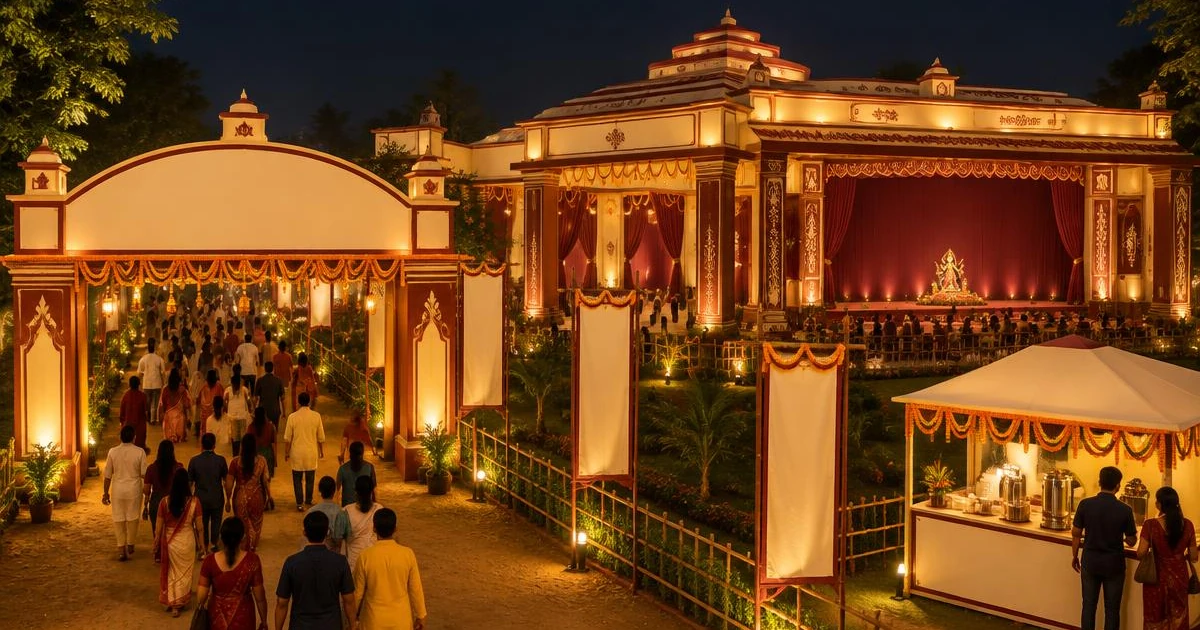
Highest raw visibility at any pandal. Everyone enters through it and most photograph it.
Typical range: ₹5,000 to ₹2,00,000.
Banners along the queue
Stationary audience, real reading time. If your message has more than four words, this is where it belongs.
Typical range: ₹800 to ₹90,000.
Souvenir programme
Well suited to clothing because it can carry photographs at a size and quality a banner cannot, and because it is read at home at leisure rather than glanced at in a crowd.
Digital LED screens
Increasingly common at larger Pujas, and clothing is one of the few categories where motion genuinely helps — drape and movement do not read on a still image.
Typical range: ₹8,000 to ₹2,00,000.
Creative that works
Show the product large. This is a visual category. A banner of a saree beats a banner of a logo, every time.
One garment, not six. A grid of small images reads as noise from ten feet away in a crowd.
Design for evening. Pandal footfall peaks after dark under coloured lighting, which distorts colour badly. Whites go blue, reds go orange. Use high contrast and avoid relying on subtle colour distinctions to carry the image.
Give the location as a landmark, not a street address.
Add urgency if you have it. "New collection in store" is weak. "Puja collection — until Panchami" is a deadline.
Photograph the fabric properly. A badly lit product photograph blown up to eight feet is worse than no image at all. Print reveals everything.
Where to buy
The right answer differs by business type.
Single showroom. Neighbourhood Pujas within realistic walking or short-driving distance. Five to eight of them. Skip the famous city-wide pandal — its crowd is from everywhere, which for you means nowhere.
Regional chain. A mix — gate or stage at the two or three biggest Pujas in each city for the brand, plus banners and stalls at neighbourhood Pujas near each store.
Online-only brand. Buy the big pandals. You have no catchment to protect, so raw reach and photograph-ability are what you want. A stage backdrop that appears in thousands of attendee photographs is doing real work for an online label.
Handloom or weaver cooperative. Stalls, without hesitation. The story of the fabric needs a person to tell it, and the Puja crowd is unusually receptive to that story at that moment.
Budget structure
For a single showroom:
| | Share | |---|---| | Stalls at two to three local Pujas | ~45% | | Banners and gate at five to eight neighbourhood Pujas | ~35% | | Souvenir pages | ~10% | | Late-opportunity reserve | ~10% |
And a genuine recommendation most brands ignore: move 20% of that budget to the pre-season occasions in August and September. The rates are a fraction of October's, and they land inside the actual buying window.
Overseas
Diaspora Pujas are, if anything, a stronger fit for ethnic wear than Indian ones.
People abroad dress up more for these events, not less — it is one of the few occasions in the year when they do. Access to good ethnic wear is limited and expensive locally. And attendees have both spending power and a real appetite for buying.
A clothing stall at a diaspora Puja in the UK, USA, Canada, Australia, Singapore or the UAE frequently outperforms an equivalent stall in India on revenue per day, because the alternatives available to those buyers are so much worse.
Committees abroad list in their own currency — pounds, dollars, dirhams, Singapore dollars.
Measuring it
A unique code per location, printed on the banner. It undercounts; use it comparatively rather than absolutely.
Ask at the till for three weeks after. Recorded consistently, this beats most dashboards.
Track footfall in the fortnight after against a comparable non-advertised period.
Count stall leads properly. Names and numbers collected at a Puja stall in October are your wedding-season list in November. That is where the return usually sits, and most brands never measure it because they never collect it.
Plan your season: browse festivals by city, footfall and budget — exact dimensions, position and duration on every listing.