Festival Advertising for Restaurants and Cloud Kitchens
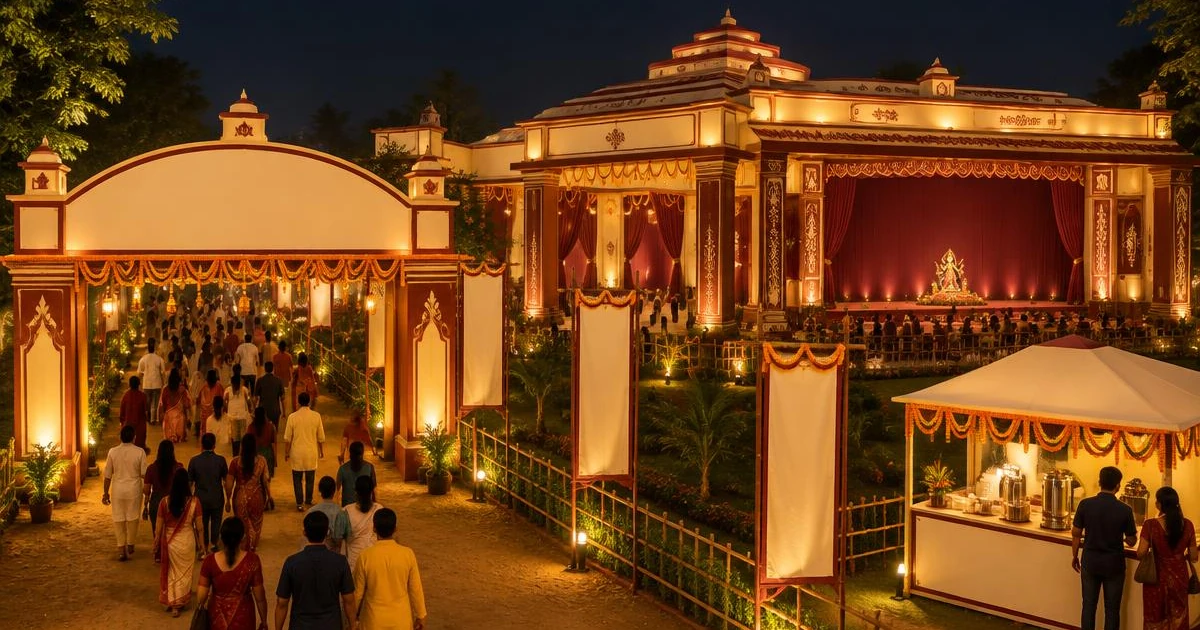
Puja week is when a city eats out more than any other week of the year — and when aggregator commissions hurt most. A banner outside the pandal down the road is the cheapest table-filler you can buy.
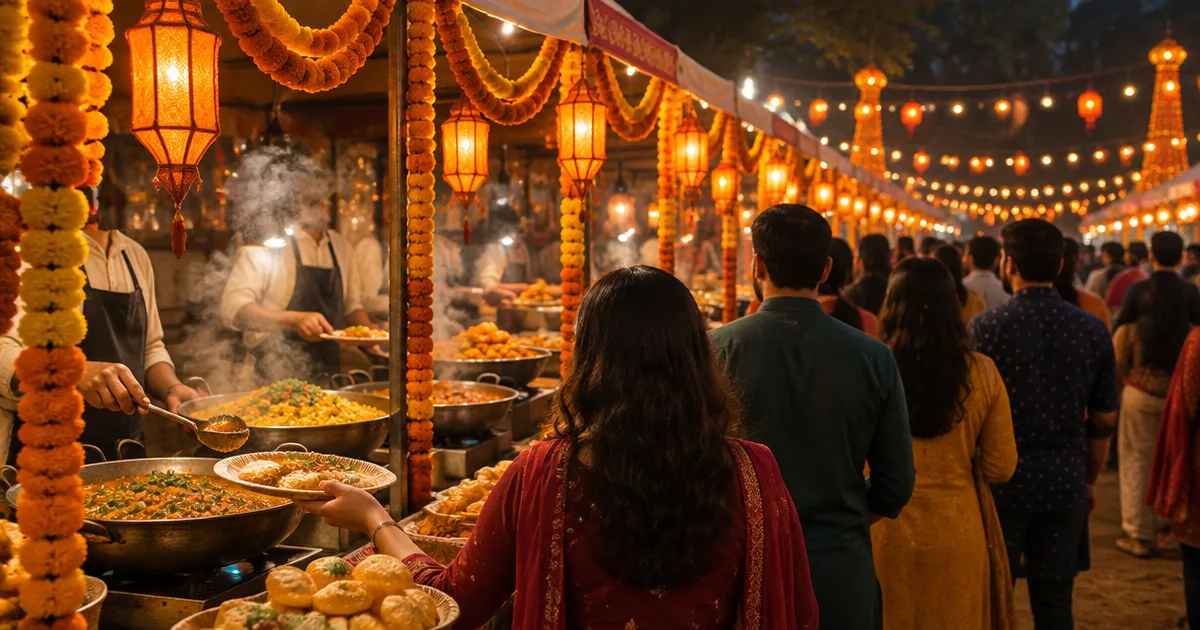
Durga Puja week is, for most eastern Indian cities and a good many others, the heaviest eating-out week of the year.
Families are out of the house from afternoon until past midnight. Nobody is cooking. Pandal-hopping runs for hours and produces continuous hunger. Restaurants near major pandals routinely run at capacity for four straight days, and delivery volumes spike across the whole city.
For a restaurant, this is the one week where demand is not the problem. Getting your share of it is.
What makes this different from every other category
Most festival advertising is about awareness — planting a name for a purchase weeks later.
Restaurant advertising at a pandal is not that. It is same-hour conversion. A hungry family standing three hundred metres from your door, deciding right now where to eat. There is almost no lag between the impression and the transaction.
That changes everything about how you buy and what you say.
The distance rule
Be ruthless about this: buy only pandals you can walk from.
The single strongest predictor of whether a pandal banner fills your tables is how far your restaurant is from the pandal. A crowd standing at a Puja two kilometres away is not coming to you — there are twenty options closer to them.
A practical hierarchy:
| Distance from pandal | Worth buying? | |---|---| | Under 500m | Yes, aggressively | | 500m – 1km | Yes | | 1km – 2km | Only for delivery messaging | | Over 2km | No, unless it is a destination restaurant |
For a cloud kitchen the rule inverts — you have no walk-in trade, so what matters is the delivery radius, not walking distance. Buy pandals across your entire serviceable area.
What to buy
Banners near the exit and the queue
The best restaurant placement at any pandal, and it is cheap.
People leaving a pandal are hungry and deciding. People standing in a darshan queue are bored and reading. Both are ideal moments for a food message.
Typical range: ₹800 to ₹90,000 for flex banners, pillars, barricades and signage.
Ask specifically for exit-side placement. It is worth more to you than the entrance, and committees rarely price it differently.
A food stall
If your food travels well and you can staff it, a stall at the Puja itself is direct revenue, not just advertising.
Typical range: ₹2,000 to ₹1,50,000.
Be realistic about operations: serving a pandal crowd for four days needs staff you can spare, a limited menu, and equipment you can run in a tent. Most restaurants that try this the first time over-menu and under-staff.
A limited menu of three or four items you can produce fast is the whole trick. Rolls, biryani, chowmein, sweets, tea — items that queue well and travel three steps.
Note that many committees run their own food stalls as a revenue line and may restrict competing categories. Ask before you plan.
Prasad packet and entry-pass branding
Every single attendee physically holds it, and they hold it while thinking about food.
Typical range: ₹2,500 to ₹1,50,000.
For a restaurant this is one of the most efficient formats available — a coupon or a QR code on something everyone takes home.
Gate branding
Highest visibility, and it works for a restaurant if you are close enough.
Typical range: ₹5,000 to ₹2,00,000.
Digital LED screens
Food is the category where motion helps most. A ten-second loop of the food being made will stop people from further away than any still image.
Typical range: ₹8,000 to ₹2,00,000.
Souvenir programme
Cheaper and longer-lived. Put a discount coupon on the page — the booklet stays in the house for months, and a coupon extends the value well past Dashami.
Creative that converts
This is a same-hour decision, so write like it.
Distance, in a number. "200m from here." "Behind the pandal." "Next to [landmark]." This is the single most important thing on the banner and it should be the largest text after your name.
One dish, photographed well and printed large. Not a menu. Not five dishes. One.
A price. "Biryani ₹180." Specific numbers stop people, and price certainty removes the main reason a family hesitates.
An offer with a boundary. "20% off till Dashami" or "Show this pandal, get a free gulab jamun."
A QR code for delivery, if you deliver. People will scan it while standing there.
Design for night and for crowds. Pandal footfall peaks after dark under coloured lighting. High contrast, heavy type, no thin fonts, no subtle colour work.
For cloud kitchens specifically
You have no signage, no walk-in trade and no location advantage. The pandal is one of the few places where you can be physically present in a neighbourhood you only otherwise reach through an app.
Three things to do differently:
1. Push the QR code hard. Your entire conversion is a scan. Make it large, put it at eye level, and make sure it goes to a direct order page — not your homepage.
2. Use a code that bypasses the aggregator. Puja week is when aggregator commission hurts most, because volume is at its peak. A pandal banner with a direct-order discount code is the cheapest customer acquisition available to you all year, and every one of those orders keeps the commission.
3. Buy across the whole delivery radius, not just the nearest pandal. Your constraint is delivery time, not walking distance.
Budget structure
For a single restaurant:
| | Share | |---|---| | Banners at three to five pandals within 1km | ~50% | | Prasad packet or entry-pass branding at the busiest one | ~25% | | Souvenir pages with a coupon | ~10% | | Reserve for last-minute placement | ~15% |
Keep a reserve deliberately. Restaurant advertising is the one category where a late buy still works — a banner going up two days before the festival will still fill tables, because the decision it influences happens on the day.
Operational reality
More restaurants lose money on Puja week by being unprepared than by underadvertising.
Staff for it. Four days at capacity needs more hands, and everyone else wants the days off too. Sort this in August.
Cut the menu. A shortened festival menu that your kitchen can execute at volume beats a full menu executed badly. Customers in a hurry, in a crowd, tolerate a short menu perfectly well.
Take payments fast. Queue time at the counter is where the crowd is lost.
Extend your hours. Pandal traffic runs late — often well past midnight. A kitchen that closes at eleven during Puja week is leaving the best hours unserved.
Measuring it
A unique coupon code per pandal. Redemption tells you exactly which locations produce. This is the rare festival placement where attribution is actually clean.
Count covers for the fortnight against a comparable normal period.
Direct-order share. For a cloud kitchen, the proportion of orders that came direct rather than through an aggregator during the week is the number that matters, and the one that pays for the whole exercise.
Keep the proof. Every booking comes with three to seven photographs and a video of your banner actually installed, with location — which also tells you whether it went up somewhere people walked past, and therefore whether to buy that pandal again.
Plan your season: browse festivals by city and area — exact dimensions, position and duration on every listing.