Festival Advertising for Real Estate Developers
Property launches cluster around the festivals for a reason. A pandal three kilometres from your site puts you in front of the exact catchment you need — at a fraction of what a hoarding costs.
Real estate has an unusual relationship with the festival season. Launches cluster around it, inventory is pushed hard through it, and a large share of the year''s bookings are signed in the weeks between Navratri and the end of the year.
Part of that is auspiciousness — buying property during the festivals is considered favourable, and many families genuinely wait for it. Part is practical: bonuses land, families gather, and the decision that has been circling all year finally gets made in a room with everyone present.
For a developer, that makes autumn the densest decision-making window of the year. And a pandal is one of the few places where you can reach a specific geographic catchment of families, together, with time to talk.
Why geography is the whole argument
Most advertising a developer buys is aimed at a city. Newspapers, radio, digital, even most hoardings — they reach a metro area and you pay for all of it.
But property demand is intensely local. The people most likely to buy in your project are people who already live within a few kilometres of it, or who have family there. They know the roads, the schools, the market, the commute. Someone across the city does not.
A neighbourhood Puja is the most precisely geographic advertising medium available. The crowd at a para pandal is that para — the exact catchment you would pay a digital platform a great deal of money to approximate badly.
Buy the Pujas around your site. Not the famous one across the city.
The two products you are actually selling
Be clear which one a given placement is for, because they need different treatment.
Visibility — the project exists
A gate, a banner, a stage backdrop. This tells several thousand local families that a project is coming up nearby, and it plants the name.
Cheap, broad, and it does real work. Most property purchases begin with a vague awareness that something is being built, not with a search.
Conversation — the site visit
A stall. This is where a developer actually earns from festival advertising.
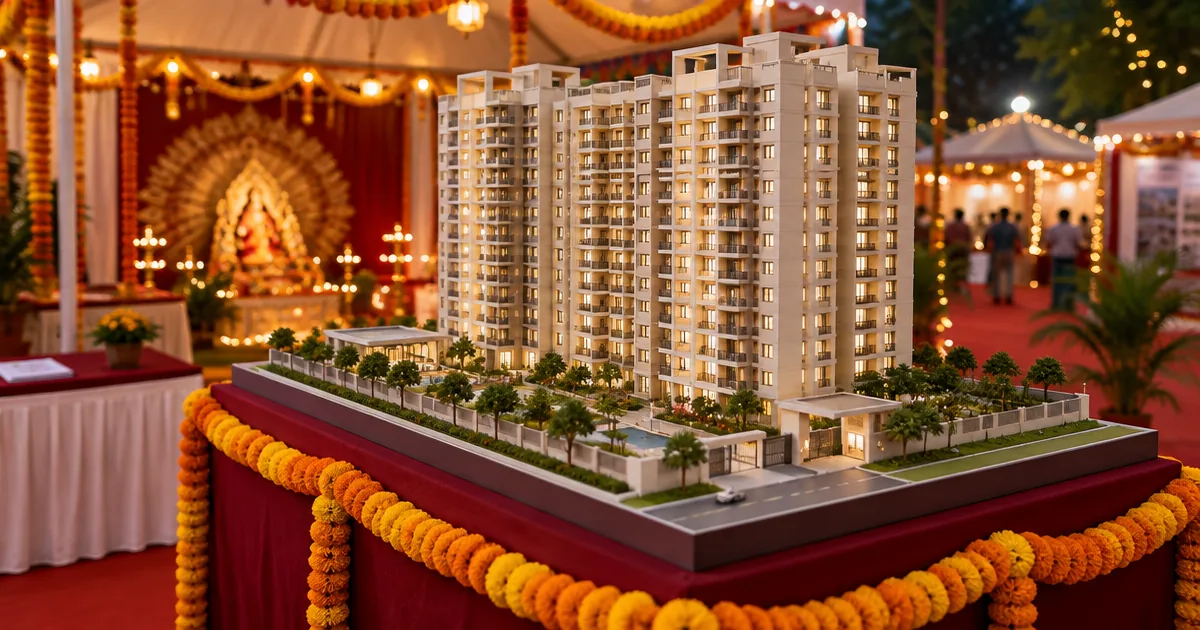
A staffed counter with a site plan, a model or a screen, and someone who can answer questions, will collect genuine site-visit appointments over four days. Not leads — appointments, from people who live three kilometres away and are attending with the family members who have to agree.
That is a materially better lead than anything a portal sells you, and usually cheaper.
What to buy, and what it costs
Stall — ₹2,000 to ₹1,50,000 depending on the Puja and the position. The highest-value format for property, without much competition.
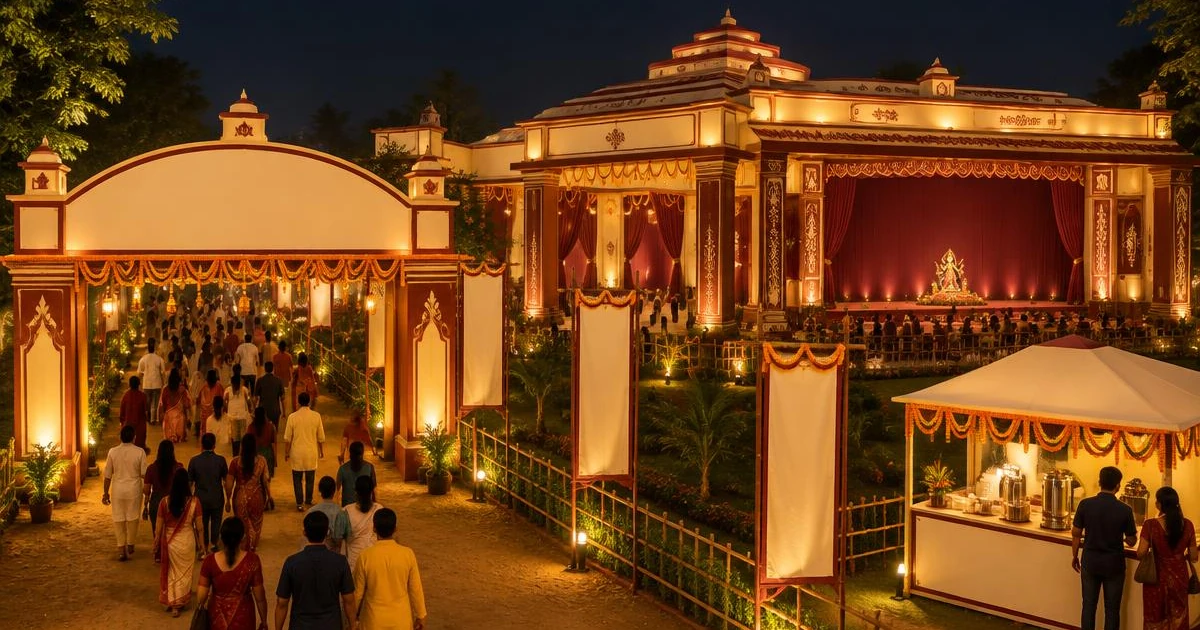
Gate or entrance arch — ₹5,000 to ₹2,00,000. Highest visibility placement at any pandal.
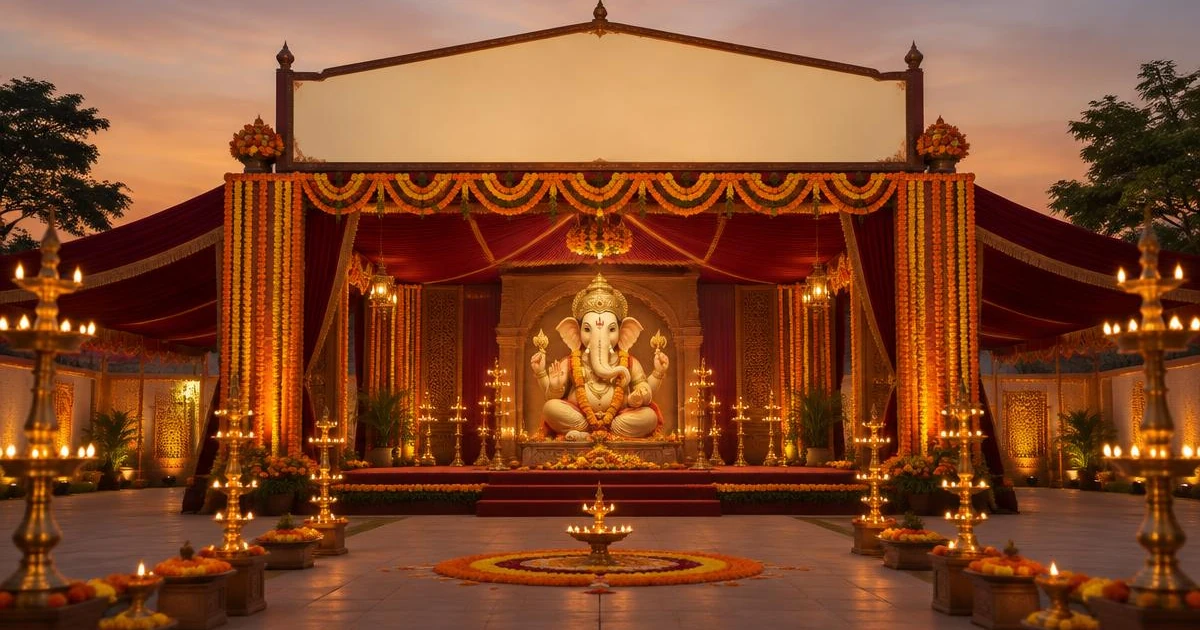
Stage backdrop — ₹5,000 to ₹1,20,000. In every photograph of the cultural programme for the whole festival.
Digital LED screens — ₹8,000 to ₹2,00,000. Good for property because a walkthrough or a drone shot of the site is far more persuasive than a still image.
Banners along the queue — ₹800 to ₹90,000. Stationary audience with real reading time. If you need to say more than five words, say it here.
Souvenir programme. Cheap, kept for years, and the one format where floor plans, specifications and payment terms can be presented at readable size.
Title sponsorship — ₹25,000 upward, reaching ₹20,00,000 at the largest Pujas. Worth considering when the pandal is genuinely in your catchment and you want the association to be permanent. A developer who sponsors the local Puja for five consecutive years becomes part of the neighbourhood in a way no campaign buys.
Running the stall properly
This is where the money is made or wasted, so be specific about it.
Staff it with people who can close a site visit, not brochure distributors. One senior person plus one junior beats three juniors.
Bring something physical. A scale model, or at minimum a large printed site plan. People stop for a model. They walk past a table of brochures.
Have a screen with a walkthrough running on loop. It stops people from a distance.
Offer the site visit for the same weekend. Your site is nearby, the family is together and free, and momentum matters enormously in property. "Come tomorrow morning, we''ll send a car" converts far better than "we''ll call you next week."
Collect properly. Name, number, current locality, budget band, timeline. A festival stall can produce a few hundred conversations over four days; without a structured capture, you keep none of them.
Do not oversell into a crowd. People came for the Puja. A polite, informative presence works. A hard sell in that setting is remembered badly, and in a neighbourhood you intend to sell into for the next three years, that matters.
Creative
Lead with the location, not the brand. "3 minutes from [landmark]" is worth more than your logo. People navigate and evaluate by landmarks.
One number. A starting price, a configuration, or a possession date. Not all three.
Show the building, large. Property is visual and aspirational.
Design for night. Pandal footfall peaks after dark under coloured lighting. High contrast, heavy type, no fine detail.
Add the RERA number where required, at legible size. This is not optional and it should not be shrunk to nothing.
The NRI angle — often the largest single opportunity
A very substantial share of Indian premium residential sales goes to non-resident buyers. Developers already know this, which is why they run expensive hotel roadshows in Dubai, London and New Jersey that draw modest attendance at high cost.
A diaspora Durga Puja gathers several thousand affluent Indian families in one hall, voluntarily, for a full weekend. They came for the festival, they are in a good mood, they are with the family members who decide, and their ties to India are exactly what your product depends on.
The Gulf is the strongest market for this by a distance — Indians are the largest community in the UAE, the remittance corridor is the world''s biggest, and property back home is a near-universal ambition. North America follows, then Britain, Australia and Singapore.
Committees abroad list in their own currency, so a stall at a Dubai Puja is priced in dirhams and paid in dirhams.
Compare the cost of a stall at a large overseas Puja against a hotel ballroom roadshow with paid registration and imported staff. The arithmetic is not close.
Measuring it
Count site visits, not impressions. A festival stall''s output is appointments. Track how many were booked, how many turned up, and how many progressed.
A dedicated phone number per pandal. Cheap, and it tells you which locations produce.
Ask at the site office where the visitor first heard of the project, and record it consistently for two months.
Keep the installation proof. Every booking comes with three to seven photographs and a video of your branding actually in place, with location. Beyond verification, it is how you decide next year which pandals put your gate somewhere people actually walked past.
Plan your season: browse festivals by city, region and footfall — exact dimensions, position and duration on every listing.