Festival Advertising for Hospitals and Diagnostic Centres
Healthcare advertising at a festival has to be done carefully or not at all. Done well — a health camp, not a hoarding — it is the most effective local marketing a hospital can buy.
Healthcare is the one category where the standard festival advertising playbook does not simply transfer.
A jeweller can put a necklace on a banner. A hospital cannot put an illness on one. Medical advertising is regulated, ethically constrained, and — more practically — a pandal is a celebration, and a crowd in a good mood does not want to be reminded of disease.
Get the tone wrong and you are the brand that put cancer statistics next to the idol.
Get it right and a hospital has access to something no other advertiser at that pandal has: a genuine reason to be useful to the people standing there.
The rule: be a service, not an advertisement
Everything below follows from this.
A hospital that buys a banner is competing for attention with a jeweller and a car dealer, and losing, because nobody at a Puja is shopping for surgery.
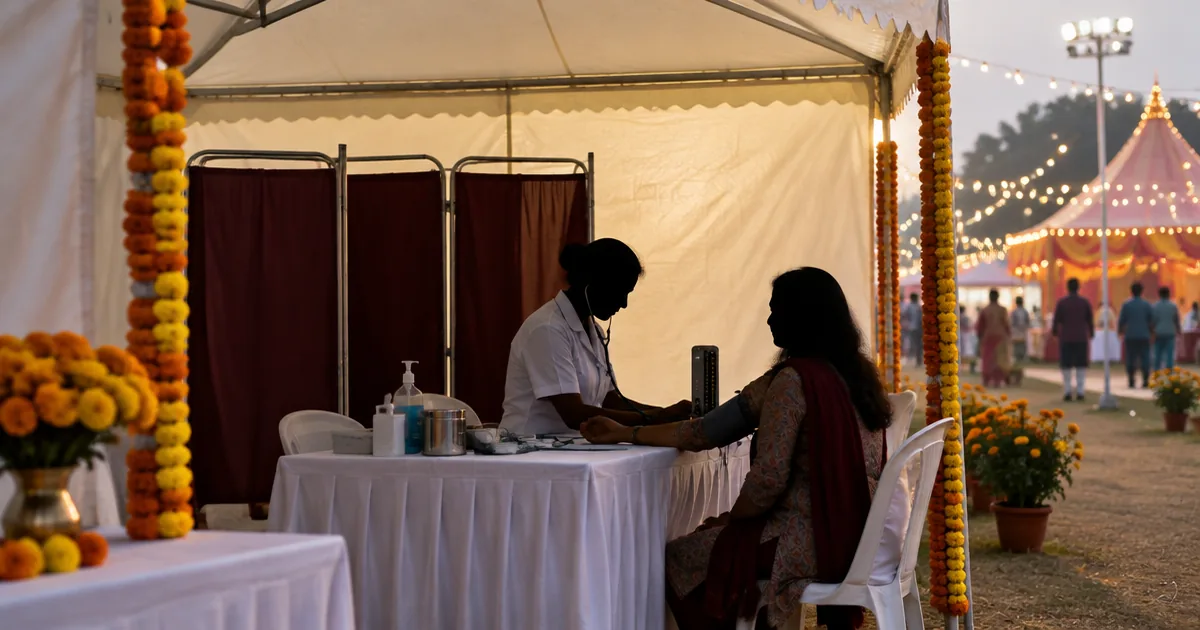
A hospital that runs a free health camp at the pandal is doing something the committee wants, the crowd values, and no other advertiser can offer. It converts better, costs about the same, and is the version that is defensible.
The health camp
This is the format. Everything else is support.
What it looks like in practice: a stall or a small enclosed area with two or three staff offering free checks that take two to five minutes each.
What works at a pandal:
- Blood pressure — fast, universally relevant, and a genuinely useful screen
- Blood sugar — a random glucose check, with obvious relevance given the sweets everyone is eating
- BMI and weight
- Basic eye screening — vision charts, quick, popular
- Bone density screening, where portable
- Consultation slots with a general physician, booked for the following week
What does not work: anything that takes more than five minutes, anything requiring privacy that a pandal cannot provide, and anything that produces a frightening result you cannot immediately follow up on responsibly.
Typical stall cost: ₹2,000 to ₹1,50,000 depending on the Puja and position.
Doing it responsibly
This matters more than the marketing and should be stated plainly.
Have a clinician present. A camp staffed only by marketing personnel is not a health camp.
Handle abnormal findings carefully. If a screening shows something concerning, the person must be told calmly, privately, and with a clear next step — a specific appointment, at a specific place. Handing someone an alarming number in the middle of a festival crowd and walking away is harmful.
Do not diagnose. A screening is a screening. The wording on every result slip should say so.
Get consent and handle data properly. You are collecting health information from members of the public. It is subject to the same duties as any clinical record.
Do not upsell in the moment. A person who has just been told their blood pressure is high is not in a position to make a purchasing decision, and pushing a package at them is indefensible. Give them the finding, give them an appointment, and stop.
Where the return actually comes from
Not from the camp itself. From what follows.
Follow-up appointments. A person screened at the pandal, given a specific appointment for the next week, and reminded once, converts at a rate no advertisement matches.
Health check packages. The most saleable product for a diagnostic centre, and a festival camp is a natural entry point — particularly for the annual check people have been postponing.
Familiarity. Hospitals are chosen partly on comfort. A family that met your doctor at the neighbourhood Puja is materially more likely to come to you in an emergency, and emergency admissions are how most hospital relationships actually begin.
The neighbourhood association. A hospital that runs the camp at the local Puja every year becomes the local hospital in a way advertising cannot achieve.
Supporting placements, and what they cost
Banners along the queue — ₹800 to ₹90,000. If you buy print, buy this. A queue gives people time to read a package list or a department list. Keep the tone informational.
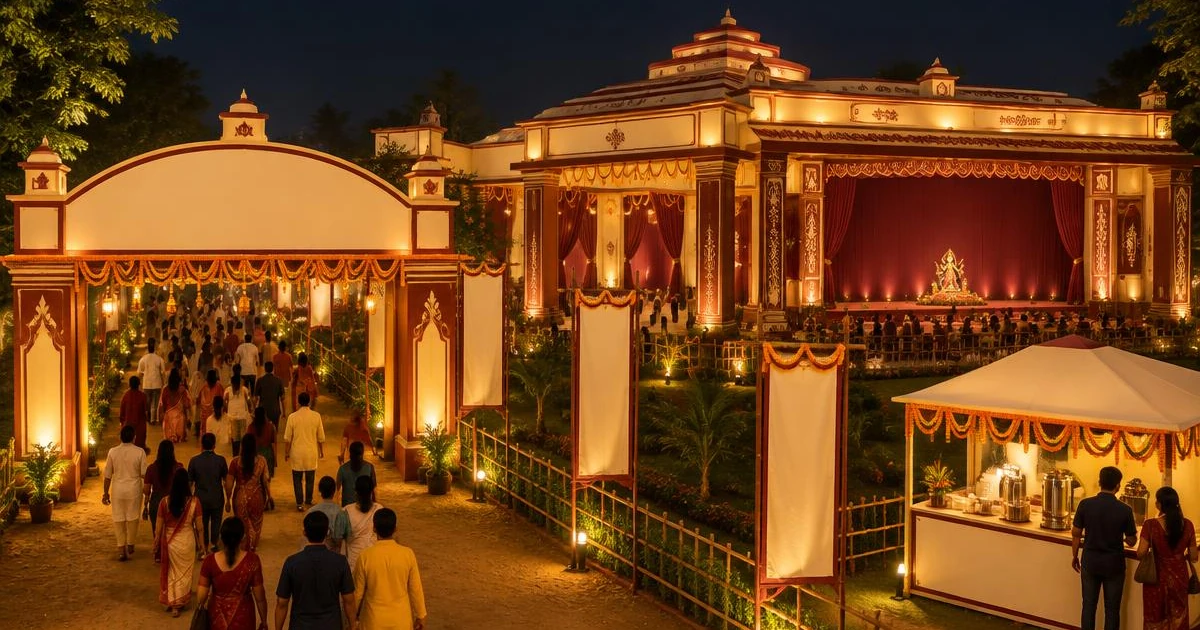
Gate or entrance arch — ₹5,000 to ₹2,00,000. Reputable and visible. A hospital name on a gate reads as institutional stability, which is the attribute you are selling.
Souvenir programme. The best print format for healthcare — read at home, at leisure, in private. Room for a full department list, doctor profiles, package details and helpline numbers. Also the right place for anything you would not want read in a crowd.
Prasad packet or entry-pass branding — ₹2,500 to ₹1,50,000. A helpline or ambulance number on something every attendee takes home is genuinely useful, and reads as such.
Digital LED screens — ₹8,000 to ₹2,00,000.
Stage backdrop — ₹5,000 to ₹1,20,000.
Title sponsorship — ₹25,000 upward. Hospitals make credible title sponsors, and the association compounds over years.
An underrated option: sponsor the medical arrangements
Large Pujas need first aid on site. Some need an ambulance on standby. Crowd sizes and the length of the days make this a real requirement, not a formality.
Sponsoring the first-aid post or the standby ambulance puts your name on something the crowd sees, values, and associates with exactly the attribute you want. It usually costs less than a gate banner and no other advertiser can buy it.
Ask the committee. Most do not think to offer it.
Creative and tone
Informational, never alarming. No disease imagery, no statistics designed to frighten, no before-and-after. This is a celebration.
Lead with the service, not the condition. "Free blood pressure and sugar check at the pandal" is right. Anything that names a disease as a threat is not.
One number, prominent — a helpline or an appointment number.
The location as a landmark.
Comply with medical advertising rules. Do not claim cures, guaranteed outcomes or comparative superiority. Follow the applicable regulations on drugs and remedies advertising, and your medical council's code. If your marketing team is unsure, have a clinician read the copy before it prints.
Design for night and distance. High contrast, heavy type, no fine detail.
Where to buy
Single hospital: pandals in your genuine catchment. People choose hospitals by distance, especially in an emergency. Five to eight nearby beats one famous one.
Diagnostic chain: more pandals, smaller placements, camps at the busiest two or three. Your product is high-frequency and price-sensitive; breadth matters.
Specialty hospital: match the pandal to the demographic. A paediatric hospital wants family-heavy residential Pujas; a cardiac or orthopaedic centre wants areas with older populations. Ask committees about attendance profile.
Diaspora market: a specific and growing opportunity. Health check packages for parents in India, bought by the child abroad, sell well at overseas Pujas — an Indian hospital group with a stall at a Durga Puja in the UAE, the UK or North America is reaching adult children who worry about ageing parents and have the means to act. It is one of the better-converting diaspora categories and very few hospitals are doing it.
Measuring it
Screenings performed at the camp — your top-of-funnel number.
Appointments booked, and how many were kept. This is the number that matters.
Package sales attributable to camp contacts, tracked over ninety days rather than four.
A dedicated number per pandal.
Ask at registration where the patient first heard of you, recorded consistently through the quarter.
Keep the installation proof — three to seven photographs and a video of your branding in place, with location, on every booking.
Plan your season: browse festivals by city, region and footfall — exact dimensions, position and duration on every listing.