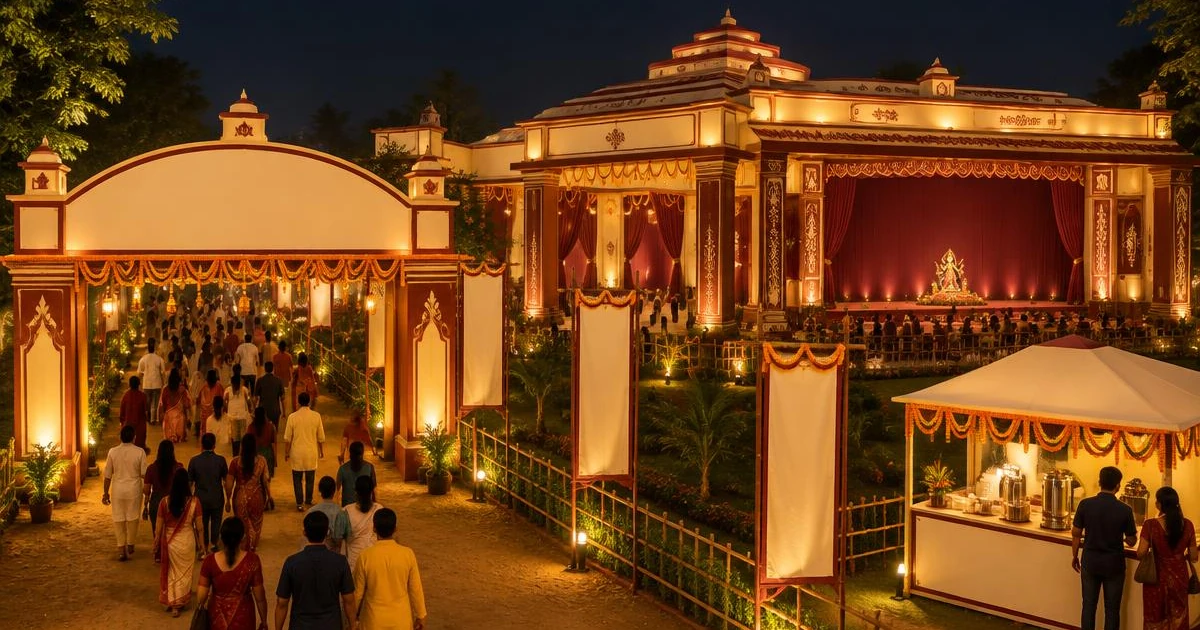
Festival Advertising for Coaching Institutes and Schools
Admission season starts weeks after Puja ends. The pandal is where parents and students are standing together, in the same neighbourhood you recruit from, with time to talk.
Education marketing has a targeting problem that festival advertising solves almost by accident.
You need to reach parents of children in a specific age band, living within travelling distance of your centre. No digital platform describes that well. Age targeting reaches the parent only if they happen to have declared a child. Radius targeting is approximate. And the parent making the decision is frequently not the one who saw the advertisement.
A neighbourhood Puja gives you the parent, the child, and often the grandparent who is funding the fees — standing together, in your catchment, with three hours to spare.
The timing is better than it looks
The instinct is that festival season and admission season are separate. They are adjacent, and that is better.
Admission and enrolment cycles for most coaching categories run from late autumn into the new year. Board exam preparation, competitive exam batches, the next academic year's school admissions, and new-year enrolment for skills and language courses all fall in the weeks and months immediately after the festivals.
Which means a pandal in October reaches parents just before the decision, not after it. The consideration set they will choose from in November and December is being formed right now.
There is also a second, quieter reason the timing works. Exam results and board results are behind them, and the next year is ahead. Parents in that window are unusually receptive to the idea that something should be done differently this time.
The stall, and why it beats everything else here
Education is a high-consideration, trust-driven purchase where the buyer wants to meet a human being. A stall is the format.
What a well-run coaching stall at a busy Puja produces:
- Parents asking about batch timings, fees and results
- Students picking up sample papers and talking to a teacher
- Counselling conversations that would take three phone calls to arrange
- Demo class registrations for the following week
- Contact details of families in your exact catchment
Typical stall cost: ₹2,000 to ₹1,50,000 depending on the Puja and position.
Staff it with a teacher, not a salesperson. This is the single most useful piece of advice in this article. Parents can tell the difference within thirty seconds, and a teacher who can actually explain how a topic is taught earns more trust in one conversation than a month of banners.
Bring something for the child. A short aptitude quiz, a puzzle sheet, a small prize. The child stops, the parent follows, and the conversation starts without you having to begin it.
Book the demo class for a specific date. "Come next Saturday at 10" converts. "We'll call you" does not.
Display results honestly. Selection lists, ranks, board results. Parents scrutinise these and they compare across stalls. Overstating is quickly found out in a neighbourhood where everyone knows someone who attended.
What else to buy, and what it costs
Banners along the queue — ₹800 to ₹90,000. The best supporting placement. A queue gives parents time to read a batch schedule, a results list or a fee structure — detail that no other pandal format can carry.
Gate or entrance arch — ₹5,000 to ₹2,00,000. Visibility and, importantly for education, an impression of establishment. A coaching centre whose name is on the neighbourhood Puja gate reads as permanent rather than fly-by-night.
Souvenir programme. Exceptionally well suited to education: read at home, kept for months, and with room for a full results list, faculty details, batch timings and fees. Cheap, and often the single best-value education placement at any pandal.
Stage backdrop — ₹5,000 to ₹1,20,000. In every photograph of the cultural programme.
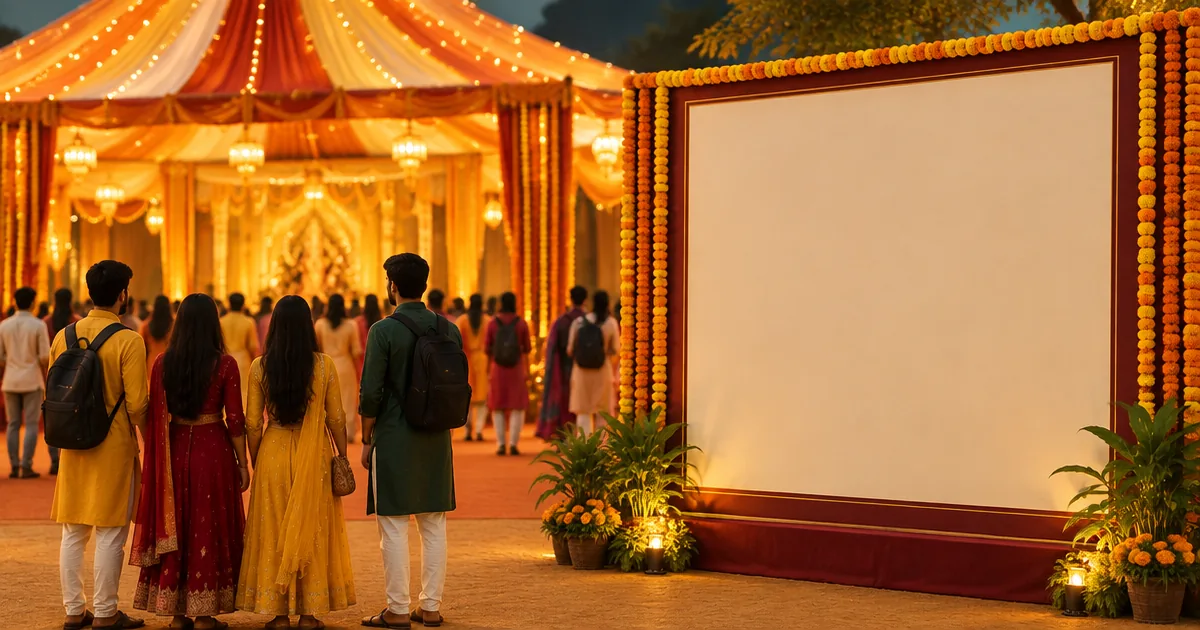
Digital LED screens — ₹8,000 to ₹2,00,000. Good for showing a results reel or a classroom.
Prasad packet or entry-pass branding — ₹2,500 to ₹1,50,000. Every attendee holds it. A discount code on early enrolment works here.
Title sponsorship — ₹25,000 upward. Established institutions in a locality often find this worth it over several years, because education is bought on reputation and reputation is built by being consistently present.
Sponsoring the cultural programme
Something specific to this category and worth doing deliberately.
Most Pujas run a cultural programme across the festival — recitation, dance, music, drawing competitions, quizzes, often with children performing and prizes given from the stage.
Sponsoring a children's competition is close to a perfect fit for an education brand. You are associated with children achieving something, in front of every parent in the neighbourhood, with your name announced from the stage each time a prize is given.
It is usually cheap, it is rarely contested by other advertisers, and it produces goodwill of a kind a banner cannot. Ask the committee directly — many do not think to list it.
Creative
Name the exam or the class. "JEE 2027 batch" or "Class 9–10 Mathematics" beats "quality education since 1998." Parents are looking for a specific fit.
One proof point. A selection count, a rank, a result percentage. Choose the strongest and make it the largest thing on the banner after your name.
Batch start date. A date creates urgency where a general message creates none.
Location as a landmark.
A number to call or a QR code.
Design for night. High contrast, heavy type. Footfall peaks after dark under coloured lighting.
Be careful with claims. Advertising standards around educational outcomes are tightening, and a neighbourhood remembers an inflated claim. State what you can substantiate.
Where to buy
Local coaching centre: four to eight pandals inside genuine travelling distance. Parents will not send a child across the city daily, so a pandal outside that radius is wasted.
Chain with several branches: cluster around each branch. One flagship pandal per city for the brand, funded separately.
School: the immediate neighbourhood, plus areas your buses serve. School catchments are defined by transport routes — buy along them.
Test prep for national exams: larger urban Pujas with a higher-income crowd, and be prepared to talk to students directly, not only parents.
Skills, language and upskilling: a different audience. Buy pandals in areas with young working populations rather than family-heavy residential ones, and expect the conversation to be with the learner rather than a parent.
Overseas education consultants: diaspora Pujas are a strong fit in the reverse direction, and Indian universities recruiting from the diaspora should look at Pujas in the UAE, Singapore, Australia and the UK.
Measuring it
Demo class registrations are the real output. Count them, count attendance, count enrolment.
A dedicated number per pandal.
Ask at enquiry where the family first heard of you, recorded consistently through to the end of the admission cycle — which may be three months after the festival. Education converts slowly; measuring at four weeks will tell you the campaign failed when it did not.
Enrolment by locality, compared year on year against areas where you did not advertise.
Keep the installation proof — three to seven photographs and a video of your branding in place, with location, on every booking.
Plan your season: browse festivals by city, region and footfall — exact dimensions, position and duration on every listing.