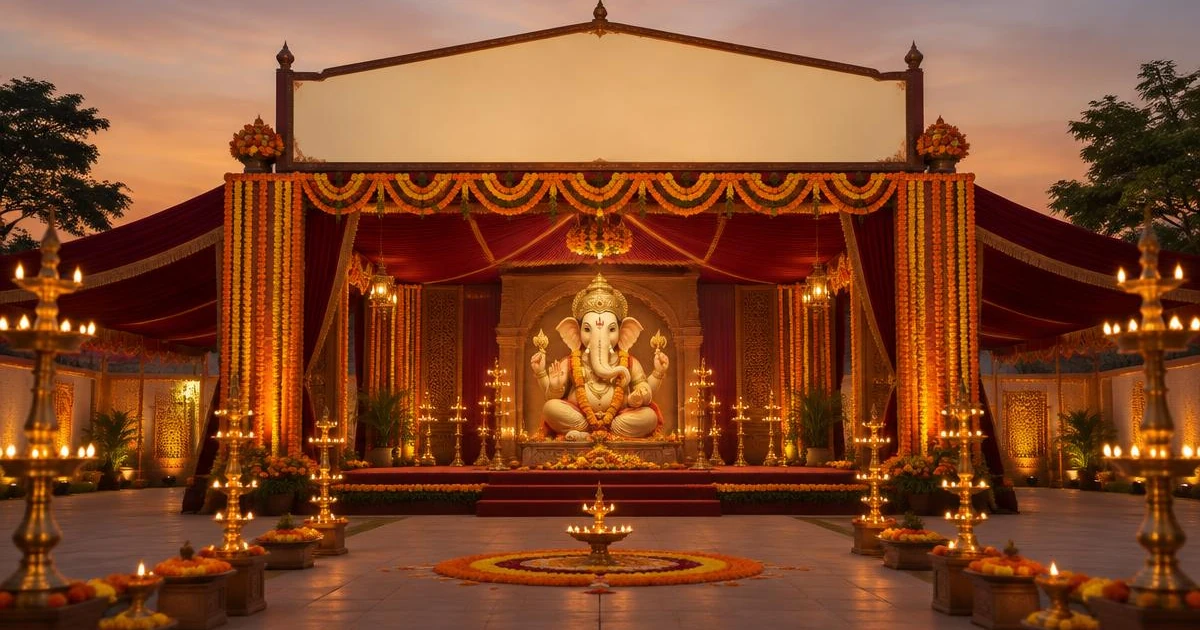
Festival Advertising for Banks, NBFCs and Insurance Companies
Festival season is when Indian households borrow, invest and insure. Pandal advertising reaches the family together — and a stall lets you have the conversation a banner cannot.
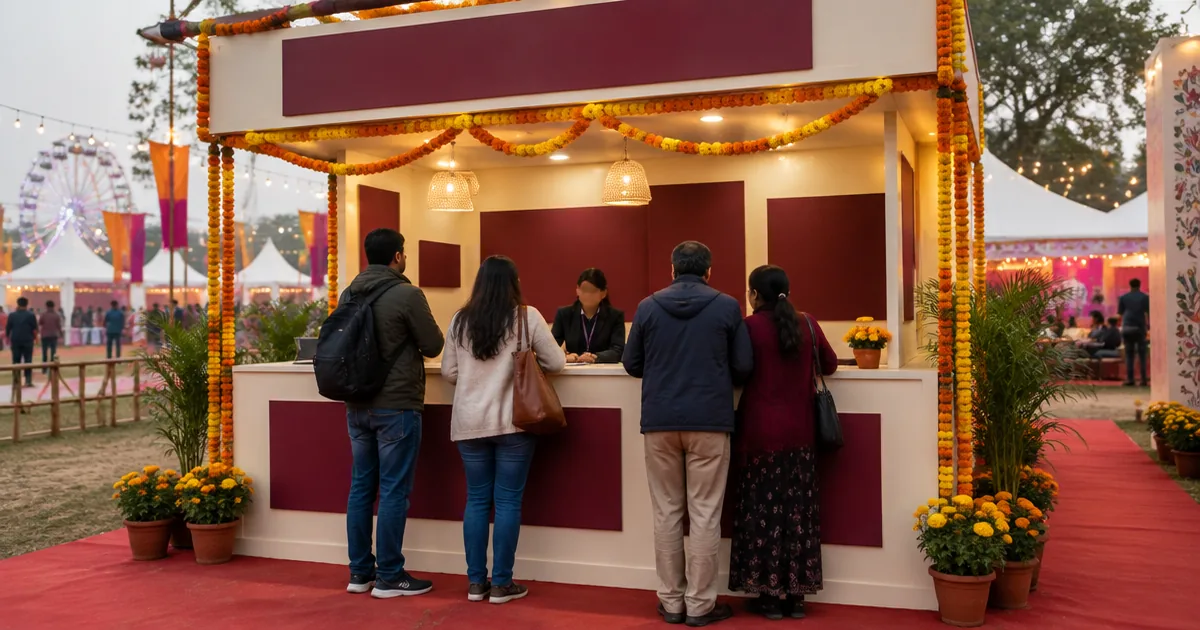
Financial services have a harder job at a pandal than any other category, and a bigger prize if they get it right.
Harder, because nobody walks into a Durga Puja thinking about term insurance. There is no equivalent to the hungry family looking for a restaurant or the woman comparing sarees.
Bigger, because the festival season is when Indian households make more financial decisions than at any other point in the year — and because financial products need explanation, which is the one thing a pandal stall provides and almost no other medium does.
What actually happens financially in this season
Set out plainly, because it determines what to advertise:
Borrowing spikes. Consumer durables, vehicles, gold loans, personal loans for festival spending, and home loans as property bookings cluster in the same weeks.
Gold-linked products move. Gold loans against jewellery bought or inherited. Digital gold and sovereign gold bonds around Dhanteras.
Investment decisions get made. Bonuses land in this window. Muhurat trading around Diwali is a genuine annual entry point for new investors — a large number of demat accounts are opened around it.
Insurance is bought. Partly tax planning as the financial year passes its midpoint, partly because families gathered together talk about protection in a way they do not otherwise.
Deposits move. Festival-season deposit schemes, and money set aside after the spending is done.
So the products with a genuine seasonal hook are: gold loans, consumer durable finance, vehicle finance, personal loans, home loans, demat account opening, insurance, and deposit schemes.
Advertising "we are a bank" achieves nothing. Advertising a gold loan rate three days before Dhanteras achieves a great deal.
The stall is the format
For most categories a stall is one option among several. For financial services it is the format, and everything else is support.
The reason is straightforward: your products are complicated, trust-dependent, and involve paperwork. Nobody buys insurance off a banner. But a person will stop at a table, ask what a gold loan against their jewellery would fetch, and give you their number.
What a well-run financial stall at a busy Puja produces over four days:
- Gold loan enquiries, which convert fast and at good value
- Demat account opening, which can be completed on the spot on a tablet
- Insurance leads, which convert over weeks
- Deposit and scheme enrolments
- Credit card applications
- Loan pre-qualification conversations
Typical stall cost: ₹2,000 to ₹1,50,000, depending on the Puja and position.
Staff it with people who can actually answer questions. A stall with junior staff handing out leaflets is money burnt. One person who can quote a gold loan value or explain a policy properly will out-produce three who cannot.
Bring the tools. A tablet with the onboarding flow, a gold-weighing scale if you do gold loans, and the ability to complete something on the spot. A lead that has to be called next week loses most of its value.
Be genuinely useful, not pushy. People came for the Puja. A stall that answers questions politely is welcome; a stall that chases people is remembered badly in a neighbourhood you intend to serve for years.
Supporting placements, and what they cost
Banners along the queue — ₹800 to ₹90,000. The best supporting format for finance, because a queue is the one place at a pandal where people have time to read more than five words. Rate tables, EMI figures and eligibility criteria are readable here and nowhere else.
Gate or entrance arch — ₹5,000 to ₹2,00,000. Visibility and credibility. A bank''s name on the gate of the neighbourhood Puja says something about permanence that no campaign message does.
Digital LED screens — ₹8,000 to ₹2,00,000.
Stage backdrop — ₹5,000 to ₹1,20,000.
Prasad packet or entry-pass branding — ₹2,500 to ₹1,50,000. Every attendee holds it. Good for a QR code or a missed-call number.
Souvenir programme. The single best print format for financial services — read at home, at leisure, with room for terms, rates and the fine print your compliance team requires.
Title sponsorship — ₹25,000 to ₹20,00,000. Banks are natural title sponsors. It signals stability, which is the attribute you are actually selling, and repeated over several years it makes you part of the neighbourhood.
Creative that works for finance
One product, one number. "Gold loan at X% — apply here." Not a list of six services.
Rate or EMI, large. This is what people compare and it is the only thing that stops them.
A missed-call number or QR code. The lowest-friction response mechanism available, and it works for people who will not fill in a form.
Branch as a landmark. "Opposite [landmark]."
Compliance copy, legibly. Whatever your regulator requires must be readable. Shrinking it to invisibility on an eight-foot banner is not compliance, and it will be noticed.
Design for night and distance. High contrast, heavy type, no fine detail. Pandal footfall peaks after dark under coloured lighting.
Where to buy
Branch banking: pandals within your branch catchment. Five to eight per branch, chosen by proximity rather than fame.
NBFC with a gold loan focus: neighbourhood Pujas in middle-income areas, and buy more of them at smaller sizes. Gold loan demand is dense, local and price-sensitive.
Insurance: stalls above all. Buy fewer pandals and staff them properly rather than spreading banners thin. A conversation is worth twenty impressions in this category.
Broking and investment platforms: larger urban Pujas with a younger, higher-income crowd. Demat account opening at a Puja stall in the run-up to Muhurat trading is well timed and works.
Microfinance and rural finance: small-town and rural festival celebrations, which are dramatically cheaper and where your customer actually is.
The NRI opportunity
For any institution with an NRI offering, diaspora Pujas are the most concentrated access available anywhere.
NRE and NRO accounts, repatriation, Indian mutual funds for non-residents, home loans for property in India, cross-border tax advisory, insurance covering parents back home — all complex, all trust-dependent, all far better sold across a table than through an advertisement.
A Durga Puja in the UK, USA, Canada, Australia, Singapore or the UAE gathers several thousand affluent Indian families in one hall for a weekend. The Gulf is the strongest market — Indians are the largest community in the UAE and the remittance corridor is the world''s largest.
Committees abroad list in their own currency, so a stall in Dubai is priced and paid in dirhams.
Measuring it
Financial services have better attribution than most categories at a pandal, because the response mechanism is trackable.
A unique missed-call number or QR per location. Clean, cheap, and it tells you which pandals produce.
Leads collected at the stall, with source recorded, tracked to conversion over ninety days — not four days. Insurance and loans convert slowly.
Applications completed on site — the cleanest number you will get.
Branch walk-ins in the fortnight, against a comparable period.
And keep the installation proof — three to seven photographs and a video of your branding actually in place, with location, on every booking. It is also your evidence for internal marketing audit, which for a regulated institution is not a small thing.
Plan your season: browse festivals by city, region and footfall — exact dimensions, position and duration on every listing.