Festival Advertising for Automobile Dealerships
A large share of the year's car and two-wheeler sales are booked between Navratri and Diwali. A pandal in your catchment is the cheapest way to reach families deciding together.
Vehicle buying in India is concentrated into the festival season to a degree that no other large category matches. A very substantial share of annual car and two-wheeler deliveries happen between Navratri and Diwali.
Some of that is auspiciousness — taking delivery on Dhanteras, Vijayadashami or Diwali is a widespread preference, and many families deliberately hold off for months to do it. Some is practical: bonuses arrive, model-year offers land, and the family is together to make the decision.
Whatever the cause, the effect for a dealership is that a few weeks decide the year. And the decision is usually made in a room with the whole family present — which is exactly the unit a pandal reaches.
Why a pandal fits this category so well
It reaches the family, not the buyer. A car purchase is rarely one person''s decision. Digital advertising reaches an individual on a phone. A pandal reaches the household — the spouse whose opinion decides, the parent funding part of it, the children who will argue for the bigger boot. All standing together, with time.
It is geographically precise. Dealership catchments are local. People buy from the showroom they drive past, whose service centre is convenient. A neighbourhood Puja reaches that catchment more exactly than any city-wide medium.
It is a considered purchase with a long window. Unlike a restaurant, you are not chasing an immediate decision. You are entering a consideration set that stays open for two to six weeks — which is precisely the shape of the festival season.
And you can put the product there. Which is the part most dealerships underuse.
Display the vehicle — this is the whole opportunity
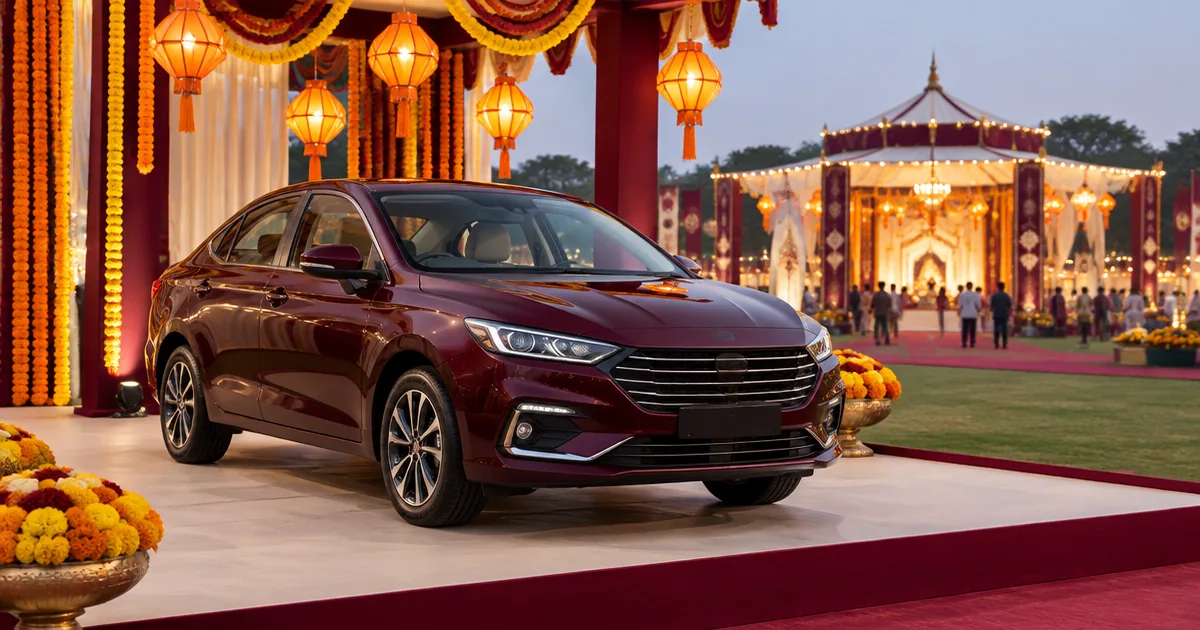
Almost every other advertiser at a pandal is buying a picture of their product. You can bring the actual product.
A car displayed at a busy pandal for four days will be looked at, sat in, photographed and discussed by thousands of people, most of whom would never walk into a showroom to do that. The showroom threshold is real — people feel committed the moment they cross it, and many avoid it until they are nearly decided.
A vehicle at a pandal removes that threshold entirely. It is the most effective thing a dealership can do in festival season and it is routinely skipped in favour of a banner.
Practical requirements:
- Space and access. Ask the committee early about a display area and how the vehicle gets in and out. Pandal sites are congested and often have barricading that goes up days before.
- Insurance and security. Overnight, in a public space, for four days.
- Two staff minimum, in rotation, for the whole time the pandal is busy — which is late.
- A test-drive booking sheet, or a QR code. This is what the display is for.
- Protection. Thousands of people will touch it. Seat covers, floor mats, and someone wiping it down.
Two-wheeler dealers have it easier — a bike or scooter takes almost no space, is trivial to move, and is a far more common festival purchase for the pandal-going demographic.
What to buy, and what it costs
Stall or display space — ₹2,000 to ₹1,50,000 depending on the Puja and position. Your primary buy.
Gate or entrance arch — ₹5,000 to ₹2,00,000. Highest visibility placement.
Digital LED screens — ₹8,000 to ₹2,00,000. Cars film well and motion sells them. If you have a decent TVC or walkaround footage, this is the format for it.
Stage backdrop — ₹5,000 to ₹1,20,000. In every photograph of the cultural programme.
Banners along the queue — ₹800 to ₹90,000. Stationary readers with time. Good for finance terms and offer detail that a gate banner cannot carry.
Souvenir programme. Cheap, kept for months, and the only format where you can print EMI tables, variant lists and specifications legibly.
Title sponsorship — ₹25,000 upward, to ₹20,00,000 at the largest Pujas. Worth it for a dealer group that wants to own a neighbourhood association over several years.
Creative
Lead with the monthly EMI, not the price. This is how vehicles are actually bought. "₹11,999/month" outperforms an ex-showroom figure every time.
One vehicle, photographed large. Not a range. Not three models.
A festival delivery promise. "Book today, deliver on Dhanteras" is the strongest line available to you in this season, and it uses the auspiciousness that is already driving the purchase.
The offer, in one number. Exchange bonus, down payment, cash discount — pick the one that is genuinely strongest and lead on it.
The showroom as a landmark, not an address.
Design for night. Pandal footfall peaks after dark under coloured lighting. Vehicles photograph poorly in those conditions on a printed banner unless the image is high contrast and simply lit. Avoid dark cars on dark backgrounds.
Where to buy
Single showroom: five to eight pandals inside your realistic catchment. Skip the city-famous one — its crowd comes from everywhere, and everywhere is somebody else''s catchment.
Dealer group with multiple outlets: cluster around each showroom, plus one large flagship pandal per city for brand presence.
Two-wheeler dealer: buy more pandals, smaller placements. Your buyer is more price-led and more local, and your inventory display cost is negligible, so spread wider.
Premium and luxury: fewer, larger, better-located pandals — particularly those in affluent neighbourhoods with paid or restricted entry. Ask committees about attendance profile, not just footfall.
Commercial vehicles: a different calendar and a different crowd. Neighbourhood Pujas in commercial and industrial areas work far better than residential ones.
Finance and insurance partners
Worth saying because it is frequently missed: your finance partner will often co-fund festival advertising. So will insurers, accessory brands and sometimes the manufacturer through co-op marketing budgets.
A joint banner with a bank''s logo costs you a fraction of a solo one and often converts better, because the finance availability is what many buyers are actually uncertain about.
Ask before you buy alone.
Measuring it
Test-drive bookings are the real output of a pandal display. Count them, count how many converted to a showroom visit, and count deliveries.
A dedicated number per pandal on the banner.
Ask at the showroom where the customer first saw the offer, recorded consistently through the season.
Compare walk-ins in the fortnight against a comparable non-festival period, and against outlets that did not advertise.
Keep the installation proof. Every booking comes with three to seven photographs and a video of your branding in place, with location. It tells you whether the gate you paid for was where you thought it was — which decides whether you buy that pandal again.
Plan your season: browse festivals by city, region and footfall — exact dimensions, position and duration on every listing.