How to Run a Festival Advertising Campaign Across India: The Complete Playbook
From setting an objective in May to reading the results in November — the full operating sequence for an Indian brand running on-ground festival advertising, month by month.
Most Indian brands do festival advertising badly, and not because they lack budget or ideas.
They do it badly because they start in September. By then the good positions are sold, the printing schedules are closed, and what remains is whatever nobody else wanted — bought in a hurry, at a bad price, and measured by nobody.
This is the operating sequence that fixes that. Nine months, laid out in order, with what to do in each one.
The one-line version
Decide in May. Buy in June and July. Print in August. Run in September and October. Read the results in November. Rebook in December.
Everything below is detail on those six steps.
May — Decide what you are buying and why
Set one objective, not four
Festival advertising can do three different jobs, and they require different purchases. Pick one.
| Objective | What you buy | How you know it worked | |---|---|---| | Awareness in a catchment | Gates, banners, stage backdrops across many venues | Recall, walk-ins, area-wise sales lift | | Conversations and leads | Stalls, staffed, at fewer venues | Leads captured, appointments booked, conversion | | Direct sales | Stalls with stock, coupon-driven banners | Revenue at the stall, coupon redemption |
Brands that try to do all three with one budget do none of them. A jeweller who buys eight banners and no stall has bought awareness when they needed conversations.
Define the catchment before the cities
This is the step almost everyone skips.
Ask: where does my customer actually come from? For a single showroom, that is a radius of a few kilometres. For a regional chain, it is a list of neighbourhoods around each outlet. For a national FMCG brand, it is states and city tiers.
Write it down. It determines every purchase that follows, and it is the reason the biggest, most famous pandal in the city is usually the wrong buy — its crowd comes from everywhere, and everywhere is somebody else's catchment.
Set the budget as a number, with a reserve
Decide the total, then split it 85% committed, 15% reserve. The reserve is not slack. Late opportunities appear every year — a committee whose sponsor fell through, a good position released in September at a discount — and the brands that can act on them get the best value in the whole season.
June — Buy the anchor inventory
This is the most important month, and the one everybody misses.
In June, committees are setting budgets and confirming venues. They need sponsorship commitments to fund their own deposits. Which means:
- Full inventory is available. Nothing is sold yet.
- You choose position, rather than accepting what is left.
- Rates are negotiable, because the committee needs the certainty more than you do.
What to lock in June
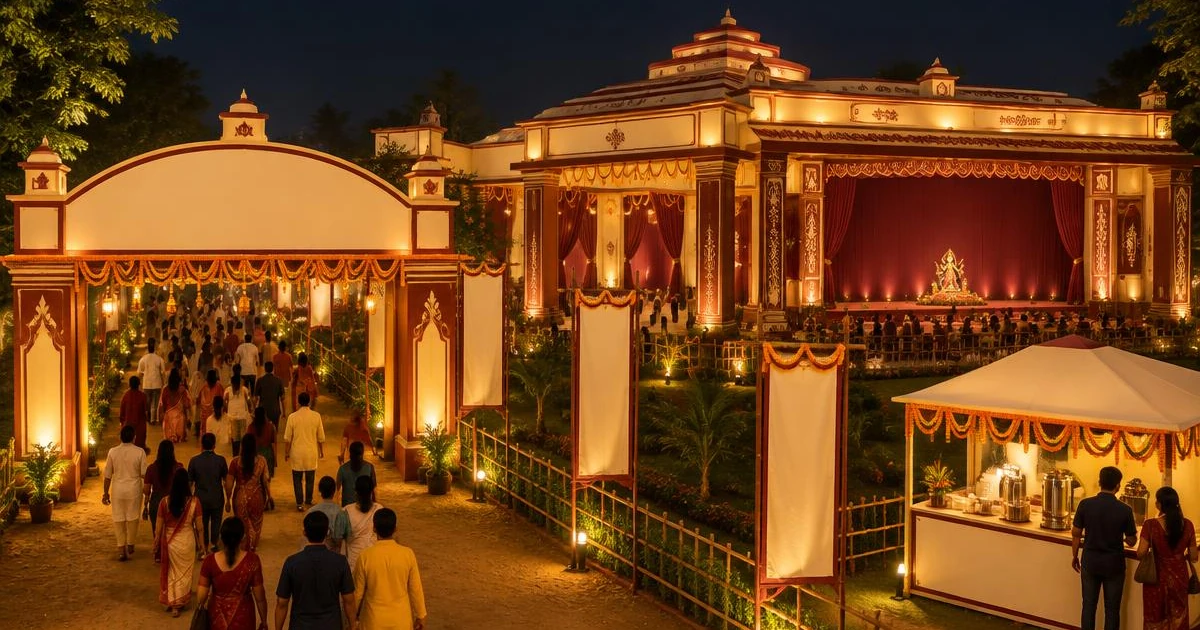
Title sponsorships and gate branding at your anchor venues. These are the first things to sell and the last things to become available again. If you want the gate at the Puja three streets from your showroom, June is when you get it.
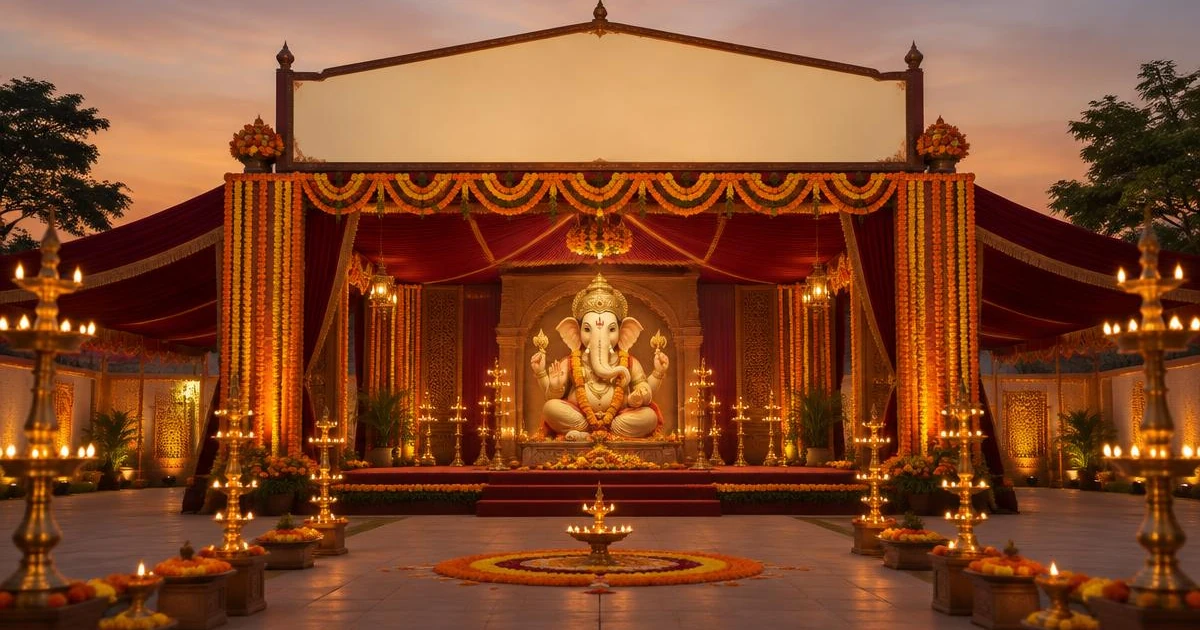
Multi-festival packages. Ask every committee that runs more than one festival for a combined rate — Durga Puja plus Kali Puja, Navratri plus Diwali, Ganesh Chaturthi plus Navratri. Most will discount it, most brands never ask, and you lock two seasons in one negotiation.
How to shortlist venues
Filter by your catchment first, then by these four questions:
- What is the stated footfall, and how was it counted? Ticketed entry and door counts are credible. "About two thousand" is a guess.
- Are there photographs of last year? A venue with no photographs is a venue you cannot evaluate.
- Are the slot specifications exact? Width and height in feet, precise position, duration. "Banner — ₹5,000" is not a product. If a listing cannot tell you the size and the position, the committee has not thought about what they are selling.
- Is the committee verified, with KYC complete? An unverified committee cannot be paid, which means your money sits in limbo.
July — Fill in the volume, close the gaps
June was for the two or three positions you really want. July is for the rest of the plan.
Buy the supporting inventory — perimeter banners, queue banners, souvenir pages, prasad and entry-pass branding across the wider set of venues in your catchment.
Book stalls now if you need them. Stalls sell later than gates but they need more planning on your side — staffing, stock, equipment, a lead-capture method. Booking in July gives you two months to organise the operation, which is the part that actually determines whether a stall earns anything.
Confirm the souvenir booklet deadline for every venue. It is almost always the earliest hard deadline in the whole campaign, usually about a month before the festival, and missing it is the most common avoidable loss in festival advertising.
August — Artwork and print
Print is final. There is no A/B test on a banner. Everything about August is getting the artwork right the first time.
The rules that matter
Design for night. Footfall at almost every Indian festival peaks after dark, under coloured lighting that distorts colour badly. Whites go blue, reds go orange, mid-tones disappear. Use high contrast and heavy type. Test your artwork by looking at it from ten feet away with your eyes half closed — if the message survives that, it will survive a pandal.
Design for distance and motion. People read a gate banner while walking, in a crowd, from several metres away. Six words maximum on a gate. Detail goes on the queue banner, where the audience is stationary, or in the souvenir booklet, which is read at home.
One message, one number. A price, an EMI figure, a rate, an offer, or a date. Not three.
Landmark, not address. People navigate by landmarks. "Opposite the metro station" beats a full postal address.
Send exact dimensions with adequate bleed, in the format the committee's printer needs. The listing states the size; use it.
Match format to message
| You need to say | Buy | |---|---| | A name and one idea | Gate, backdrop | | A rate table, terms, specifications | Queue banner, souvenir booklet | | Something that moves | LED screen | | Something complicated | A stall with a person | | A coupon people take home | Prasad packet, entry pass, souvenir page |
September and October — Run it
Before the festival
Confirm installation. A week out, check with each committee that your material has been received and where it is going up.
Brief your stall staff properly. This is where most stall budgets are wasted. A stall is not a leaflet distribution point. Send someone senior who can answer real questions, give them a lead-capture method that takes fifteen seconds per person, and set a daily target.
During the festival
Check the proof. Every booking comes back with three to seven photographs from different angles and a short video of your advertising actually installed, with location captured where possible. Look at them.
Not as a formality — as data. Is the banner where you thought it was? Is it visible, or behind a barricade nobody approaches? Is it lit? A banner in a dark corner is a banner you should not buy again, and the only way you will ever know is by looking at the photographs.
Track responses daily. Coupon redemptions, missed calls, QR scans, stall leads. Daily numbers tell you which venues are working while you still have a reserve budget to act on.
Use the reserve
By the second week of the season you know which venues are producing. If one is clearly working and has inventory left for the next festival, buy more of it. That is what the 15% was for.
November — Read the results honestly
Attribution at a pandal is imperfect. Anyone who tells you otherwise is selling something. Measure what you can, and be clear about what each number does and does not prove.
| Measure | What it tells you | Its limit | |---|---|---| | Coupon or code redemption per venue | Which venues drive action | Undercounts heavily — most people who act never use the code | | Dedicated number or QR per venue | Direct response | Same undercount, but comparable across venues | | Stall leads, tracked to conversion | The real output of a stall | Needs 60–90 days for considered purchases | | Walk-ins or footfall in the fortnight after | Aggregate lift | Confounded by everything else in the season | | Area-wise sales versus non-advertised areas | The closest thing to a clean read | Needs the areas to be genuinely comparable |
Use codes comparatively, not absolutely. A code that gets 40 redemptions at Venue A and 4 at Venue B has told you something real about the two venues, even though both numbers understate the truth.
Give considered purchases time. Property, education, insurance and vehicles convert over weeks and months. Measuring an insurance campaign four weeks after Diwali will tell you it failed when it did not.
December — Rebook before anyone else asks
The single cheapest thing you can do all year.
Go back to the venues that worked, while the relationship is warm and their next-season inventory is completely unsold, and book the same position for next year. You will get a better rate, you will get the position you want, and you will have finished your planning before your competitors have started theirs.
Keep a simple record for each venue: what you bought, what it cost, where it actually went up (you have the photographs), and what it produced. Three years of that file is worth more than any agency's recommendation.
The condensed calendar
| Month | Do this | |---|---| | May | One objective. Define catchment. Set budget with 15% reserve | | June | Lock title and gate at anchor venues. Ask for multi-festival rates | | July | Volume inventory, stalls, souvenir deadlines | | August | Artwork and print. Design for night and distance | | September–October | Run, check proof photographs, track daily, deploy reserve | | November | Measure comparatively. Allow time for considered purchases | | December | Rebook the winners at next year's opening rates |
What this replaces
The default Indian festival campaign is: someone remembers in mid-September, three committees are called, a banner is printed in two days, it goes up somewhere, nobody photographs it, and in November nobody can say whether it worked.
The sequence above costs the same money and produces a campaign you can actually learn from — which is the only way the second year is better than the first.
Start with the inventory: browse festivals by city, region, footfall and budget — every listing shows exact dimensions, position, duration and price, with proof photographs after installation.