Advertising to the Indian Diaspora: Why Festival Pandals Beat Digital
Thirty-two million people of Indian origin live outside India, with far higher average incomes than at home. Here is why a pandal in Wembley reaches them better than a Meta campaign.
There are roughly 32 million people of Indian origin living outside India. They are among the highest-earning immigrant groups in the countries they live in. They send home tens of billions of dollars a year — India has been the world's largest recipient of remittances for over a decade.
If your business sells to that audience, you already know how hard they are to reach online.
This is about a channel most marketers have never seriously considered, largely because nobody has ever packaged it: on-ground advertising at diaspora festivals.
The targeting problem nobody solves
Try to build a diaspora audience on Meta or Google and you will quickly find the tools do not describe your customer.
Language targeting fails. Your audience's browsing language is English. A Bengali family in Toronto reads English news, searches in English, and has their phone in English. Targeting Bengali-language users finds you almost nobody in Canada.
Interest targeting is crude. "Interested in Indian culture" catches everyone who once watched a Bollywood clip. You pay for all of them.
Ethnicity targeting is restricted, and in several countries flatly prohibited for certain ad categories — housing and financial services included. Which is awkward, because property developers and remittance firms are exactly the advertisers who want this audience.
Lookalike audiences drift. Seed with a thousand diaspora customers and the algorithm optimises toward whoever is cheapest to convert, which is rarely the segment you started from.
So marketers end up with a familiar compromise: broad targeting, low relevance, high spend, and a CAC they quietly stop reporting.
What a pandal gives you instead
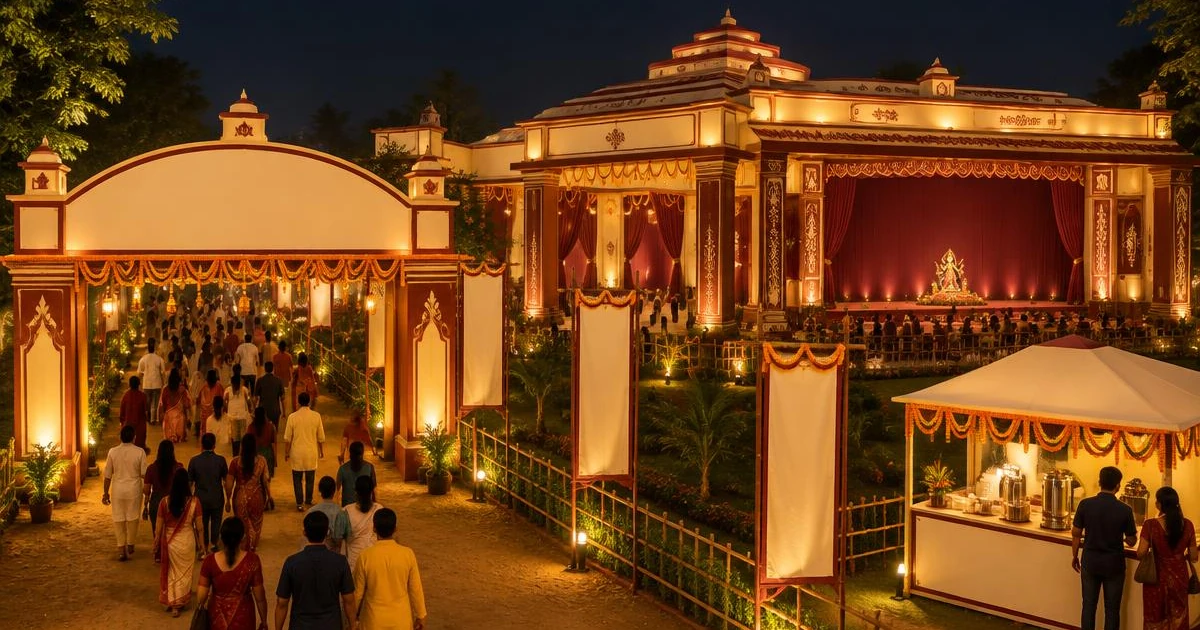
A Durga Puja in London or a Diwali mela in New Jersey solves the targeting problem by not needing to solve it.
The audience self-selects. Nobody attends a Durga Puja by accident. Every person in that hall has chosen, on a working weekend, to travel and participate. That is a far stronger signal of cultural connection than any interest tag.
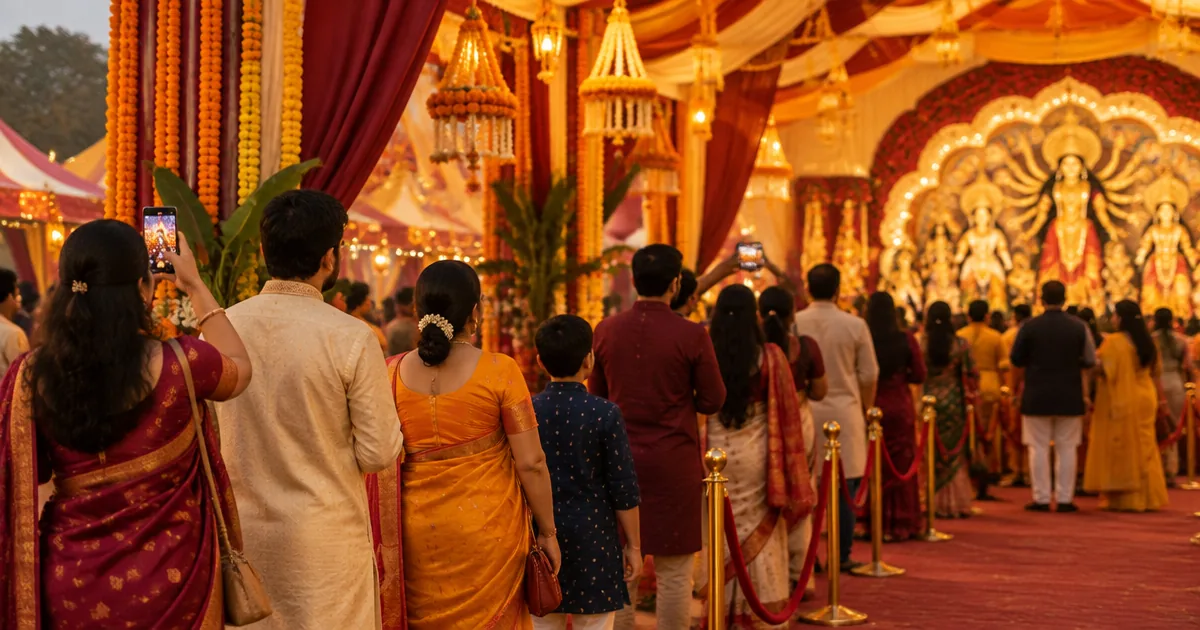
It is a family unit, not an individual. Digital reaches one person holding one phone. A pandal reaches a household — parents, children, grandparents, often visiting relatives. For a property developer or a jeweller, the person who decides is standing right there next to the person who was targeted.
Dwell time is measured in hours. Average time in a pandal over a festival runs to several hours across multiple visits. Compare that to a 1.7-second average view on a scrolled feed.
It is repeat exposure with no frequency penalty. People come back on consecutive days. In digital, showing the same person the same creative five times is called ad fatigue and it degrades performance. In a pandal it is called a banner, and the fifth viewing is when they finally read it properly.
The context is affection, not interruption. Your brand is not blocking something someone wanted to see. It is part of an event they are glad to be at, associated with the most emotionally loaded week of their cultural year. Very few media placements buy that.
There is no ad blocker, no skip button, no bot traffic. Roughly a fifth of desktop users run an ad blocker. Nobody blocks a gate arch.
Who should be buying this
Be concrete about it. The diaspora audience is disproportionately valuable to a specific set of businesses:
Money transfer and remittance
Remittance volume spikes around festivals. Every major corridor sees it. Your competitors are fighting over the same search terms at rising cost per click — and here is a hall containing several thousand people who are actively sending money home this month, in a good mood, with time to talk to someone at a stall.
Airlines and travel
Festival season is when diaspora families book flights to India. Many attendees are deciding, or have just decided. A stall with a fare board is not an interruption; it is a service.
Real estate developers selling to NRIs
NRI property sales are already done at diaspora events — usually expensive hotel roadshows with modest attendance. A Puja pandal is a better room at a fraction of the cost, and the people there came voluntarily.
Jewellery
Durga Puja and Diwali are gold-buying season. This holds in Leicester exactly as in Kolkata. A jeweller — local branch or Indian house selling to NRIs — has no better four days in the year.
Education and immigration consultancy
Student visas, PR applications, university placement. The parents making those decisions are in the hall with their teenagers.
Indian groceries and FMCG importers
The people in the pandal are, near enough, the entire addressable market for an Indian grocery chain in that city. Sampling at a Puja is about as efficient as sampling gets.
Financial services for NRIs
NRE and NRO accounts, Indian tax advisory, insurance, mutual funds for non-residents. A complicated product that benefits enormously from a human being at a table who can explain it.
Telecom, matrimonial, healthcare
International calling plans. Matrimonial services, where a family-attended event is the entire premise. Diagnostic and health-check packages for parents in India — a purchase made by the child abroad.
What it actually costs
Overseas committees price in their own currency, and rates vary widely by city and footfall. But the arithmetic is usually favourable in a way that surprises people.
A mid-size overseas Puja might draw two to four thousand attendees across four days. Gate branding, a stage backdrop or a stall typically costs a few hundred to a few thousand in local currency.
Run that as a CPM against actual physical footfall and compare it with what you currently pay for a viewable impression in the same country — with the further difference that a pandal impression comes with dwell time, family context and a positive mood, and a display impression comes with none of those.
Add the thing digital cannot price at all: a stall lets you talk to people. Conversations, not clicks.
Being honest about the limits
This is not a replacement for performance marketing, and anyone selling it that way is overselling.
Attribution is weak. You will not get a clean conversion path from a banner to a sale. Use a dedicated QR code, a unique landing page or an event-specific offer code, and accept that you are measuring a floor, not the truth.
Scale is finite. There are hundreds of significant diaspora Pujas, not hundreds of thousands. You cannot pour budget into this the way you can into an auction.
Quality varies. A well-run Puja with three thousand attendees and a five-hundred-person one are both called a Durga Puja. Footfall claims need checking — which is why listings on PujaSathi carry stated footfall, photographs and installation proof.
It is seasonal. Autumn is dense — Durga Puja, Navratri, Diwali, Kali Puja within weeks of each other. The rest of the year is thinner.
Creative must be physical. A banner is printed once and cannot be A/B tested mid-festival. Get the artwork right before it goes to print.
Used properly, this is an awareness and consideration channel with unusually good context — and, where you take a stall, a direct-conversation channel. It is not a last-click acquisition machine.
How to buy it
The historical obstacle has been access, not appetite. Overseas Puja committees are volunteer-run, hard to find, hard to verify and harder to pay. A marketing team in Mumbai or a brand manager in London had no way to locate the committee in Edison, agree a price, transfer money and confirm the banner ever went up.
That is the specific gap PujaSathi closes:
- Browse by country — the UK, USA, Canada, Australia, New Zealand, Singapore, Malaysia, the UAE, Germany, the Netherlands, Nepal, Sri Lanka, Bangladesh, Indonesia, Mauritius, Fiji, Trinidad and Tobago, South Africa.
- See exactly what you are buying — size in feet, precise position, duration, stated footfall.
- Pay in the listed currency, with the platform fee, GST and TCS shown as separate lines rather than buried in a total.
- Send artwork only. The committee prints, installs, maintains and removes it at their cost.
- Get proof. Three to seven photographs and a video of your branding actually installed, with location, before the committee is paid.
That last point is the one that changes the category. Nobody funded a diaspora event remotely before, because nobody could verify it happened.
Want to reach the diaspora this season? Browse overseas festivals and book on-ground space directly.
Running a Puja abroad? List it in your own currency.